
Introduction
Accent Wall Details | An empty wall can make an otherwise beautiful room feel unfinished. At the same time, adding too many colors, patterns, or decorations to one wall can make the entire space feel busy. The difference usually comes down to planning.
Accent wall details give you a way to turn one ordinary wall into an intentional part of the room without redesigning everything around it. You can use paint, wallpaper, paneling, artwork, mirrors, shelves, photographs, typography, or a carefully selected combination of these elements.
A successful accent wall doesn’t have to be dramatic. In a preppy room, it often works better when the wall feels connected to the rest of the space through color, pattern, proportion, and repetition.
If you’re building a room around classic patterns, fresh colors, elegant furniture, and personal details, the broader inspiration at Preppy Room can help you establish the overall design direction before deciding how much attention your accent wall should receive.
The key is to think of the accent wall as part of the room rather than a separate decoration.
This guide explains how to choose the right wall, select colors and materials, combine decorative elements, create balance, avoid common mistakes, and design an accent wall that feels polished rather than overcrowded.
What Are Accent Wall Details?
Accent wall details are the decorative, architectural, or color-based features used to make one wall stand out from the surrounding walls.
They can include:
- Paint colors
- Wallpaper
- Wall paneling
- Moldings
- Stripes
- Botanical patterns
- Decorative prints
- Framed artwork
- Gallery walls
- Mirrors
- Personal photographs
- Shelves
- Typography
- Textured finishes
- Coordinated accessories
- Architectural details
The purpose isn’t simply to make one wall different.
A well-designed accent wall should help establish a focal point, reinforce the room’s color palette, create visual depth, or give an otherwise plain area more personality.
In a preppy room, this could mean a navy paneled wall behind a classic bed, a soft botanical wallpaper behind a desk, or a gallery arrangement combining traditional illustrations with personal photographs.
The strongest accent walls usually have one clear visual idea.
Instead of asking, “What can I put on this wall?” ask:
“What should this wall contribute to the room?”
That small change in thinking makes decorating much easier.
Why Does an Accent Wall Matter in a Preppy Room?
A preppy room often combines several visual elements at once.
You might have:
- Striped bedding
- Gingham
- Floral patterns
- Classic furniture
- Brass accents
- Decorative pillows
- Framed artwork
- Books
- Mirrors
- Plants
- Soft textiles
Without some form of visual organization, all these details can compete for attention.
An accent wall can provide the structure that brings them together.
The wall can act as:
A Focal Point
The eye naturally needs somewhere to settle.
A feature wall behind the bed, desk, dresser, or reading chair can create that visual destination.
A Color Anchor
If your room uses navy, cream, blush, or sage in several places, the accent wall can reinforce one of those colors.
A Pattern Anchor
Wallpaper or paneling can introduce a pattern or architectural detail that is repeated subtly elsewhere.
A Background
Sometimes the accent wall isn’t meant to be the star.
A softly colored wall can simply provide a beautiful background for artwork, shelves, or a mirror.
A Personal Statement
Photographs, artwork, books, or meaningful objects can make the room feel connected to the person who uses it.
How Do You Choose the Best Wall for an Accent?
The best accent wall is usually the wall you naturally notice when entering the room.
In a bedroom, that is often the wall behind the bed.
In a study, it might be the wall behind the desk.
In a living area, it could be the wall behind a sofa, console, or major seating arrangement.
Before choosing the wall, consider:
- Where the furniture is positioned
- Where the eye naturally travels
- How much uninterrupted wall space exists
- Whether doors or windows break up the surface
- How much natural light reaches the wall
- Whether artwork will be placed there
- Whether the wall already contains architectural features
A wall with too many doors, windows, switches, or unrelated objects may be difficult to turn into a coherent feature.
A relatively uninterrupted wall often gives you more freedom.
The Furniture Relationship Matters
An accent wall should work with the furniture in front of it.
For example, a strong patterned wallpaper behind an equally patterned headboard may create too much visual activity.
A simpler wall treatment may be better.
Likewise, a plain upholstered bed can often support a more detailed wall behind it.
Think of the wall and furniture as one composition.
Should the Accent Wall Be Behind the Bed?
For bedrooms, the wall behind the bed is one of the most natural locations for an accent wall.
The bed is already a major focal point, so the wall behind it becomes an extension of that focal area.
You could use:
- Navy paint
- Soft blue wallpaper
- Vertical paneling
- Botanical wallpaper
- Classic illustrations
- A gallery wall
- Framed artwork
- Decorative shelves
- A subtle geometric pattern
The important thing is to avoid creating competition between the bed and wall.
If the bedding has a bold floral pattern, for example, a quieter accent wall may create better balance.
If the bedding is mostly solid, the wall can carry more pattern.
This relationship is especially useful when designing a Preppy Room Bedroom, because the bed, wall, lighting, and surrounding furniture can be planned as one connected arrangement.
How Do You Choose an Accent Wall Color?
Color is one of the simplest ways to create an accent wall, but choosing the right shade requires more thought than simply picking your favorite color.
Start by looking at the existing room.
Identify:
- The dominant color
- The supporting color
- The accent color
- The main neutral
Then decide which one should become more noticeable on the wall.
For example:
White + navy + brass
could become:
- White walls
- Navy accent wall
- Brass lighting
- White bedding
- Navy pillows
- Natural wood furniture
Or:
Cream + sage + soft blue
could become:
- Cream walls
- Sage accent wall
- Soft blue textiles
- Natural wood
- Brass details
The goal is repetition rather than isolation.
A wall color should appear somewhere else in the room, even if only in small amounts.
Which Colors Work Well for Preppy Accent Walls?
Preppy interiors are flexible, so there isn’t one required accent wall color.
Some useful directions include:
Navy
Navy creates depth and works especially well with white, cream, light blue, brass, and natural wood.
A navy wall can feel traditional, sophisticated, coastal, or modern depending on the surrounding furniture.
Soft Blue
Soft blue is lighter and more relaxed.
It works beautifully in bedrooms where you want the accent wall to feel noticeable without becoming visually heavy.
Sage Green
Sage introduces a natural quality.
Pair it with cream, white, light wood, botanical artwork, and warm metals for a calm composition.
Blush Pink
Blush can create a softer preppy direction.
It works particularly well when balanced with white, navy, cream, brass, or natural textures.
Deep Green
A deeper green can create a dramatic traditional backdrop.
Use lighter bedding and artwork around it to maintain balance.
Cream
An accent wall doesn’t have to be dark.
A warm cream wall with paneling, molding, or textured wallpaper can create subtle architectural interest.
How Do You Use Coordinated Colors on an Accent Wall?
A successful accent wall rarely exists in isolation.
Instead, its color should connect with the wider room.
If you’re unsure how to create that connection, start by establishing a broader Coordinated Colors approach.
For example, if your room uses navy, white, and brass, you don’t need to make every wall navy.
Instead:
- Use navy on one wall
- Repeat navy in pillows
- Add a small navy element in artwork
- Use white bedding
- Introduce brass through lighting
- Keep larger furniture relatively neutral
This creates repetition without making the room monochromatic.
How Can You Match the Accent Wall to Different Preppy Styles?

The same wall can look completely different depending on the design direction.
Classic Preppy Accent Wall
A classic approach may include:
- Navy
- Cream
- Traditional paneling
- Botanical prints
- Brass
- Classic furniture
- Symmetry
If your overall room follows a traditional direction, Classic Preppy Room inspiration can help you keep the accent wall connected to timeless patterns and furniture.
Modern Preppy Accent Wall
A modern version might use:
- Clean paneling
- Simple geometric wallpaper
- Muted colors
- Minimal artwork
- Contemporary lighting
- Cleaner furniture lines
The Modern Preppy Room approach can be useful when you want classic preppy character without making the wall feel overly traditional.
Cute Preppy Accent Wall
A playful room can use:
- Pink
- Pastels
- Small-scale patterns
- Cheerful illustrations
- Personal photographs
- Decorative accessories
For a softer, more playful direction, Cute Preppy Room ideas can help guide the balance between personality and visual restraint.
Cozy Preppy Accent Wall
A cozy wall should feel warm rather than highly dramatic.
Consider:
- Warm neutrals
- Soft wallpaper
- Wood
- Textured artwork
- Warm lighting
- Shelves with books
The Cozy Preppy Room style works particularly well when comfort is as important as visual presentation.
Minimal Preppy Accent Wall
A minimal approach might use:
- One strong color
- Simple paneling
- One large artwork
- Limited accessories
- Clean furniture
The Minimal Preppy Room direction is useful if you want the wall to feel intentional without becoming decorative overload.
Should You Paint or Wallpaper an Accent Wall?
Both can work.
The better option depends on the effect you want.
| Feature | Paint | Wallpaper |
|---|---|---|
| Color impact | Strong | Strong |
| Pattern | Limited | Excellent |
| Installation | Usually simpler | More involved |
| Architectural effect | Requires added details | Can create instant pattern |
| Easy changes | Usually easier | Can require more work |
| Best for | Clean color statements | Pattern and visual storytelling |
Paint is often the easiest solution when you already have plenty of patterns elsewhere.
Wallpaper becomes especially useful when you want the wall itself to introduce personality.
How Do You Use Wallpaper for Accent Wall Details?
Wallpaper can completely change the character of a wall.
For a preppy room, consider:
- Stripes
- Botanical patterns
- Small florals
- Gingham-inspired patterns
- Geometric designs
- Traditional motifs
- Soft watercolor patterns
The scale matters.
A large pattern can become the dominant feature.
A smaller pattern may create texture and interest without taking over.
Consider the Distance
Look at the wallpaper sample from both close and far away.
Some patterns look beautiful up close but become visually noisy across an entire wall.
Others appear simple at first but create an elegant repeated texture when viewed across the room.
Always judge the pattern at the scale of the actual wall.
Can Wall Paneling Create a Preppy Accent Wall?
Absolutely.
Wall paneling is one of the most effective ways to create architectural interest without relying heavily on color.
Common options include:
- Picture-frame molding
- Board-and-batten
- Vertical paneling
- Raised panels
- Simple geometric molding
Paneling works especially well with classic preppy interiors because it creates structure and visual order.
A navy paneled wall behind a white bed, for example, can create a strong focal point while still feeling timeless.
You can also paint the paneling the same color as the surrounding wall.
This creates a subtle accent based on texture and shadow rather than contrast.
How Do You Use Accent Wall Details With Framed Artwork?
Artwork can either strengthen an accent wall or make it too busy.
The key is understanding the relationship between background and artwork.
If the wall is already heavily patterned, choose simpler artwork.
If the wall is a solid color, you can introduce more detailed artwork.
For a sophisticated look, combine:
- One dominant artwork
- Two or three supporting pieces
- Consistent frame finishes
- Repeated colors
If you want the artwork itself to be the main feature, explore Framed Artwork for ideas that can work with the wider preppy aesthetic.
When Should You Use Decorative Prints?
Decorative prints are useful when you want to introduce visual interest without committing to a full gallery wall.
They can include:
- Botanical illustrations
- Landscapes
- Architectural prints
- Abstract patterns
- Vintage-inspired artwork
- Simple line drawings
A solid navy accent wall can become much more interesting with two or three cream-framed botanical prints.
For more ideas on incorporating individual art pieces, see Decorative Prints.
The important thing is to repeat at least one color from the wall in the artwork.
Can a Gallery Wall Become an Accent Wall?
Yes.
A gallery wall can function as the entire accent feature without changing the wall color.
This is especially helpful if you live in a rental or don’t want to commit to wallpaper or paint.
A gallery wall might contain:
- Family photographs
- Illustrations
- Botanical prints
- Typography
- Small paintings
- Travel memories
- Decorative objects
The challenge is maintaining visual order.
Use a consistent frame finish, repeated colors, or a clear layout structure.
A dedicated Gallery Walls approach can help you think about spacing, composition, and artwork relationships before hanging everything.
How Do Personal Photographs Work on an Accent Wall?
Personal photographs make an accent wall feel less like a showroom and more like a real room.
They work especially well in bedrooms, study areas, and cozy spaces.
You don’t need dozens of photographs.
A small arrangement can be more effective.
For example:
Three framed photographs + one illustration + one small typography piece
can create a personal display without overwhelming the wall.
Keep the frames coordinated so the photographs feel like part of the room’s design.
For more inspiration, Personal Photographs can help you explore ways to make personal memories part of the decorative composition.
How Can Patterned Wall Art Be Used?
Patterned wall art can reinforce the preppy character of an accent wall.
It might include:
- Stripes
- Checks
- Geometric patterns
- Floral motifs
- Repeating shapes
- Traditional textile-inspired designs
The important thing is to avoid repeating too many competing patterns.
If your bedding already has gingham and your curtains have stripes, the wall may need a simpler pattern.
If the rest of the room is mostly solid, patterned wall art can become a stronger feature.
Explore Patterned Wall Art when you want to use pattern without necessarily covering the entire wall.
How Do Mirrors Work With Accent Wall Details?
Mirrors are useful because they combine decoration with function.
A mirror can:
- Reflect light
- Make a room feel more open
- Break up a dark wall
- Add shape
- Introduce a metallic frame
- Create another focal point
A large mirror can work beautifully on a painted accent wall.
However, don’t automatically place a mirror on every feature wall.
If the wall already contains a strong gallery arrangement, a mirror may compete with it.
A mirror works best when its frame supports the room’s existing finishes.
For more ideas, explore Mirrors.
Should You Add Inspirational Typography?
Typography can personalize an accent wall, but it needs to be used carefully.
Not every preppy room needs motivational quotes.
Typography can instead communicate:
- Personality
- Humor
- Literature
- Family meaning
- Favorite words
- Memories
- Creativity
A single well-designed typography piece can be much more effective than several unrelated signs.
If typography fits your room’s personality, Inspirational Typography offers another way to think about words as decorative elements.
How Do Classic Illustrations Work on Accent Walls?
Classic illustrations can add an established, collected feeling to a preppy interior.
Consider:
- Botanical illustrations
- Architectural drawings
- Traditional landscapes
- Animals
- Nautical illustrations
- Vintage-inspired studies
They work particularly well against:
- Cream
- Navy
- Soft green
- Pale blue
- Warm white
A small group of coordinated illustrations can create a sophisticated wall without requiring a dramatic paint color.
For this direction, Classic Illustrations can provide useful inspiration.
Can Decorative Shelves Become Accent Wall Details?
Yes, especially when the wall needs both storage and decoration.
Decorative shelves can display:
- Books
- Small plants
- Framed artwork
- Photographs
- Ceramics
- Small decorative objects
- Collectibles
The secret is leaving empty space.
A shelf filled from end to end often looks cluttered.
Instead, create visual groups.
For example:
Books + small plant + artwork
can become one group.
Then leave some breathing room before the next group.
For additional ideas, see Decorative Shelves.
How Do You Combine Multiple Accent Wall Elements?

This is where many accent walls go wrong.
People often start with a painted wall and then add:
- Wallpaper
- Artwork
- Mirrors
- Shelves
- Typography
- Photographs
- Plants
- Decorative objects
The result can become visually overwhelming.
Instead, establish a hierarchy.
Primary Element
Choose one major feature.
Examples:
- Wallpaper
- Paneling
- Large artwork
- Gallery wall
Secondary Element
Add one supporting feature.
Examples:
- Mirror
- Small artwork
- Decorative shelf
Finishing Details
Use only a few small accents.
Examples:
- Plant
- Book
- Small photograph
- Decorative object
This three-level hierarchy creates much better visual control.
How Many Accent Wall Details Are Too Many?
There isn’t one exact number.
It depends on:
- Wall size
- Pattern scale
- Furniture
- Room size
- Lighting
- Color contrast
- Decorative density
A large empty wall can support more detail than a small wall.
A highly patterned wallpaper may need almost no additional decoration.
A plain wall may support several framed pieces.
The practical rule is:
The stronger the background, the simpler the decoration should become.
And:
The simpler the background, the more freedom you have with artwork.
How Do You Create an Accent Wall Around a Color Palette?
A useful method is to create a simple three-level palette.
60% Dominant Color
This might be:
- White
- Cream
- Soft blue
- Pale neutral
30% Supporting Color
This could be:
- Navy
- Sage
- Blush
- Green
10% Accent Color
This might be:
- Brass
- Red
- Deep green
- Dark blue
The exact percentages don’t need to be mathematically perfect.
They simply help you avoid using every color equally.
For specific combinations, you can explore:
Navy and White Preppy Room Ideas
Pink and White Preppy Room Ideas
Green and Cream Preppy Room Ideas
Red and Navy Preppy Room Ideas
Green and Navy Preppy Room Ideas
These aren’t separate rules for accent walls. They are useful references for understanding how different color relationships can influence the wall and the rest of the room.
How Do You Design a Navy Accent Wall?
Navy is one of the easiest colors to build around because it provides strong contrast while remaining relatively timeless.
Try:
Navy wall + white bedding + brass lighting + natural wood
or:
Navy wall + cream furniture + light blue textiles + framed botanical artwork
or:
Navy wall + pink accents + white furniture + brass details
The wall doesn’t need to contain every color.
Instead, allow navy to establish the foundation and repeat smaller colors throughout the room.
How Do You Design a Blue and Cream Accent Wall?
Blue and cream can create a softer alternative to navy and white.
Use:
- Cream walls or trim
- Blue wallpaper
- Blue artwork
- Cream furniture
- Natural wood
- Soft textiles
This palette is particularly effective when you want a room to feel relaxed rather than dramatic.
The accent wall can be patterned while the rest of the room remains quiet.
How Do You Design a Pink Accent Wall?
Pink can become sophisticated when it is controlled.
Instead of using an extremely saturated pink across every surface, consider:
- Blush
- Dusty rose
- Soft pink
- Muted coral
- Pink and cream wallpaper
Then introduce navy, white, green, or brass as supporting details.
For a broader pink-focused direction, Pink Preppy Room and Pink Preppy Room Ideas can provide useful inspiration.
A more decorative version can also connect with Aesthetic Pink Preppy Room.
How Do You Design a Green Accent Wall?
Green works particularly well with traditional and nature-inspired preppy details.
Try:
- Sage green
- Olive
- Forest green
- Muted emerald
- Soft botanical green
Pair green with:
- Cream
- White
- Navy
- Brass
- Natural wood
Botanical artwork is a natural companion.
A green wall behind a bed with cream bedding and small navy accents can feel both classic and fresh.
Can Red Work on an Accent Wall?
Red can work, but it should be handled with more restraint.
Instead of making the entire room red, use red as a deliberate feature.
A red accent wall may work when:
- The room is otherwise neutral
- Furniture is simple
- Artwork uses small red details
- Textiles repeat the color carefully
A red-and-navy palette can create a traditional preppy direction when balanced with white or cream.
See Red and Navy Preppy Room Ideas for broader color inspiration.
How Do You Use a Neutral Accent Wall?
A neutral accent wall is useful when you want architectural interest rather than strong color.
Consider:
- Warm beige
- Cream
- Greige
- Soft taupe
- Warm white
Then create contrast through:
- Paneling
- Molding
- Texture
- Artwork
- Mirrors
- Lighting
This approach is particularly effective for a minimal or classic room.
The wall stands out because of structure rather than color.
How Do You Create an Accent Wall With Classic Patterns?
Patterns are central to many preppy interiors.
Useful patterns include:
- Stripes
- Gingham
- Plaid
- Florals
- Checks
- Geometric designs
- Small repeating motifs
But don’t use every pattern at full strength.
A good approach is:
One dominant pattern + one secondary pattern + solid colors
For example:
Striped wallpaper + solid bedding + small floral pillows
is usually easier to control than:
Striped wallpaper + floral bedding + gingham curtains + geometric rug + patterned artwork
The second combination can work, but it requires much more careful color coordination.
How Do You Use Stripes on an Accent Wall?
Vertical stripes can make a wall feel taller.
Horizontal stripes can make a wall feel wider.
But stripe scale matters.
Thin stripes can create a subtle tailored appearance.
Wide stripes make a stronger statement.
If your furniture is already visually strong, consider narrower or softer stripes.
If the room is simple, a wider stripe can become the main feature.
How Do You Use Gingham on an Accent Wall?
Gingham has a cheerful preppy quality.
It can work through:
- Wallpaper
- Fabric panels
- Artwork
- Decorative prints
- Small wall sections
Because gingham is already visually repetitive, keep surrounding elements relatively calm.
Pairing a large gingham wall with many other strong patterns can quickly make the room feel crowded.
How Do You Use Floral Patterns Without Making the Room Feel Too Busy?
Floral wallpaper can be beautiful, especially in bedrooms.
The trick is to look at:
- Flower size
- Background color
- Contrast
- Repetition
- Surrounding patterns
A small floral pattern with a light background tends to feel softer.
A large, high-contrast floral pattern becomes a major design feature.
Once you’ve chosen a strong floral wall, allow the bedding, furniture, and artwork to support it instead of competing with it.
How Do You Use an Accent Wall in a Small Room?
Small rooms require more restraint.
A common mistake is assuming that a small room must have completely plain walls.
That’s not necessarily true.
A well-planned accent wall can actually make a small room feel more intentional.
Try:
- One strong wall
- Light surrounding walls
- Limited accessories
- Consistent colors
- Smaller artwork
- Reflective surfaces
A mirror can help balance a darker wall.
Lighter bedding can prevent the room from feeling visually heavy.
Avoid covering every available surface with decoration.
How Do You Use an Accent Wall in a Large Room?
Large rooms provide more flexibility.
You can use:
- Larger artwork
- Bigger patterns
- Architectural paneling
- Deeper colors
- Larger mirrors
- Wider gallery arrangements
However, large doesn’t mean unlimited.
A huge wall covered with dozens of small decorations can still feel messy.
Use larger-scale elements that relate to the size of the room.
How Does Lighting Affect an Accent Wall?
Lighting can dramatically change how an accent wall appears.
Natural daylight may make a color look:
- Brighter
- Cooler
- Softer
Warm artificial lighting can make the same wall appear:
- Richer
- Warmer
- Deeper
Before finalizing the wall color, look at it at different times of day.
This is particularly important for dark colors.
A navy wall may look elegant during the day but significantly deeper at night.
Accent lighting can also highlight:
- Paneling
- Artwork
- Shelves
- Texture
- Architectural details
For a complete lighting strategy, the broader Preppy Room With LED Lights ideas can be useful when deciding whether accent lighting belongs in the room.
Should You Use LED Lights on an Accent Wall?
LED lighting can work, but it should support the design rather than become the entire design.
Instead of making the lighting the focal point, consider using it to:
- Highlight shelving
- Create a soft glow
- Emphasize artwork
- Define a desk area
- Add evening atmosphere
The light color also matters.
A soft, warm tone usually integrates more easily into a classic preppy room than an aggressively bright color-changing effect.
How Do You Match Accent Walls With Furniture?
Furniture should help determine the strength of the wall.
Dark Furniture
A dark accent wall can make the composition heavy.
Use lighter textiles and artwork to create contrast.
Light Furniture
Light furniture gives you more freedom to use stronger wall colors.
Wood Furniture
Wood works with almost every major preppy accent color.
It can soften navy, green, blue, and pink.
Upholstered Furniture
Fabric introduces another texture.
If the wall is heavily patterned, choose simpler upholstery.
How Do You Match the Accent Wall With Bedding?

The bed is often the largest visual element in a bedroom.
Therefore, the accent wall should work with it.
If your bedding is:
White and navy stripes
consider:
- Soft blue wall
- Navy paneling
- Cream wallpaper
- Subtle botanical print
If your bedding is:
Pink floral
consider:
- Cream wall
- Soft blush wall
- Sage wall
- Simple paneling
If your bedding is:
Mostly solid
you can introduce more pattern on the wall.
The broader Preppyroom Bedroom Decor direction can help you think about the relationship between bedding, wall decor, furniture, and accessories as one complete composition.
How Do You Use Accent Walls With Preppy Furniture?
Furniture provides the structure of the room.
For example, a classic bed can work with:
- Paneled navy wall
- Brass sconces
- Cream bedding
- Botanical artwork
A modern upholstered bed might work better with:
- Muted blue wall
- Minimal artwork
- Clean bedside tables
- Simple lighting
When selecting furniture around the wall, avoid making every element equally decorative.
Your Preppy Room Furniture direction should help determine whether the wall needs to be traditional, modern, playful, or minimal.
How Do You Use an Accent Wall in a Preppy Study Area?
A desk wall can be an excellent accent wall because it provides a natural functional zone.
Consider:
- Soft blue paint
- Vertical paneling
- Shelving
- Framed artwork
- A desk lamp
- Books
- Personal photographs
A study wall should still feel organized.
Avoid creating a decorative arrangement that interferes with the practical use of the desk.
The wall should make the area feel intentional without making it harder to work.
How Do You Create an Accent Wall During a Preppy Room Makeover?
If you’re changing the entire room, don’t start with the wall.
Start with the overall design.
Step 1: Photograph the Room
Take pictures from several angles.
Step 2: Identify What Already Works
Keep furniture and objects that fit the new direction.
Step 3: Choose the Color Palette
Select your dominant, supporting, and accent colors.
Step 4: Decide the Focal Point
Determine whether the bed, artwork, wall, or furniture should lead.
Step 5: Choose the Wall Treatment
Select paint, wallpaper, paneling, artwork, or another solution.
Step 6: Add Supporting Details
Bring the accent wall color into pillows, artwork, rugs, or accessories.
Step 7: Edit
Remove anything that competes with the new focal point.
If you’re planning a larger transformation, Preppy Room Makeover can be considered alongside your accent-wall planning.
Can You Create an Accent Wall Without Painting?
Yes.
This is useful if:
- You’re renting
- You want flexibility
- You don’t want permanent changes
- You prefer artwork
- You want to experiment
Options include:
- Gallery walls
- Removable wallpaper
- Large artwork
- Mirrors
- Fabric
- Shelving
- Photographs
- Decorative panels
- Textile hangings
You can create the visual effect of an accent wall without changing the actual wall color.
How Do You Make an Accent Wall Feel Personal?
The best accent walls often include something that couldn’t simply be copied from another room.
Consider:
- Personal photographs
- Favorite artwork
- Books
- Travel memories
- Meaningful illustrations
- Collections
- Initials
- Handmade objects
This is one reason personal details are important in preppy interiors.
The room can still look polished while reflecting the person who lives there.
Can DIY Projects Create Accent Wall Details?
Yes.
Simple DIY options include:
- Painting one wall
- Creating a simple gallery arrangement
- Building floating shelves
- Framing personal photographs
- Creating decorative panels
- Updating old frames
- Making a small artwork collection
For more project-based inspiration, DIY Preppy Room Decor can be useful.
The important point is to choose projects appropriate for your space and skill level.
Don’t make a wall more complicated simply because you can.
What Are the Most Common Accent Wall Mistakes?
Mistake 1: Choosing the Wall Randomly
Not every wall is a good focal point.
Choose one that supports the room’s natural layout.
Mistake 2: Using Too Many Patterns
A strong wallpaper combined with patterned bedding, curtains, rugs, and artwork can become overwhelming.
Choose a hierarchy.
Mistake 3: Ignoring Lighting
A color can look completely different under different lighting conditions.
Test before committing.
Mistake 4: Making Everything Match Exactly
A room doesn’t need every accessory to be the same color.
Repeat colors naturally instead.
Mistake 5: Filling Every Empty Space
Negative space is important.
A wall needs room to breathe.
Mistake 6: Making the Accent Wall Compete With the Bed
In bedrooms, the bed is already a major focal point.
The wall should support it.
Mistake 7: Ignoring Scale
Tiny artwork on a huge wall can feel lost.
Massive artwork on a narrow wall can feel overwhelming.
Mistake 8: Following Trends Too Closely
A trendy wall can become dated quickly.
Consider whether you will still like the design several years from now.
Mistake 9: Forgetting the Rest of the Room
An accent wall cannot fix a room that has no overall visual direction.
The wall should be part of a complete design.
Mistake 10: Adding Decorations Without a Purpose
Every major element should contribute something:
- Color
- Texture
- Function
- Personality
- Balance
- Structure
If it does none of these, you may not need it.
How Can You Avoid Overdecorating an Accent Wall?
Use the editing process.
After decorating the wall, step back.
Ask:
- What do I notice first?
- Is that what I intended?
- Is anything competing with it?
- Does the wall connect to the rest of the room?
- Is there enough empty space?
- Does the wall still look good without every small object?
Then remove one or two things.
Often, the wall becomes stronger after editing.
How Do Professionals Think About Accent Walls?
A professional-looking wall isn’t necessarily the most decorated wall.
Professionals usually think about:
Composition
Where does the eye go first?
Balance
Does one side feel heavier?
Scale
Are the objects appropriate for the wall?
Repetition
Do colors and shapes appear elsewhere?
Contrast
Is there enough difference between elements?
Negative Space
Is there room around important objects?
Function
Does the wall support how the room is actually used?
These principles matter more than simply following a particular decorating trend.
How Do You Plan Accent Wall Details Step by Step?
Step 1: Identify the Purpose
Decide whether the wall should:
- Create a focal point
- Add color
- Add architecture
- Display artwork
- Provide storage
- Add personality
Don’t move forward until you know what job the wall needs to perform.
Step 2: Study the Room
Look at:
- Furniture
- Flooring
- Bedding
- Curtains
- Lighting
- Existing artwork
- Natural light
Step 3: Choose the Visual Weight
Decide whether you want:
Subtle
or
Moderate
or
Dramatic
Step 4: Select the Main Treatment
Choose one:
- Paint
- Wallpaper
- Paneling
- Artwork
- Gallery wall
- Shelving
Step 5: Add Supporting Details
Use only elements that reinforce the main idea.
Step 6: Repeat the Main Color
Bring the wall color somewhere else in the room.
Step 7: Check the Composition
Look at the entire room from the doorway.
Step 8: Edit
Remove anything unnecessary.
This final step is often what separates an attractive wall from a cluttered one.
What Should You Put Above a Bed on an Accent Wall?
Popular options include:
- One large artwork
- A symmetrical pair of prints
- A gallery wall
- A mirror
- Paneling
- Wallpaper
- A simple shelf
- A decorative headboard
The correct choice depends on the bed.
A highly detailed headboard may need a quieter wall.
A simple bed frame may support more elaborate artwork or wallpaper.
Should Accent Wall Decor Be Symmetrical?
Symmetry is especially useful for classic preppy rooms.
Examples include:
- Two matching lamps
- Two matching framed prints
- Two nightstands
- Centered artwork
- Symmetrical paneling
But symmetry isn’t mandatory.
A more modern room may benefit from controlled asymmetry.
The key is visual balance rather than perfect duplication.
Can You Mix Old and New Accent Wall Details?
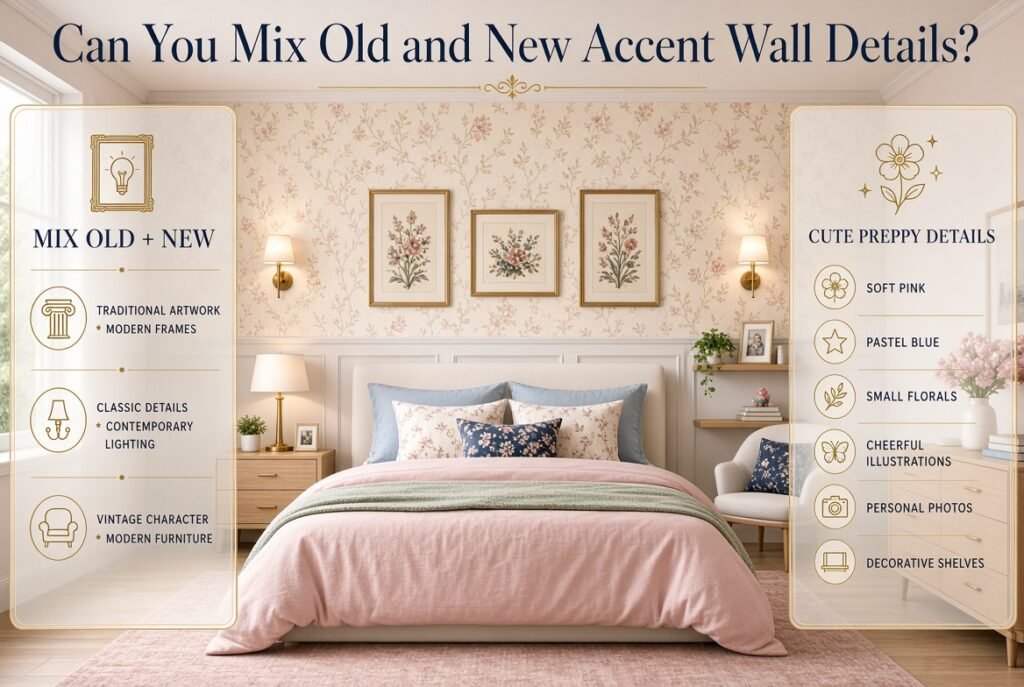
Yes.
This can make a preppy room feel more collected and personal.
For example:
Traditional botanical print + modern frame
or:
Classic paneling + contemporary lighting
or:
Vintage-inspired artwork + modern furniture
This prevents the room from feeling like a perfectly matched furniture showroom.
The result can feel more natural and lived-in.
How Do You Use Accent Wall Details in a Cute Preppy Room?
A cute room can use more playful elements without becoming chaotic.
Try:
- Soft pink
- Pastel blue
- Small floral wallpaper
- Cheerful illustrations
- Personal photographs
- Decorative shelves
- Small colorful accents
The Cute Preppy Room Ideas direction can help if you want the wall to feel youthful and expressive.
You can also explore Cute Preppy Room inspiration for a softer interpretation.
How Do You Create an Aesthetic Preppy Accent Wall?
An aesthetic wall usually depends more on composition than on one specific color.
Try combining:
- A controlled palette
- Soft lighting
- Coordinated frames
- Textured materials
- Personal artwork
- A few decorative objects
For a broader design direction, Aesthetic Preppy Room Decor can help connect the wall with the rest of the room.
The goal is not to copy a particular image.
Instead, understand what makes the composition feel cohesive.
How Do You Use Accent Walls With Preppy Room Decor?
Accent walls should support the wider decor strategy.
If your room already has:
- Decorative pillows
- Artwork
- Rugs
- Curtains
- Plants
- Books
- Lamps
the wall doesn’t need to carry all the visual responsibility.
A strong room usually distributes visual interest across several areas.
For broader inspiration, Preppy Room Decor and Preppy Room Decor Ideas can help you think about the room as a complete composition.
How Does the Accent Wall Fit Into the Overall Preppy Room Aesthetic?
The wall should reinforce the qualities you want the room to communicate.
A classic room may emphasize:
- Structure
- Symmetry
- Traditional artwork
- Timeless colors
A modern room may emphasize:
- Clean lines
- Simpler patterns
- Minimal accessories
A cozy room may emphasize:
- Texture
- Warm colors
- Soft lighting
A cute room may emphasize:
- Playful colors
- Personal details
- Cheerful artwork
The accent wall should make that direction clearer.
How Do You Use Accent Wall Details in a Neutral Room?
Neutral rooms are excellent backgrounds for stronger wall details.
For example:
Cream room + navy accent wall
or:
Warm white room + botanical wallpaper
or:
Beige room + paneled feature wall
Because the surrounding colors are quieter, the accent wall can provide personality without creating excessive competition.
How Do You Use an Accent Wall With Natural Wood?
Natural wood is one of the easiest materials to pair with preppy colors.
It works particularly well with:
- Navy
- Sage
- Cream
- Soft blue
- Blush
- White
Wood can prevent a strong accent color from feeling too cold.
A navy wall with oak furniture, for example, creates a useful balance between depth and warmth.
How Do You Add Brass Details to an Accent Wall?
Brass can be introduced through:
- Picture frames
- Lamps
- Wall sconces
- Mirrors
- Shelving hardware
- Small decorative objects
You don’t need brass everywhere.
A few repeated details are enough to make the finish feel intentional.
If the wall already has gold or brass frames, avoid introducing several unrelated metal finishes nearby.
How Do You Use Shelves Without Cluttering the Wall?
Start with fewer objects than you think you need.
For each shelf, consider:
- One stack of books
- One small artwork
- One plant
- One decorative object
Then leave space.
Vary height.
Avoid putting every object in the center.
Create small groups rather than a continuous line of decorations.
What Is the Best Accent Wall for a Classic Bedroom?
A classic bedroom usually benefits from one of three approaches:
Option 1: Paneled Navy Wall
Strong but timeless.
Option 2: Cream Paneling
Subtle and architectural.
Option 3: Traditional Wallpaper
Decorative without requiring multiple separate objects.
Pair any of these with:
- Structured bedding
- Classic furniture
- Brass details
- Traditional artwork
- Balanced accessories
What Is the Best Accent Wall for a Modern Bedroom?
A modern preppy bedroom often benefits from:
- Muted color
- Clean paneling
- Minimal artwork
- Simple geometric wallpaper
- One oversized piece of art
Keep the composition controlled.
Avoid combining too many traditional decorative elements if the furniture has a very modern shape.
What Is the Best Accent Wall for a Cozy Bedroom?
Focus on atmosphere.
Try:
- Warm cream
- Soft sage
- Muted blue
- Textured wallpaper
- Wood
- Soft lighting
- Shelves with books
The wall should feel comfortable rather than overly formal.
What Is the Best Accent Wall for a Pink Preppy Bedroom?
A pink accent wall can be created with:
- Soft blush paint
- Pink-and-white wallpaper
- Floral patterns
- Framed artwork
- White paneling
- Brass accents
Keep some neutral space around it.
If everything becomes pink, the accent wall stops functioning as an accent.
How Do You Make an Accent Wall Look Expensive?
You don’t need expensive materials.
A polished appearance usually comes from:
- Good proportions
- Clean installation
- Consistent frames
- Coordinated colors
- Appropriate scale
- Quality lighting
- Intentional spacing
- Minimal clutter
Even a simple painted wall can look sophisticated when the furniture and artwork are arranged thoughtfully.
How Do You Make a Feature Wall Look Timeless?
Avoid depending entirely on short-lived trends.
Choose:
- Classic colors
- Simple patterns
- Quality-looking frames
- Traditional proportions
- Flexible artwork
- Materials that work with different decor styles
Then use smaller accessories to introduce trends.
That way, the wall can evolve without requiring a complete redesign.
How Do You Know When an Accent Wall Is Finished?
Your wall is probably finished when:
- The focal point is obvious
- The colors connect to the room
- Nothing feels randomly placed
- There is enough empty space
- Furniture and wall work together
- Lighting supports the design
- The wall feels personal
- You aren’t tempted to keep adding things
If you keep adding decoration because the wall still feels incomplete, step back and consider whether the problem is actually balance rather than a lack of objects.
What Is the Best Wall to Use as an Accent Wall?
The best accent wall is usually the wall that already has a natural visual focus. In a bedroom, this is often the wall behind the bed because the bed naturally becomes the main piece of furniture in the room. In a living room, it may be the wall behind a sofa, console, fireplace, or another architectural feature.
Rather than choosing a wall simply because it is empty, look at how the room is experienced when you first walk in. An accent wall should strengthen the room’s existing layout instead of competing with it. If the wall already has furniture, lighting, artwork, or architectural details, those elements can help create a more intentional feature.
For a preppy room, the wall behind the bed can work especially well because it provides a structured background for framed artwork, classic illustrations, decorative prints, mirrors, or carefully selected shelving.
Useful points to consider:
Choose a wall that naturally attracts attention.
Consider the position of the bed, sofa, or main furniture.
Avoid choosing a wall simply because it has the most empty space.
Check how natural and artificial light reaches the wall.
Make sure the accent treatment works with the rest of the room.
Keep the surrounding walls quieter when the feature wall is visually strong.
The goal is not to make one wall look completely different from the rest of the room. A successful accent wall should feel like a deliberate extension of the overall design.
What Colors Work Best for a Preppy Accent Wall?
Preppy accent walls work particularly well when the color connects with the room’s existing palette rather than introducing an unrelated shade. Navy, soft blue, sage green, cream, blush pink, deep green, and carefully selected red tones can all create different interpretations of a preppy feature wall.
The important part is how the color interacts with the furniture, bedding, artwork, flooring, and surrounding walls. For example, a navy accent wall can create a traditional and sophisticated foundation, while soft blue can produce a lighter and more relaxed appearance. Sage green can introduce a natural quality, while blush pink can make the room feel softer without relying entirely on pink accessories.
Instead of selecting a color because it is currently popular, build the accent wall around a palette that can continue working with the room as other accessories change.
A practical color approach:
Use navy for a classic, structured appearance.
Choose soft blue for a lighter and calmer feature wall.
Try sage or deep green when you want a natural, collected feel.
Use blush or muted pink for a softer preppy bedroom.
Consider cream when texture or artwork is the main focus.
Use stronger colors carefully when the room already contains patterns.
A useful rule is to repeat at least one accent-wall color elsewhere in the room. It could appear in bedding, artwork, cushions, curtains, a rug, or a small decorative object. This creates visual continuity and prevents the wall from looking disconnected.
Should You Use Wallpaper, Paint, Paneling, or Artwork for an Accent Wall?
There is no single treatment that works for every room. The right choice depends on whether you want the wall itself to become the main feature or whether you want the wall to provide a background for decoration.
Paint is often the simplest option and works well when you want color to establish the foundation of the design. Wallpaper can introduce pattern, texture, or traditional character, making it particularly useful for a more decorative preppy direction. Paneling adds architectural depth and can give a bedroom or study area a more established, tailored appearance.
Artwork provides another approach. Instead of changing the entire surface, you can keep the wall relatively simple and build the feature through framed artwork, decorative prints, a gallery wall, personal photographs, or classic illustrations.
Consider these factors before choosing:
Paint: Best when color is the primary feature.
Wallpaper: Useful when pattern or visual character is important.
Paneling: Suitable when you want architectural structure.
Artwork: Ideal when personalization is the main goal.
Shelving: Helpful when display and storage need to work together.
Layering: Works when several subtle elements need to create one feature.
You can also combine treatments. For example, a softly colored wall can provide the background for framed artwork, while simple paneling can add structure underneath a gallery arrangement. The strongest results usually come from choosing one dominant feature and allowing the supporting details to remain controlled.
How Do You Decorate an Accent Wall Without Making It Look Too Busy?
The key to a successful accent wall is not the number of decorative pieces you can fit onto it, but how clearly those pieces work together. A wall can contain beautiful artwork, mirrors, shelves, photographs, patterns, and decorative objects and still feel unfinished if there is no visual hierarchy.
Start by deciding what you want the viewer to notice first. If the wallpaper is highly patterned, the artwork can be simpler. If the wall color is bold, fewer decorative elements may be necessary. If the wall is neutral, you can allow artwork or texture to provide more of the visual interest.
Negative space is also important. Leaving areas of the wall visible gives the eye somewhere to rest and helps individual pieces maintain their importance.
Ways to keep the composition controlled:
Choose one main focal element.
Limit the number of competing patterns.
Repeat colors rather than introducing many unrelated shades.
Leave intentional empty space around important pieces.
Keep frame styles visually compatible.
Avoid placing every decorative item at the same height.
Step back regularly to judge the wall as a whole.
A useful test is to remove one element and look at the wall again. If the composition immediately feels clearer, the removed piece may not have been necessary. Good accent-wall design often comes from editing rather than adding more.
How Can You Make a Preppy Accent Wall Look Expensive and Timeless?
A polished accent wall rarely depends on expensive materials alone. It usually looks refined because the proportions, colors, materials, and decorative details have been carefully coordinated.
For a timeless preppy look, start with a restrained palette and choose materials that have visual staying power. Classic paint colors, balanced paneling, traditional frames, quality-looking artwork, natural wood, brass accents, and carefully selected textiles can create depth without making the wall feel overly trendy.
The arrangement also matters. Artwork should have enough breathing room, shelves should not be overloaded, and decorative objects should relate to the scale of the wall and furniture beneath them. Even relatively simple materials can look sophisticated when they are properly proportioned.
Focus on these details:
Use a limited and coordinated color palette.
Choose artwork that complements the room rather than competing with it.
Repeat materials such as wood or brass in small amounts.
Pay attention to frame proportions and spacing.
Use texture to create depth instead of adding excessive decoration.
Keep the wall visually connected to the furniture below it.
Avoid relying on short-lived trends for the main design.
Most importantly, think beyond the wall itself. An accent wall looks expensive when it feels integrated into the entire room. The bedding, furniture, lighting, flooring, artwork, and accessories should appear to belong to the same design story.
A timeless preppy accent wall should still feel appropriate when individual accessories are changed later. That flexibility is one of the clearest signs that the feature wall was designed thoughtfully rather than simply decorated for a particular trend.
Conclusion
A well-designed accent wall can completely change the character of a room, but the strongest results come from thoughtful planning rather than simply choosing a bold color or adding more decoration. The purpose of an accent wall is to create a clear visual focus while still feeling connected to the furniture, lighting, colors, patterns, and personality of the rest of the room.
For a preppy interior, there are many ways to achieve this balance. You can use classic navy or soft blue, introduce wallpaper or paneling, create a carefully arranged gallery wall, or build interest through framed artwork, decorative prints, mirrors, photographs, shelves, and other meaningful details. The choice should reflect the style and function of the room rather than following a single decorating formula.
The most successful accent walls usually have three things in common: a clear focal point, a coordinated color palette, and enough negative space to prevent the design from becoming overwhelming. Instead of trying to use every available decoration, select pieces that contribute something useful to the overall composition.
Whether you are creating a classic bedroom feature wall, a softer pink design, a modern study area, or a cozy preppy space, think of the accent wall as part of the complete room rather than an isolated decoration. When its colors, textures, artwork, furniture, and lighting work together, the result feels intentional, personal, and timeless.
Ultimately, great accent wall details are not about making one wall louder than everything else. They are about giving the room a sense of character and creating a feature that feels naturally connected to the way you live in and enjoy the space.