Introduction
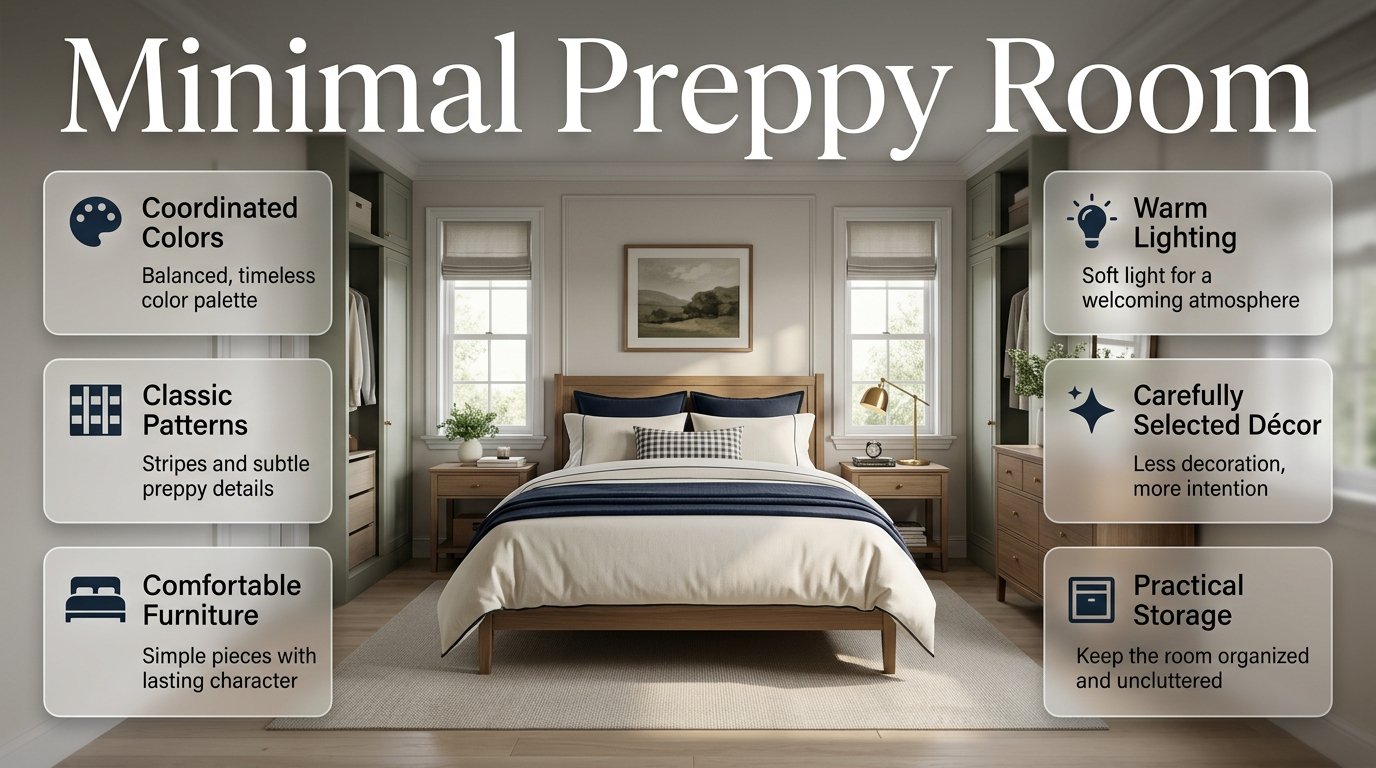
Minimal Preppy Room | A room can look beautiful without being crowded with furniture, decorations, colors, and patterns. If you love classic interiors but prefer a clean and organized atmosphere, a minimal preppy room can give you the best of both worlds. At Preppy Room, the focus is on creating spaces that feel timeless, fresh, personal, and easy to live in—not simply filling a room with trendy décor.
Minimal preppy style takes the recognizable character of preppy interiors and edits it down to the essentials. Instead of using every possible pattern and decorative detail, you choose a few elements that work together: a thoughtful color palette, comfortable furniture, crisp textiles, classic patterns, warm lighting, natural materials, and carefully selected accessories.
The result is a room that feels polished without feeling overly decorated.
This guide explains how to create that balance from the ground up. You’ll learn how to choose colors, arrange furniture, style the bed, introduce patterns, use texture, select artwork, improve lighting, manage storage, decorate small rooms, work with different budgets, and personalize the space without losing the minimalist character.
What Is a Minimal Preppy Room?
A minimal preppy room combines the traditional visual language of preppy interior design with the simplicity and restraint of minimalist decorating.
Preppy style is often associated with classic color combinations, stripes, checks, tailored textiles, traditional artwork, natural materials, and a sense of timeless order. Minimalism, on the other hand, focuses on simplicity, function, negative space, and avoiding unnecessary visual clutter.
Put those ideas together and you get a room that has personality without excess.
A minimal preppy bedroom might feature a simple upholstered bed, crisp cream bedding, a navy striped cushion, a wooden nightstand, a warm bedside lamp, a textured rug, and one carefully chosen piece of artwork.
There may be fewer objects in the room, but each object has more visual importance.
That distinction is important.
Minimal preppy doesn’t mean removing every interesting feature. It means choosing interesting features carefully.
The Core Idea Behind Minimal Preppy Design
Think of the style as:
Classic preppy character + minimalist editing + comfortable functionality
The room should feel:
- Clean
- Fresh
- Organized
- Timeless
- Comfortable
- Sophisticated
- Personal
- Easy to maintain
It shouldn’t feel empty, sterile, or overly formal.
Why Is Minimal Preppy Style Becoming So Popular?
Many people like the personality of traditional interiors but don’t enjoy the visual clutter that can come from too many patterns, accessories, and decorative objects.
A minimal preppy room solves that problem.
It gives you the opportunity to enjoy classic design details while maintaining a calmer visual environment.
There’s also a practical advantage. A simpler room is generally easier to organize and maintain. When every surface isn’t covered with objects, cleaning becomes easier, storage becomes more manageable, and the room can feel more spacious.
Another advantage is longevity.
Trendy rooms can become dated quickly. A restrained combination of cream, navy, natural wood, classic textiles, and timeless artwork can remain attractive for years.
The style also gives you flexibility.
You can make it:
- Traditional
- Modern
- Cozy
- Youthful
- Elegant
- Casual
- Coastal
- Academic
- Playful
The underlying principles remain the same even when the personality changes.
What Makes a Room Look Preppy?
Preppy style isn’t created by one specific piece of furniture or one color.
It’s the combination of several recognizable design characteristics.
Common preppy elements include:
- Navy and white
- Soft blue
- Forest or sage green
- Stripes
- Gingham
- Plaid
- Traditional artwork
- Tailored fabrics
- Brass accents
- Natural wood
- Symmetry
- Classic furniture shapes
- Crisp bedding
- Nautical references
- Botanical prints
- Refined but approachable accessories
The important word for a minimalist room is selection.
You don’t need all of these features.
If you use navy, stripes, brass, plaid, botanical artwork, nautical décor, patterned curtains, decorative books, and several accessories at once, you may create a beautiful traditional preppy room—but it may no longer feel minimal.
Minimal preppy design asks you to select the strongest elements and allow them to breathe.
How Is Minimal Preppy Different From Traditional Preppy Style?
Traditional preppy design often celebrates layering.
You might see multiple patterns, decorative pillows, artwork, accessories, furniture pieces, and colors working together.
Minimal preppy style uses the same design language but reduces the number of competing elements.
| Feature | Traditional Preppy | Minimal Preppy |
|---|---|---|
| Colors | Several coordinated shades | Usually 2–4 main colors |
| Patterns | Multiple patterns | One dominant pattern, sometimes two |
| Furniture | More layered | Essential pieces |
| Accessories | Numerous | Carefully selected |
| Artwork | Gallery walls are possible | One focal piece or small arrangement |
| Bedding | Highly layered | Crisp and edited |
| Storage | Can be visible | Preferably organized or concealed |
| Negative space | Moderate | Important |
| Overall mood | Rich and collected | Calm and polished |
Neither style is better.
The right choice depends on your personality and the atmosphere you want.
If you love decorative layering, traditional preppy may suit you better.
If you want classic personality without visual overload, minimal preppy is a strong option.
How Do You Start Designing a Minimal Preppy Room?
The biggest mistake beginners make is shopping before creating a design direction.
A room becomes easier to design when you decide on the overall structure first.
Start with:
- Room function
- Existing architecture
- Color palette
- Furniture arrangement
- Bed or primary focal point
- Textiles
- Lighting
- Artwork
- Accessories
- Storage
This sequence prevents random purchases.
You can also use a simple rule:
Large elements first. Small decorative elements last.
There’s little value in finding the perfect decorative tray if you haven’t decided where the dresser belongs.
1. Start With the Room’s Function
Before choosing colors or furniture, ask what the room actually needs to do.
Is it primarily:
- A bedroom?
- A study-bedroom?
- A guest room?
- A teenager’s room?
- A reading space?
- A shared bedroom?
- A compact apartment bedroom?
The answer affects your design decisions.
For example, a bedroom used for studying needs a practical desk and suitable lighting.
A guest room may need additional storage.
A small bedroom may require multifunctional furniture.
A teenager’s room may need space for books, hobbies, technology, and personal belongings.
Minimalism shouldn’t remove necessary functionality.
Instead, it should help you organize that functionality more intelligently.
2. Choose a Simple Color Palette
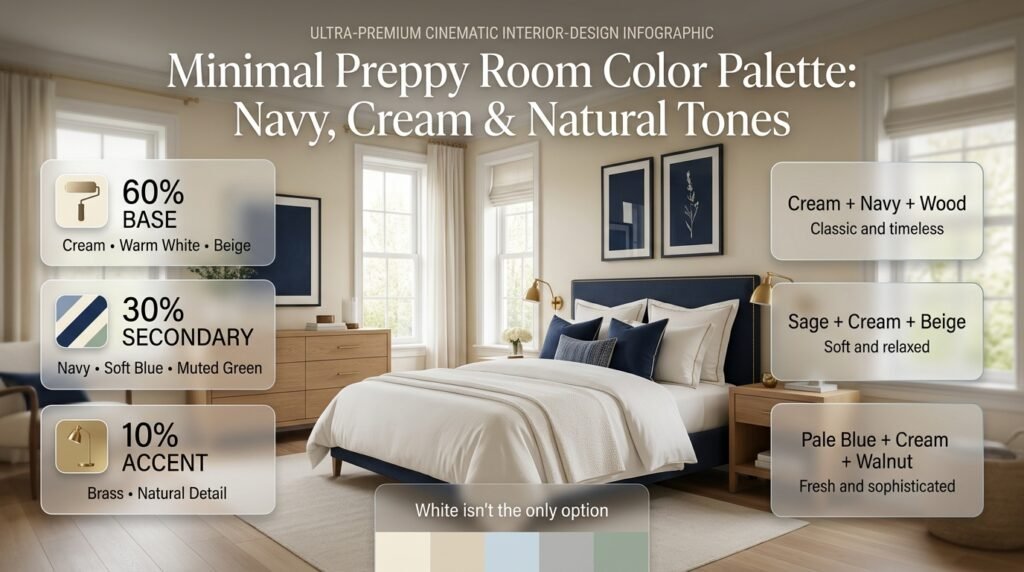
Color is one of the most powerful tools in a minimal preppy room.
The classic combination of navy and white is popular for a reason. It’s clean, recognizable, versatile, and easy to coordinate.
But you have many other choices.
Consider:
- Cream + navy + natural wood
- White + soft blue + brass
- Sage + cream + beige
- Navy + warm white + tan
- Pale blue + cream + walnut
- Soft pink + cream + muted green
- Gray + white + navy
- Forest green + ivory + natural wood
The best approach is to choose a dominant base, a secondary color, and a small accent.
A Simple Three-Color Formula
60% base color
30% secondary color
10% accent color
These don’t have to be exact measurements.
They’re simply a useful visual guideline.
For example:
Cream walls + cream bedding + natural wood
could form the base.
Navy pillows + navy artwork
provide the secondary color.
Brass lamp hardware
becomes the accent.
This gives the eye a clear visual hierarchy.
Should a Minimal Preppy Room Be White?
No.
White is useful because it creates a clean background, but minimal preppy rooms can work beautifully with cream, beige, pale blue, soft gray, or muted green.
In fact, slightly warmer neutrals can make a minimalist space feel more comfortable.
Pure white combined with cool lighting can sometimes feel stark.
Cream or warm white paired with natural wood and soft textiles often creates a more welcoming atmosphere.
If the room receives plenty of natural light, you have even more flexibility.
3. Consider the Existing Architecture
Don’t design the room as if it’s a blank box.
Look at what you already have.
Consider:
- Flooring
- Ceiling height
- Window placement
- Door position
- Built-in storage
- Wall color
- Architectural trim
- Radiators or vents
- Existing lighting
- Natural light direction
Traditional architectural features can actually strengthen a preppy aesthetic.
For example, simple wall molding, paneling, classic trim, or a traditional window shape can provide visual character without requiring additional decoration.
If the architecture is modern, you can create the preppy feeling through textiles, furniture, artwork, and color.
4. Choose Furniture With Clean, Classic Lines
Furniture is one of the easiest ways to establish the difference between minimalist and cluttered design.
Look for pieces that are:
- Proportionate
- Functional
- Comfortable
- Visually simple
- Well constructed
- Easy to coordinate
A classic wooden nightstand can look more preppy than an ultra-modern glossy cabinet.
At the same time, you don’t need heavily ornate furniture.
The sweet spot is often somewhere between traditional and contemporary.
Furniture Pieces to Prioritize
For a bedroom, begin with:
- Bed
- Nightstand
- Dresser
- Wardrobe or closet storage
- Chair, if space allows
- Desk, if required
- Lighting
Everything else should be considered optional.
If the room already feels full after these essentials are placed, don’t force additional furniture into it.
5. Make the Bed the Main Focal Point
The bed is usually the largest visual element in a bedroom, so use it to establish the room’s identity.
A minimal preppy bed doesn’t need ten pillows.
Instead, focus on:
- High-quality-looking bedding
- Layered but controlled textiles
- One recognizable pattern
- Good proportions
- Comfortable materials
For example:
White sheets + cream duvet + navy striped lumbar cushion + textured throw
can create a strong preppy identity without looking busy.
Another option:
Cream bedding + sage check cushion + natural woven throw
creates a softer interpretation.
The goal is to make the bed look inviting rather than overstyled.
How Many Pillows Should a Minimal Preppy Bed Have?
There’s no strict number.
What matters is proportion.
A king-size bed can handle more pillows than a twin bed, but a minimalist arrangement should still feel easy to use.
A practical arrangement might include:
- Sleeping pillows
- One pair of decorative pillows
- One accent cushion
The accent doesn’t necessarily need to be a different color.
It could simply introduce texture.
If you have to move ten decorative pillows every night before sleeping, the arrangement probably isn’t serving the minimalist goal.
6. Use Preppy Patterns Carefully
Pattern is one of the most recognizable features of preppy design.
The challenge is using enough pattern to establish character without overwhelming the room.
Good options include:
- Stripes
- Gingham
- Plaid
- Checks
- Small geometric patterns
- Botanical prints
- Traditional motifs
For a minimal room, begin with one primary pattern.
Example
A navy-and-white striped cushion can become the main preppy pattern.
Everything else can remain solid or subtly textured.
If you want another pattern, make it smaller and less visually dominant.
For example:
Large stripe + tiny check
is easier to manage than:
Large stripe + large plaid + floral + geometric print
7. Use Pattern Repetition Instead of Pattern Multiplication
This is an important professional design principle.
You don’t necessarily need more patterns.
Instead, repeat one existing pattern or color in different locations.
For example:
- Navy stripe on bedding
- Small navy detail in artwork
- Navy book on the nightstand
The eye recognizes the connection.
This creates coordination without introducing additional visual complexity.
8. Add Texture Instead of More Décor
When a minimalist room feels boring, the first instinct is often to buy more accessories.
That’s usually not the best solution.
Try texture first.
You can introduce:
- Linen
- Cotton
- Wool
- Woven fibers
- Natural wood
- Ceramic
- Bouclé
- Rattan
- Textured rugs
- Knitted throws
Texture adds visual depth while preserving simplicity.
Imagine a cream room with:
- Linen bedding
- Oak furniture
- A woven rug
- Ceramic lamp
- Soft cotton curtains
There may be very little decoration, but the room can still feel rich.
💡 Pro Tip: When a minimal room feels flat, add a new material before adding a new object.
9. Select the Right Rug
A rug can visually connect the bed and furniture while making the room feel more comfortable.
For minimal preppy interiors, good choices include:
- Neutral textured rugs
- Traditional low-contrast patterns
- Navy and cream designs
- Soft striped rugs
- Natural fiber rugs
- Subtle geometric patterns
A rug should complement the room rather than become an unrelated focal point.
If the bedding already has a strong pattern, consider a simpler rug.
If the bedding is mostly solid, the rug can introduce a subtle traditional pattern.
10. Use Natural Wood for Warmth
Natural wood works particularly well with preppy interiors because it feels timeless.
Depending on the room, consider:
- Oak
- Walnut
- Medium wood
- Painted wood
- Whitewashed wood
Wood helps balance cooler colors such as navy, blue, and gray.
For example:
Navy + white + natural oak
has a completely different feeling from:
Navy + white + glossy black
Both can work, but the first combination often feels warmer and more relaxed.
11. Add Brass Carefully
Brass can introduce a subtle sense of refinement.
It can appear through:
- Lamp hardware
- Drawer pulls
- Picture frames
- Curtain rods
- Small decorative objects
The goal isn’t to make every object metallic.
One or two brass details may be enough.
Too much brass can shift the room toward a more formal or glamorous aesthetic, which may not be what you want from a relaxed minimal preppy room.
12. Choose Wall Art That Supports the Room
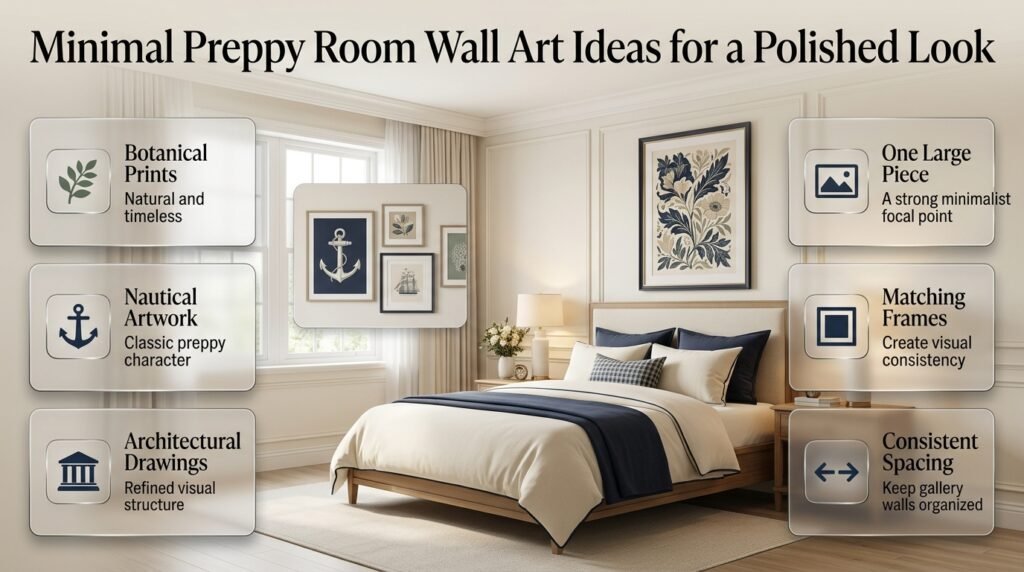
Artwork should connect with the room rather than simply occupy an empty wall.
Good choices include:
- Botanical prints
- Traditional landscapes
- Nautical-inspired artwork
- Architectural drawings
- Simple maps
- Classic illustrations
- Minimal line art
- Understated typography
Look at your existing palette before selecting artwork.
If your room is cream and navy, artwork containing those colors can create cohesion.
One Large Artwork vs. Gallery Wall
A gallery wall can look beautiful, but it adds visual activity.
For a minimalist room, one large framed piece above the bed can be more effective.
If you prefer multiple pieces, keep them coordinated through:
- Matching frames
- Similar colors
- Related subject matter
- Consistent spacing
13. Use Symmetry to Create Order
Symmetry is particularly effective in classic interiors.
A simple example is:
Lamp + nightstand + bed + nightstand + lamp
This arrangement immediately creates balance.
Symmetry doesn’t mean everything must be identical.
You can have slightly different accessories while maintaining the same overall structure.
For example, two matching lamps can frame the bed while each nightstand has one different small object.
The room still feels organized.
14. Choose Lighting for Both Function and Atmosphere
A room shouldn’t rely on one ceiling fixture.
Instead, think about layers.
Ambient Lighting
Provides overall illumination.
Task Lighting
Helps with reading, studying, or other activities.
Accent Lighting
Creates atmosphere and draws attention to selected areas.
Bedside lamps are especially useful in a preppy bedroom because they provide both function and symmetry.
Warm-toned lighting can also make cream, wood, and navy feel more comfortable.
How Bright Should a Minimal Preppy Bedroom Be?
During the day, make use of natural light whenever possible.
At night, the room should have enough light for practical activities without feeling harsh.
If possible, use separate lighting controls for different purposes.
For example:
Ceiling light → general use
Bedside lamp → reading
Small accent light → evening atmosphere
This gives you control over how the room feels throughout the day.
15. Keep Curtains Simple
Curtains can cover a large visual area, so they have a significant effect on the room.
For a minimal preppy room, consider:
- Cream
- White
- Beige
- Soft blue
- Light gray
- Subtle stripes
If the bedding already contains a strong pattern, simple curtains usually work best.
If everything else is solid, a subtle striped curtain could become an elegant preppy detail.
Avoid choosing a bold curtain simply because the window looks empty.
The window treatment should support the overall composition.
16. Use Storage to Protect the Minimal Look
Minimal design depends heavily on organization.
A beautiful color palette can’t compensate for visible clutter everywhere.
Consider:
- Under-bed storage
- Closed drawers
- Baskets
- Storage ottomans
- Built-in wardrobes
- Closed cabinets
- Decorative boxes
- Desk organizers
The best storage is often the storage you don’t notice.
When everyday objects have a designated place, keeping the room visually clean becomes much easier.
How Do You Keep a Minimal Preppy Room Organized?
Create a simple system based on frequency of use.
Daily Items
Keep them easily accessible.
Weekly Items
Store them nearby but out of sight.
Rarely Used Items
Place them in less accessible storage.
This prevents frequently used objects from constantly appearing on surfaces.
For example, books you read every night can remain on the nightstand.
Old notebooks, spare cables, seasonal accessories, and other occasional items can be stored elsewhere.
17. Don’t Decorate Every Surface
One of the most important minimalist principles is allowing empty space.
An empty nightstand isn’t unfinished.
An empty shelf isn’t necessarily missing something.
An empty section of wall can help artwork stand out.
Negative space gives the eye somewhere to rest.
This is especially important when working with preppy patterns because patterns already create visual interest.
⚠ Common Mistake: Adding decorative objects simply because a surface looks empty.
Before adding anything, ask:
Would this object improve the room if the surface were already visually balanced?
If not, leave the surface alone.
18. Bring Nature Into the Room
Plants can work beautifully in a minimal preppy interior.
You don’t need a jungle.
One healthy plant can add:
- Natural color
- Texture
- Height
- Organic shape
You can also use flowers or branches in a simple vase.
Natural elements are particularly effective when the rest of the room contains structured lines and tailored textiles.
They soften the composition without creating clutter.
19. Add Personality Without Creating Clutter
Minimalism doesn’t mean the room should look like a hotel.
Personal details matter.
You might display:
- A meaningful photograph
- A favorite book
- A small collection
- A travel memory
- A personal artwork
- A special object
- A hobby-related item
The key is editing.
Instead of displaying every meaningful object you own, choose a few that matter most.
That makes those objects more noticeable.
20. Design a Minimal Preppy Room for a Small Space
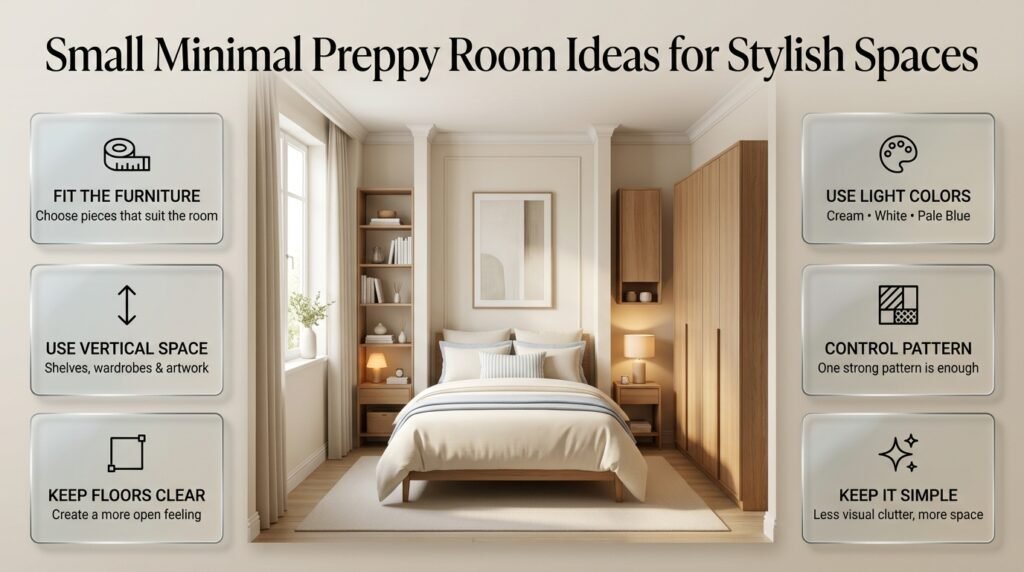
Small bedrooms can benefit significantly from this style.
When floor space is limited, visual simplicity becomes even more valuable.
Use Furniture That Fits the Room
Large furniture can quickly dominate a small bedroom.
Measure before purchasing.
Use Vertical Space
Consider:
- Tall shelves
- Vertical artwork
- Wall-mounted storage
- Tall wardrobes
Keep the Floor Clear
The more floor you can see, the more open the room may feel.
Use Light Colors
Cream, white, pale blue, and soft neutrals can help maintain visual openness.
Control Pattern
One strong pattern is usually enough.
For more traditional inspiration, explore Classic Preppy Room.
Minimal Preppy Room Ideas for a Teen Bedroom
A minimal preppy style can be adapted easily for a teenager.
The important thing is to leave room for personality.
A practical teen bedroom may need:
- Comfortable bed
- Study desk
- Task chair
- Bookshelf
- Clothing storage
- Charging area
- Good lighting
- Personal display area
Instead of removing personality in the name of minimalism, organize it.
For example, a small display shelf can showcase favorite objects while keeping the rest of the room visually calm.
A navy-and-white palette with striped bedding can create a classic foundation, while photographs, books, or artwork make the room personal.
Minimal Preppy Room Ideas for a Guest Bedroom
Guest rooms benefit from a calm, timeless design.
You don’t know exactly what every guest will prefer, so a neutral foundation is useful.
Consider:
- Cream or white bedding
- Soft blue or navy accents
- Simple artwork
- Comfortable lighting
- A clear bedside table
- Convenient storage
- Extra blanket
- Simple curtains
Avoid filling the room with highly personal or fragile décor.
A guest bedroom should feel welcoming and easy to use.
Minimal Preppy Room Ideas for Couples
A couple’s bedroom needs to balance two personalities.
Instead of designing around one person’s favorite theme, establish a shared foundation.
Choose:
- Neutral base
- One shared accent color
- Simple patterns
- Comfortable textiles
- Balanced furniture
- Functional storage
Personal preferences can appear through smaller objects.
For example, one person might prefer books while the other prefers plants. They can coexist without requiring two completely different decorating styles.
Minimal Preppy Room Ideas for a Study Area
If your bedroom includes a desk, keep the study zone visually connected to the rest of the room.
Choose a desk with simple lines.
Use organizers to keep small items controlled.
Add a task lamp.
Keep the desktop relatively clear.
A framed print or small plant can add personality.
Avoid turning the desk into a storage area for everything that doesn’t have another home.
The same minimalist principle applies:
Function first, decoration second.
How to Make a Minimal Preppy Room Cozy
Minimal rooms can sometimes feel cold when they rely too heavily on hard surfaces and pale colors.
Warmth can be added without creating clutter.
Try:
- Soft bedding
- Layered textiles
- Natural wood
- Warm lighting
- Cream instead of stark white
- Textured rugs
- Woven baskets
- Curtains
- A comfortable chair
- One or two meaningful accessories
The secret is to increase sensory comfort, not object count.
A soft blanket contributes more to coziness than another decorative item sitting on a shelf.
For a warmer interpretation of the style, explore Cozy Preppy Room.
How to Make a Minimal Preppy Room Look More Modern
Traditional preppy elements can sometimes feel formal.
To create a modern interpretation, simplify the shapes.
Try:
- Streamlined furniture
- Minimal hardware
- Solid bedding
- One geometric or striped accent
- Simple artwork
- Fewer accessories
- Cleaner lighting
You can also introduce a contemporary material such as glass, matte metal, or smooth upholstery.
The goal is not to remove all traditional character.
It’s to balance it.
A simple modern bed with a navy striped cushion and traditional framed artwork can feel both current and classic.
For more ideas, explore Modern Preppy Room.
How to Create a Cute Minimal Preppy Room
“Cute” and “minimal” can work together when playful details are controlled.
Instead of covering the room with novelty décor, choose one or two charming elements.
For example:
- Soft pink accent
- Small floral print
- Playful cushion
- Charming framed illustration
- Small decorative lamp
- Soft pastel accessories
Keep the larger furniture and background neutral.
This allows the playful details to stand out without taking over the room.
You can explore Cute Preppy Room for a more playful interpretation.
Coordinating Colors Across the Room
Color coordination is one of the easiest ways to make a room look professionally designed.
The trick is repetition.
If navy appears on the bed, introduce a small amount of navy elsewhere.
If warm wood appears in the furniture, repeat that warmth through another material.
If sage green appears in the artwork, echo it through a cushion or plant.
This creates relationships between separate objects.
For more color-planning ideas, explore Coordinated Colors.
Minimal Preppy Color Combinations to Try
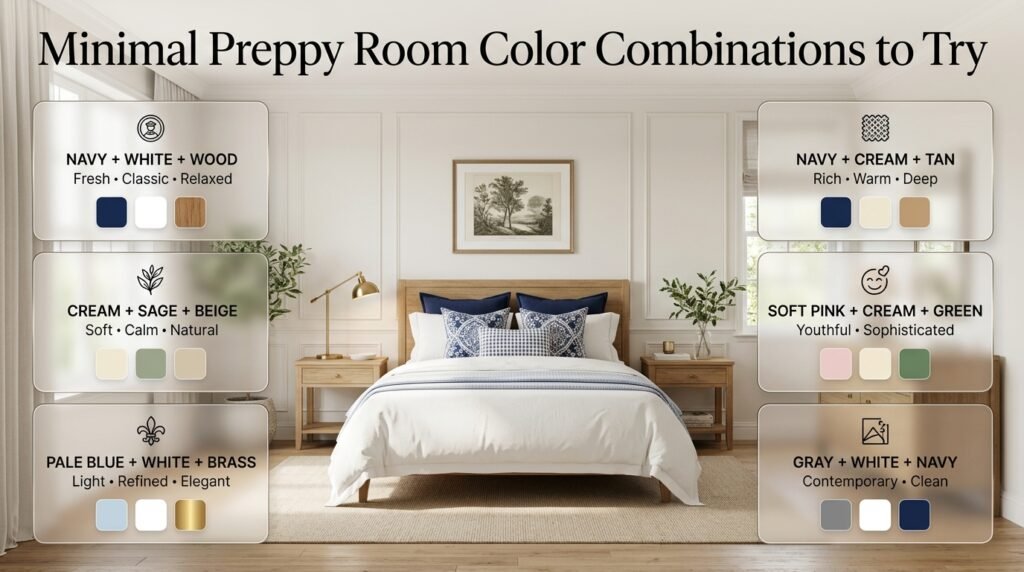
Navy, White, and Natural Wood
This is one of the most recognizable combinations.
It feels:
- Fresh
- Classic
- Clean
- Relaxed
Use navy as the accent rather than covering the entire room with it.
Cream, Sage, and Beige
This combination feels softer.
It’s ideal if you want a room that feels calm and natural rather than crisp and nautical.
Pale Blue, White, and Brass
This combination feels light and refined.
Brass works particularly well in small amounts through lamps, hardware, and frames.
Navy, Cream, and Tan
This palette has more visual depth.
It’s especially effective with medium or dark wood.
Soft Pink, Cream, and Green
This can create a youthful but sophisticated room.
Keep the pink muted rather than overly bright if you want to preserve the minimalist character.
Gray, White, and Navy
This is useful for a more contemporary interpretation.
It works especially well with streamlined furniture and simple artwork.
Minimal Preppy Room Furniture Guide
| Furniture | What to Look For | Why It Works |
|---|---|---|
| Bed | Simple, proportionate frame | Establishes the focal point |
| Nightstand | Clean classic shape | Supports symmetry |
| Dresser | Functional drawers | Controls clutter |
| Wardrobe | Closed storage | Keeps visual space calm |
| Desk | Simple lines | Supports productivity |
| Chair | Comfortable upholstery | Adds function and texture |
| Bench | Low-profile design | Useful without visual bulk |
Don’t buy furniture simply because it looks preppy.
Ask whether it fits the room.
Proportion matters as much as style.
How Important Is Proportion in a Minimal Room?
Extremely important.
When there are fewer objects, each one becomes more noticeable.
A tiny rug under a large bed can look disconnected.
An oversized dresser can dominate a small bedroom.
A very small artwork above a large bed may feel lost.
Before purchasing anything, measure the room.
Measure:
- Wall width
- Ceiling height
- Bed dimensions
- Walking paths
- Door clearance
- Window placement
- Furniture depth
Good proportions often make an inexpensive room look more sophisticated.
Common Minimal Preppy Room Mistakes
Mistake 1: Using Too Many Patterns
Why it happens
Preppy style is associated with patterns, so beginners may think more patterns automatically create a stronger preppy room.
Why it hurts
Too many competing patterns make it difficult for the eye to identify a focal point.
Better approach
Choose one dominant pattern and perhaps one supporting pattern.
Mistake 2: Making Everything White
Why it happens
White is associated with clean minimalist interiors.
Why it hurts
An entirely white room can lack warmth and depth.
Better approach
Introduce wood, cream, navy, green, brass, and texture.
Mistake 3: Filling Every Empty Surface
Why it happens
Empty space can look unfinished to someone accustomed to highly decorated rooms.
Why it hurts
The room loses the calm quality that makes minimalism attractive.
Better approach
Treat negative space as part of the design.
Mistake 4: Ignoring Storage
Why it happens
People focus on visible décor rather than everyday organization.
Why it hurts
Clutter quickly destroys the minimalist appearance.
Better approach
Plan storage before purchasing decorative objects.
Mistake 5: Buying Furniture Without Measuring
Why it happens
Furniture may look appropriate online or in a showroom.
Why it hurts
It may overwhelm the actual room.
Better approach
Measure the room and create a basic floor plan first.
Mistake 6: Choosing Style Over Comfort
Why it happens
People sometimes prioritize photographs over daily life.
Why it hurts
A bedroom should be comfortable and functional.
Better approach
Choose practical furniture and comfortable textiles first.
Mistake 7: Using Trends Everywhere
Why it happens
Trendy items can be attractive and easy to find.
Why it hurts
Too many trends can make a room feel dated quickly.
Better approach
Use timeless foundations and let smaller accessories carry seasonal trends.
Mistake 8: Making Everything Match Perfectly
Why it happens
People want the room to look coordinated.
Why it hurts
Perfect matching can make a room feel manufactured.
Better approach
Coordinate colors and materials while allowing small variations.
How to Create a Minimal Preppy Room on a Budget
You don’t have to replace everything.
In fact, one of the best ways to create this style is to work with what you already have.
Start with decluttering.
Then rearrange the furniture.
Then identify the items that are visually inconsistent.
You may only need to change:
- Bedding
- Pillow covers
- Lighting
- Artwork
- Rug
- Curtains
These changes can have a large visual impact.
A Budget-Friendly Upgrade Order
If your budget is limited, prioritize in this order:
1. Declutter
Free.
2. Rearrange Furniture
Also free.
3. Improve Bedding
High visual impact.
4. Improve Lighting
High atmosphere impact.
5. Add a Rug
Adds comfort and definition.
6. Add Artwork
Creates personality.
7. Add Small Accessories
Finish the design.
This order prevents spending money on details before fixing the overall composition.
How to Make Cheap Décor Look More Sophisticated
The secret isn’t always price.
Presentation matters.
A simple inexpensive object can look better when:
- It matches the color palette
- It has enough surrounding space
- It’s grouped thoughtfully
- It isn’t competing with too many objects
- It has an appropriate scale
For example, one simple ceramic vase on a clear nightstand can look more intentional than a collection of expensive decorative objects crowded together.
How to Style a Nightstand
A minimal preppy nightstand can be extremely simple.
Try:
Lamp + book + small object
or:
Lamp + small framed photograph + tray
That’s often enough.
If the nightstand has drawers, use them for everyday clutter.
Keep chargers, cables, receipts, and random objects out of sight where practical.
The goal is for the surface to remain calm.
How to Style a Dresser
A dresser provides more surface area, which means it’s easy to overdecorate.
Start with one focal object.
Then add:
- Lamp
- Mirror or artwork
- Small tray
- Plant or vase
Leave some surface visible.
The empty area creates balance.
Should You Use Mirrors?
Yes.
Mirrors can be particularly useful in smaller rooms.
They can:
- Reflect light
- Add depth
- Make a room feel more open
- Provide functional value
Choose a frame that connects with the room.
A simple brass, wood, white, or dark frame can work depending on the palette.
Don’t use an oversized mirror simply because you want the room to feel larger. Proportion still matters.
How to Use Books in a Minimal Preppy Room
Books are a natural fit for preppy and academic-inspired interiors.
They can also provide color.
However, don’t treat books purely as decoration.
Display books that you actually enjoy or use.
A small stack on a nightstand or shelf can add personality while remaining functional.
If you have many books, use a proper bookshelf rather than scattering them throughout the room.
How to Use Baskets and Woven Storage
Woven baskets are useful because they combine storage with texture.
They can hold:
- Blankets
- Pillows
- Accessories
- Books
- Everyday items
Choose a basket that complements your materials.
Natural woven textures work especially well with cream, navy, sage, beige, and wood.
Again, don’t use baskets simply because they look attractive.
Use them where they solve an actual storage problem.
How to Choose Bedding for a Minimal Preppy Room
Bedding is one of the easiest elements to change.
Look for:
- Crisp appearance
- Comfortable fabric
- Coordinated colors
- Simple pattern
- Good proportions
Solid bedding is a safe starting point.
Then introduce a preppy pattern through one accent.
Alternatively, use subtle stripes across the duvet and keep the pillows simpler.
Avoid making every bedding layer patterned.
Should Bedding Be Light or Dark?
Both can work.
Light bedding creates an airy atmosphere.
Dark navy bedding creates more depth.
If using dark bedding, keep surrounding walls and larger furniture lighter to maintain balance.
If the room is small, a lighter bedding foundation may help preserve an open feeling.
How to Choose a Headboard
A headboard can establish the character of the bed.
Good options include:
- Upholstered headboards
- Simple wooden headboards
- Panel-style designs
- Classic framed designs
For a minimalist look, avoid overly complicated silhouettes.
The headboard should support the bed rather than become a competing focal point.
Minimal Preppy Room for Different Personalities
The style can be customized without losing its identity.
For a Classic Personality
Use:
- Navy
- Cream
- Traditional artwork
- Wood
- Brass
- Stripes
For a Modern Personality
Use:
- White
- Gray
- Navy
- Streamlined furniture
- Simple artwork
For a Soft Personality
Use:
- Cream
- Sage
- Beige
- Linen
- Botanical artwork
For a Playful Personality
Use:
- Soft pink
- Pale blue
- Small patterns
- Charming artwork
- A few colorful accessories
The foundation remains minimal.
The personality comes through selected details.
A Professional Approach to Editing the Room
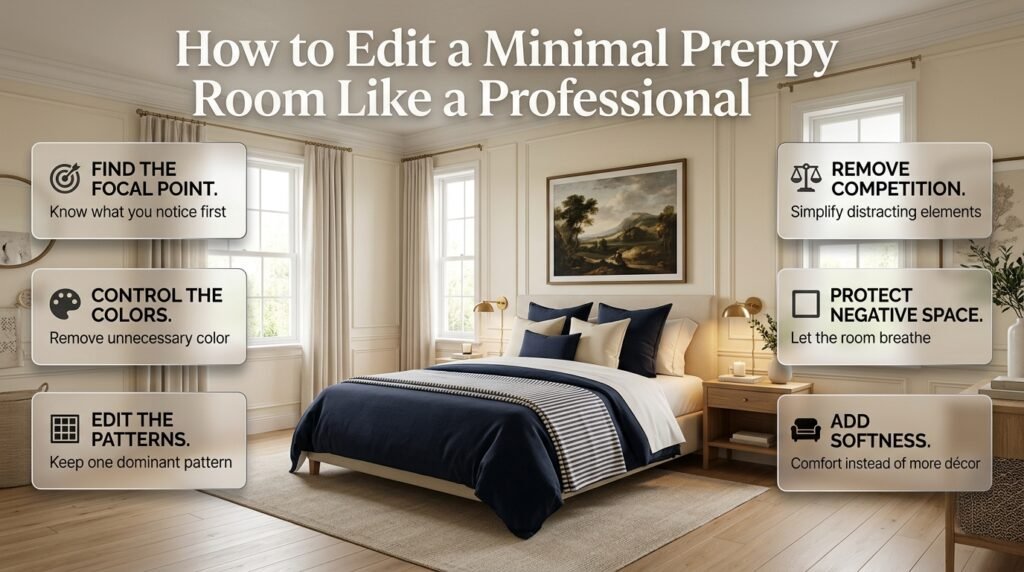
Once everything is installed, don’t assume you’re finished.
Edit.
Stand at the doorway.
Look at the room as a whole.
Then ask:
What do I notice first?
That should generally be an intentional focal point.
Is anything competing with it?
If yes, simplify.
Are there too many colors?
Remove or relocate unnecessary colors.
Are patterns competing?
Keep one dominant pattern.
Is there enough negative space?
If not, remove something.
Does the room feel comfortable?
If not, add softness rather than decoration.
This editing stage is one of the easiest ways to make a room look more professionally designed.
The 80/20 Rule for Minimal Preppy Interiors
A useful way to think about the room is:
80% calm foundation
20% personality
The 80% might include:
- Neutral walls
- Solid bedding
- Simple furniture
- Neutral rug
- Plain curtains
The 20% might include:
- Navy stripe
- Artwork
- Brass lamp
- Plant
- Personal objects
This isn’t a strict mathematical rule.
It’s a visual strategy.
The room needs enough quiet space for personality to become visible.
Minimal Preppy Room vs. Other Preppy Styles
| Style | Main Feeling | Pattern Level | Visual Density |
|---|---|---|---|
| Minimal Preppy | Clean and refined | Low | Low |
| Classic Preppy | Traditional and timeless | Medium | Medium |
| Modern Preppy | Crisp and contemporary | Low-Medium | Low-Medium |
| Cute Preppy | Playful and charming | Medium | Medium |
| Cozy Preppy | Warm and relaxed | Medium | Medium |
If you’re unsure which direction to choose, think about how you want the room to feel every day.
A room isn’t successful simply because it photographs well.
It should support your lifestyle.
Step-by-Step Minimal Preppy Room Makeover
Step 1: Empty the Room Mentally
You don’t necessarily have to remove everything physically.
Instead, identify what is essential.
Ask:
What would I keep if I were starting over?
Step 2: Choose Your Color Palette
Select a base, secondary color, and accent.
Write them down.
This makes future shopping easier.
Step 3: Measure the Room
Measure furniture and walking spaces.
Avoid guessing.
Step 4: Arrange the Main Furniture
Place the bed first.
Then storage.
Then secondary furniture.
Step 5: Choose Bedding
Create a clean foundation.
Step 6: Add One Preppy Pattern
Use stripes, checks, gingham, or another suitable motif.
Step 7: Introduce Texture
Add rug, wood, linen, woven material, or another tactile element.
Step 8: Add Lighting
Prioritize useful bedside and task lighting.
Step 9: Add Artwork
Choose artwork that reinforces the palette.
Step 10: Organize Storage
Put everyday clutter away.
Step 11: Add Personal Details
Choose only the objects that matter.
Step 12: Edit
Remove anything that feels unnecessary.
This final step can make the biggest difference.
Minimal Preppy Room Shopping Checklist
Before buying anything, ask:
Color
- Does this item fit my palette?
- Will I use this color elsewhere?
Pattern
- Is this becoming another dominant pattern?
- Does it work with the existing pattern?
Scale
- Is it appropriately sized?
- Will it overwhelm the room?
Function
- Does it serve a useful purpose?
Material
- Does it add a useful texture or finish?
Longevity
- Will I still like it in a few years?
Personality
- Does it actually feel like me?
If an item fails several of these questions, don’t buy it simply because it looks attractive by itself.
How to Photograph a Minimal Preppy Room
If you’re creating a room for social media or a design website, photography becomes important.
Keep the composition simple.
Photograph near natural light when possible.
Show:
- Overall room
- Bed styling
- Nightstand
- Artwork
- Texture details
- Color relationships
Avoid making the room look artificially perfect.
A realistic room with thoughtful styling feels more useful and relatable.
How do you make a room look preppy but still minimal?
The key is to choose a few recognizable preppy details instead of using every preppy element at once. A minimal preppy room should have a clear visual hierarchy: a simple furniture foundation, a restrained color palette, one main pattern, and a few classic accents. Stripes, navy, gingham, traditional artwork, natural wood, and brass can all work, but they don’t need to compete for attention.
A practical combination would be a cream or white foundation, navy accents, simple wooden furniture, crisp bedding, one striped cushion, and a traditional framed artwork. This creates the preppy character without making the room look themed or overcrowded. Designers increasingly emphasize that good minimalism is about intentionality rather than simply having fewer objects.
Practical points:
Keep the main furniture visually simple.
Choose one dominant preppy pattern.
Repeat one or two colors throughout the room.
Use texture instead of adding unnecessary decorations.
Leave some surfaces and wall space intentionally empty.
Let one feature—usually the bed or artwork—act as the focal point.
What colors work best for a minimal preppy room?
A strong minimal preppy palette usually starts with a calm neutral foundation and then introduces one or two classic preppy colors. White, cream, beige, soft blue, sage green, navy, and natural wood are particularly versatile. The important thing isn’t choosing a specific “preppy color”; it’s making sure the colors have a clear relationship with each other.
For a softer and more contemporary room, cream with sage and warm wood can work beautifully. For a more recognizable classic look, white, navy, and natural wood are hard to beat. You can also introduce brass as a small accent through lighting or hardware rather than making metallic finishes a major part of the palette.
Current bedroom design discussions are also moving toward warmer neutrals, earthy tones, natural finishes, and more personalized spaces rather than relying entirely on cold whites and gray.
A useful palette formula:
Base: cream, white, beige, or soft gray
Main preppy color: navy, sage, pale blue, or muted green
Accent: brass, warm wood, muted pink, or another small supporting tone
The goal is coordination, not color quantity.
How can you create a minimal preppy room in a small bedroom?
A small bedroom actually suits minimal preppy design very well because the style naturally encourages careful furniture selection, controlled patterns, and less visual clutter. The biggest mistake is trying to squeeze a full-size version of a large bedroom into a small space.
Start with the bed and storage because they’re the pieces that have the biggest impact on how much usable space remains. Choose furniture with a relatively light visual footprint, keep walking paths clear, and use storage that takes advantage of vertical or hidden space.
For example, a simple bed, compact nightstand, streamlined dresser, one rug, and one strong artwork can be enough. You don’t need a large chair, oversized dresser, multiple tables, and a collection of decorative accessories.
Designers specifically recommend streamlined furniture, less bulky beds, minimal bedding, and floating or visually lighter nightstands when trying to make a small bedroom feel more spacious.
For a small room:
Measure furniture before buying it.
Keep the floor as visually clear as possible.
Choose one main pattern instead of several.
Use wall-mounted or vertical storage where practical.
Keep bedding relatively streamlined.
Use a light or warm neutral base.
Choose one strong artwork rather than filling every wall.
Avoid oversized furniture simply because it looks impressive in a showroom.
A small room doesn’t need to look empty. It needs to look edited and well-proportioned.
How do you make a minimal preppy room cozy without making it cluttered?
The best way to make a minimal preppy room cozy is to add texture, warmth, and comfort—not lots of extra objects. This distinction makes a huge difference.
For example, instead of adding five decorative items to an empty nightstand, add a warm table lamp. Instead of adding several pillows, choose comfortable bedding and one or two well-selected cushions. Instead of filling a wall with decorations, use one meaningful artwork with a good frame.
Natural wood, linen, cotton, woven materials, textured rugs, warm lighting, and soft throws can give the room depth without destroying the clean aesthetic. Current bedroom design guidance is increasingly emphasizing tactile materials and layered comfort, while designers caution against confusing minimalism with stark emptiness.
Focus on these elements:
Warm rather than harsh lighting
Soft bedding
Textured rugs
Natural wood
Linen or cotton fabrics
Woven baskets
Cream and warm neutral tones
One comfortable throw
A small amount of greenery or natural material
A good test is simple: if the room feels cold, improve the materials before adding more decoration.
How do you make a minimal preppy room look modern instead of old-fashioned?
The easiest way to modernize preppy design is to keep the classic details but simplify their presentation. You don’t need to remove stripes, navy, traditional artwork, brass, or wood. Instead, combine those elements with cleaner furniture, fewer accessories, simpler bedding, and more intentional negative space.
For example, a streamlined upholstered bed can be paired with a navy striped cushion, a simple wooden nightstand, one traditional artwork, and a contemporary lamp. The classic details provide personality while the modern shapes keep the room fresh.
This approach also fits the broader direction of current interiors, where traditional references are increasingly being combined with personalized, comfortable, and contemporary spaces rather than reproduced as a complete historical style.
To modernize the look:
Use fewer decorative objects.
Choose streamlined furniture.
Keep patterns controlled.
Mix traditional artwork with contemporary pieces.
Use warm natural materials.
Avoid making every item match perfectly.
Keep the room functional rather than purely decorative.
Let one or two classic preppy elements carry the identity.
The result should feel classic at first glance but current on closer inspection—which is exactly where minimal preppy design becomes much more interesting.
Conclusion
Creating a minimal preppy room is not about removing everything from the space or following a strict decorating formula. It is about choosing the right elements and giving each one enough room to make an impact. Classic colors, refined patterns, comfortable textures, practical furniture, and a few carefully selected decorative pieces can create a bedroom that feels polished without becoming busy.
The strongest minimal preppy rooms usually have a clear visual direction. Start with a simple foundation such as white, cream, soft beige, or another balanced neutral, then introduce signature preppy touches through navy, green, stripes, gingham, tailored bedding, classic furniture, or subtle traditional details. Instead of decorating every surface, focus on a few elements that genuinely contribute to the room’s character.
A successful design should also feel comfortable and personal. Layering soft bedding, adding natural textures, displaying meaningful artwork, and using warm lighting can prevent a minimalist room from feeling cold or unfinished. At the same time, thoughtful storage and controlled pattern use help maintain the clean appearance that makes the style work.
Most importantly, you do not need a large bedroom or an unlimited budget to achieve this look. A well-chosen duvet, coordinated pillows, a simple rug, attractive lighting, and a few timeless accessories can make a noticeable difference when they work together.
The goal is simple: create a room that feels organized, comfortable, classic, and distinctly yours. When every piece has a purpose and the overall palette remains coordinated, minimalism and preppy style can work together beautifully.
Leave a Reply