Introduction
Decorative Shelves | A beautiful room can still feel unfinished when an empty wall, open bookcase, or floating shelf has no clear purpose. On the other hand, filling every shelf with small accessories can create the opposite problem: the space starts looking crowded, disconnected, and difficult to maintain.
This is where decorative shelves can make a noticeable difference.
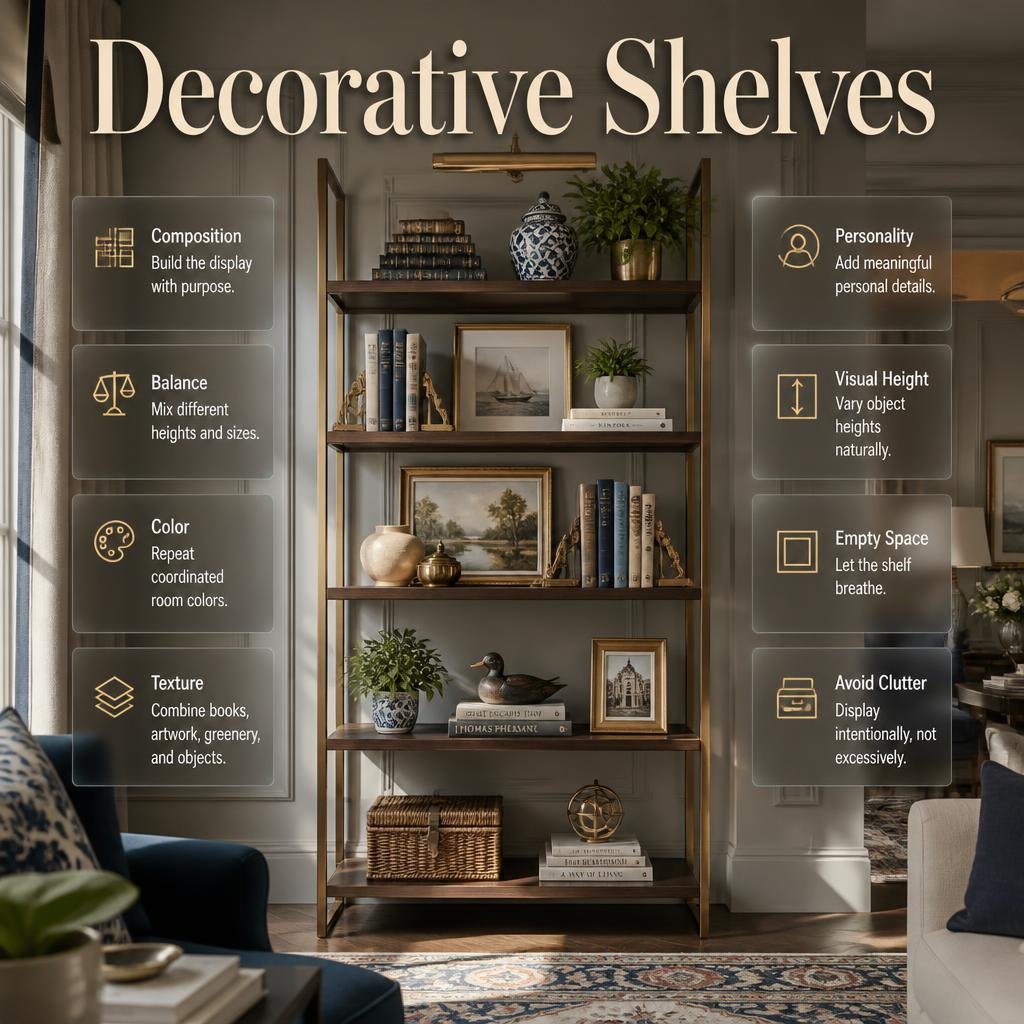
Shelves aren’t simply places to put objects. When they are planned properly, they become part of the room’s overall design. They can introduce height, color, texture, personality, artwork, books, greenery, and meaningful personal details without requiring a complete room makeover.
The challenge is knowing what belongs on the shelf, how much to display, how to combine different sizes, and how to make everything feel connected.
A shelf filled with beautiful objects can still look messy if every item competes for attention. Likewise, a nearly empty shelf can look unfinished when the pieces are too small for the available space.
The most effective approach is to think about composition rather than quantity.
Instead of asking, “What else can I put here?” ask:
“What does this shelf actually need?”
That small change in thinking can completely improve the result.
If you’re building a classic, colorful, cozy, or modern room, you can use shelving to reinforce the style instead of treating it as a separate decorating feature. For broader inspiration, explore Preppy Room, where different approaches to color, furniture, artwork, and room styling can be combined into one cohesive interior.
In this complete guide, you’ll learn how to choose decorative shelves, plan their purpose, combine books and artwork, use color, create balance, style different shelf types, avoid clutter, decorate small and large shelving units, and create a polished preppy-inspired display without making the room feel overdecorated.
What Are Decorative Shelves?
Decorative shelves are shelving surfaces that combine practical display or storage with an intentional visual role in a room.
They can be:
- Floating shelves
- Wall-mounted shelves
- Built-in shelves
- Freestanding bookcases
- Open shelving units
- Cube shelves
- Corner shelves
- Picture ledges
- Narrow display shelves
- Ladder-style shelving
- Shelves integrated into furniture
The difference between ordinary storage and decorative shelving is usually the way the space is used.
A storage shelf may be packed according to function.
A decorative shelf is usually arranged with more attention to:
- Proportion
- Color
- Height
- Texture
- Negative space
- Visual balance
- Personal meaning
- Relationship with surrounding furniture
This doesn’t mean decorative shelving has to be impractical.
In fact, the best displays often combine both purposes.
A shelf can hold books you actually read, a box that stores useful items, photographs you genuinely care about, and a few decorative pieces that complete the arrangement.
The result feels more authentic because the shelf isn’t simply designed to look good in a photograph.
It belongs to the room.
Why Are Decorative Shelves Important in Interior Design?
Decorative shelves are useful because they turn vertical space into an opportunity for both function and visual interest.
Large walls can sometimes feel empty even when the furniture underneath is well chosen. Shelves help connect the lower and upper parts of a room.
They can also introduce smaller decorative elements without requiring a large piece of furniture.
Shelves Add Vertical Interest
Most furniture sits relatively low in a room.
A sofa, bed, dresser, desk, console, and side table occupy the lower portion of the visual field.
Shelves draw attention upward.
A tall arrangement can make the wall feel more developed and give the room additional visual structure.
Shelves Display Personality
Your shelf can reveal something about the people who live in the room.
Books can show interests.
Photographs can represent memories.
Artwork can communicate taste.
Travel objects can tell stories.
Plants can introduce a connection to nature.
Small inherited or handmade objects can give the room character.
This is one reason personal objects often work better than generic accessories.
Shelves Are Easy to Change
Unlike large furniture, shelves can be restyled without completely changing the room.
You can replace:
- Artwork
- Books
- Plants
- Seasonal accessories
- Photographs
- Decorative objects
This makes shelving especially useful when you enjoy refreshing your room occasionally.
How Do You Choose the Right Decorative Shelves?
Before styling anything, consider the shelf itself.
The wrong size, depth, material, or location can make even excellent accessories look awkward.
Consider the Wall
Start by examining the wall where the shelf will go.
Ask:
- How much horizontal space is available?
- Is the wall narrow or wide?
- Are there doors, windows, switches, or furniture nearby?
- Does the wall already have artwork?
- Will the shelf compete with another focal point?
A shelf should work with the architecture rather than fight it.
Consider Depth
Deep shelves provide more room for layered displays.
You can place:
- Books behind smaller objects
- Artwork behind ceramics
- Plants beside baskets
- Decorative pieces in front of larger frames
Narrow shelves are better suited to:
- Small artwork
- Photographs
- Slim books
- Small plants
- Lightweight accessories
Avoid using oversized objects on a narrow shelf simply because you like them.
Scale matters.
Consider Material
Shelf material influences the room’s visual character.
Wood Shelves
Wood adds warmth and works well with:
- Traditional interiors
- Cozy rooms
- Classic preppy spaces
- Natural palettes
- Neutral rooms
White Shelves
White shelves create a lighter appearance and work particularly well with:
- Blue
- Navy
- Pink
- Green
- Cream
- Pastel palettes
Metal Shelves
Metal can create a more contemporary appearance.
It works well with:
- Modern interiors
- Minimal styling
- Industrial details
- Black-and-white palettes
Glass Shelves
Glass can make a display feel visually lighter, but it also requires careful editing because every object remains visible.
How Do You Plan Decorative Shelves Before Styling Them?
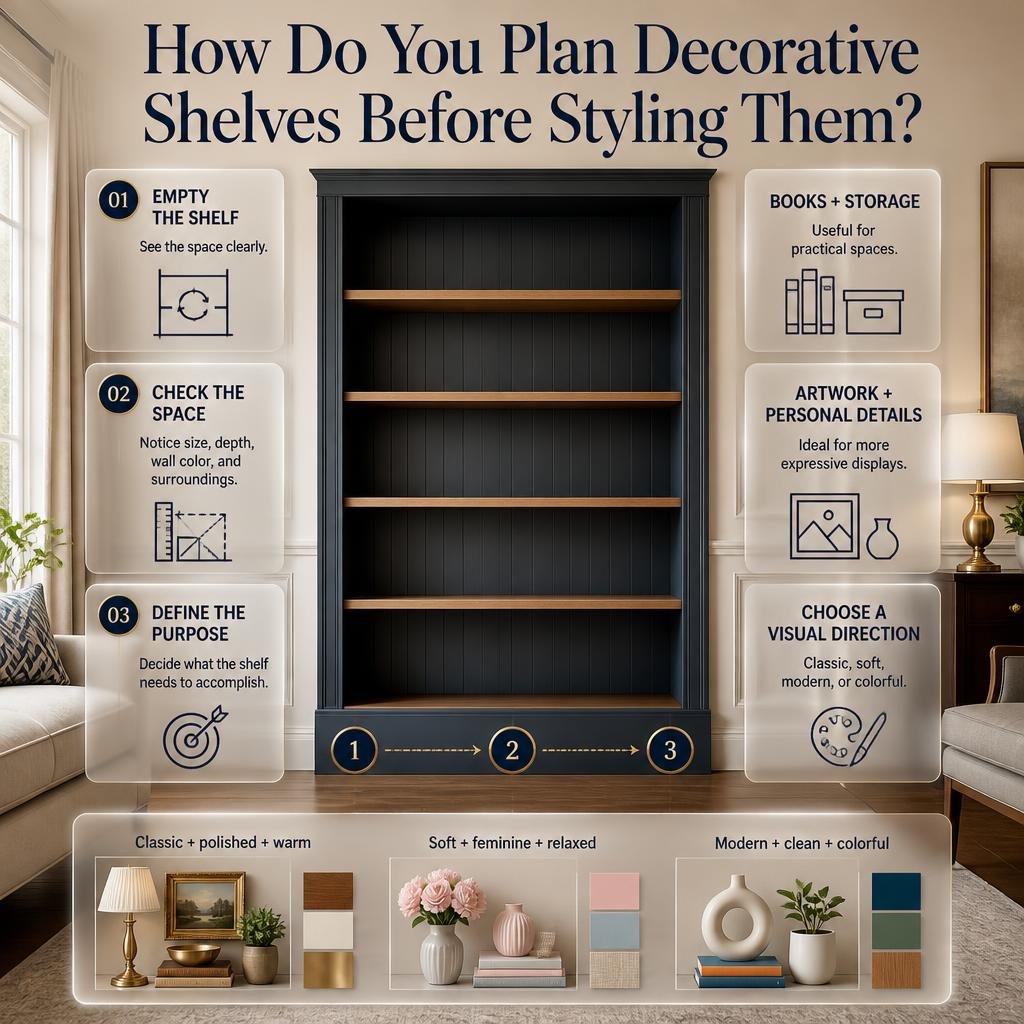
One of the easiest mistakes is starting to place objects immediately.
Instead, create a quick plan.
Step 1: Empty the Shelf
Remove everything.
This gives you a clear view of:
- Shelf size
- Wall color
- Depth
- Surrounding furniture
- Available negative space
Starting with a blank shelf is also recommended by professional styling guides because it lets you rebuild the arrangement intentionally rather than adjusting an existing mess.
Step 2: Decide the Purpose
Ask what you want the shelf to accomplish.
Is it mainly for:
- Books?
- Artwork?
- Storage?
- Personal objects?
- Plants?
- A mixture?
The answer changes the styling strategy.
A home office shelf may need more books and storage.
A bedroom shelf may focus more on artwork and personal details.
A living-room shelf may combine all of them.
Step 3: Choose a Visual Direction
You don’t need a strict theme.
Just choose a few words.
For example:
Classic + polished + warm
or:
Soft + feminine + relaxed
or:
Modern + clean + colorful
This simple direction helps prevent random purchases from taking over the display.
What Should You Put on Decorative Shelves?
There is no universal list, but certain objects are especially useful because they provide different shapes, heights, and textures.
Books
Books are one of the most useful shelf-styling elements.
They provide:
- Height
- Color
- Texture
- Structure
- Personality
You can arrange books vertically or horizontally.
Vertical books create height.
Horizontal stacks create platforms.
Combining both creates visual variation.
For a more personal display, use books you actually enjoy rather than selecting books only because their covers match the room.
Framed Artwork
Artwork can act as an anchor.
A medium-sized frame placed toward the back of a shelf can create depth.
You can layer a smaller object in front of it.
This creates a simple visual relationship:
Artwork → books → small accessory
For additional artwork ideas, explore Framed Artwork.
For a timeless and collected look, explore Classic Illustrations to discover artwork ideas that can add traditional character, detail, and visual interest to your preppy room.
Decorative Prints
Prints can introduce:
- Pattern
- Illustration
- Typography
- Botanical details
- Color
- Historical or artistic references
They are especially useful when a shelf needs visual interest but doesn’t have enough space for large artwork.
You can explore Decorative Prints for another way to incorporate art into a room.
Personal Photographs
Personal photographs prevent shelving from feeling overly staged.
A single meaningful photograph can have more emotional value than several generic decorative objects.
For more ideas about incorporating personal memories into a room, see Personal Photographs.
Plants
Plants soften the hard lines of shelving.
They can also add natural color and organic shapes.
Consider:
- Small leafy plants
- Trailing plants
- Compact potted plants
- Dried branches
- Seasonal greenery
Don’t put a plant on every shelf.
One or two strategically placed plants are often enough.
Ceramics
Ceramic objects work particularly well because they introduce shape and texture.
Try:
- Small vases
- Bowls
- Sculptural forms
- Decorative dishes
- Handmade pieces
A handmade object can make the shelf feel more collected and less like a showroom.
Decorative Boxes and Baskets
These are particularly useful when the shelf needs to combine beauty with storage.
They can hide:
- Cables
- Small accessories
- Stationery
- Remote controls
- Personal items
This is an excellent solution for rooms where shelving needs to remain practical.
How Do You Make Decorative Shelves Look Balanced?
Balance is one of the most important principles in shelf styling.
It does not mean that both sides have to look identical.
Instead, it means that the visual weight feels reasonably distributed.
A large dark vase may visually carry more weight than three tiny pale objects.
Likewise, a large framed artwork may dominate more than several small books.
Professional styling guidance commonly recommends placing the largest pieces first, then adding medium and small pieces around them.
A useful sequence is:
Large → Medium → Small
For example:
- Large frame
- Stack of books
- Small ceramic object
Or:
- Large plant
- Medium basket
- Small photograph
This creates a visual hierarchy.
What Is the Triangle Method for Shelf Styling?
The triangle method is a simple way of distributing similar visual elements across a shelving display.
The idea is to place related colors, shapes, or heights at different points so the eye naturally moves around the arrangement.
For example, imagine three navy elements:
- Navy books on the bottom shelf
- Navy artwork on the middle shelf
- Small navy accessory on the top shelf
Instead of appearing as three unrelated objects, the repeated color creates a visual connection.
Recent design guidance also describes using varying heights and groups of three to create visual triangles and prevent shelving from becoming overly symmetrical.
You don’t need to follow this as a rigid rule.
Use it as a framework.
If an arrangement already looks balanced without three repeated elements, don’t add another object just to satisfy a formula.
How Do You Use Empty Space on Decorative Shelves?
Empty space is not wasted space.
It gives decorative objects room to be noticed.
If every shelf is completely filled, the viewer’s eye has nowhere to rest.
This can make even beautiful objects feel unimportant.
Instead, allow some areas to remain open.
For example:
Shelf 1: Large artwork + books
Shelf 2: Plant + ceramic bowl
Shelf 3: Photograph + open space
Shelf 4: Books + decorative box
The amount of empty space should depend on your preferred style.
Minimal interiors generally need more open space.
Traditional or collected interiors can tolerate more objects.
But even maximalist shelving benefits from intentional organization.
How Do You Use Books on Decorative Shelves?
Books are one of the easiest ways to build a shelf arrangement.
Vertical Books
Vertical books create a traditional bookcase appearance.
They work well when you need:
- Height
- Structure
- A strong visual block
You can use bookends to keep them organized.
Horizontal Books
Horizontal stacks create layers.
A small plant or decorative object can sit on top.
For example:
3 books + small ceramic vase
This turns the books into a display platform.
Mixed Book Arrangements
Instead of placing every book in exactly the same orientation, alternate between:
- Vertical groups
- Horizontal stacks
- Small leaning groups
This creates rhythm.
Contemporary shelf-styling advice frequently recommends mixing vertical and horizontal books rather than arranging every book identically.
Should You Arrange Books by Color?
You can, but you don’t have to.
Color-coordinated books can create a polished appearance, especially when the room has a strong palette.
For example:
Navy + Cream Room
Use:
- Navy book spines
- Cream covers
- Natural wood
- Brass accents
Green + Cream Room
Use:
- Green books
- Botanical artwork
- Cream ceramics
- Natural materials
Explore Green and Cream Preppy Room Ideas for broader inspiration.
However, arranging books entirely by color can sometimes make the shelf feel artificial.
If you prefer a more personal appearance, let the books remain mixed.
The best approach depends on the atmosphere you’re trying to create.
How Do You Use Artwork on Decorative Shelves?
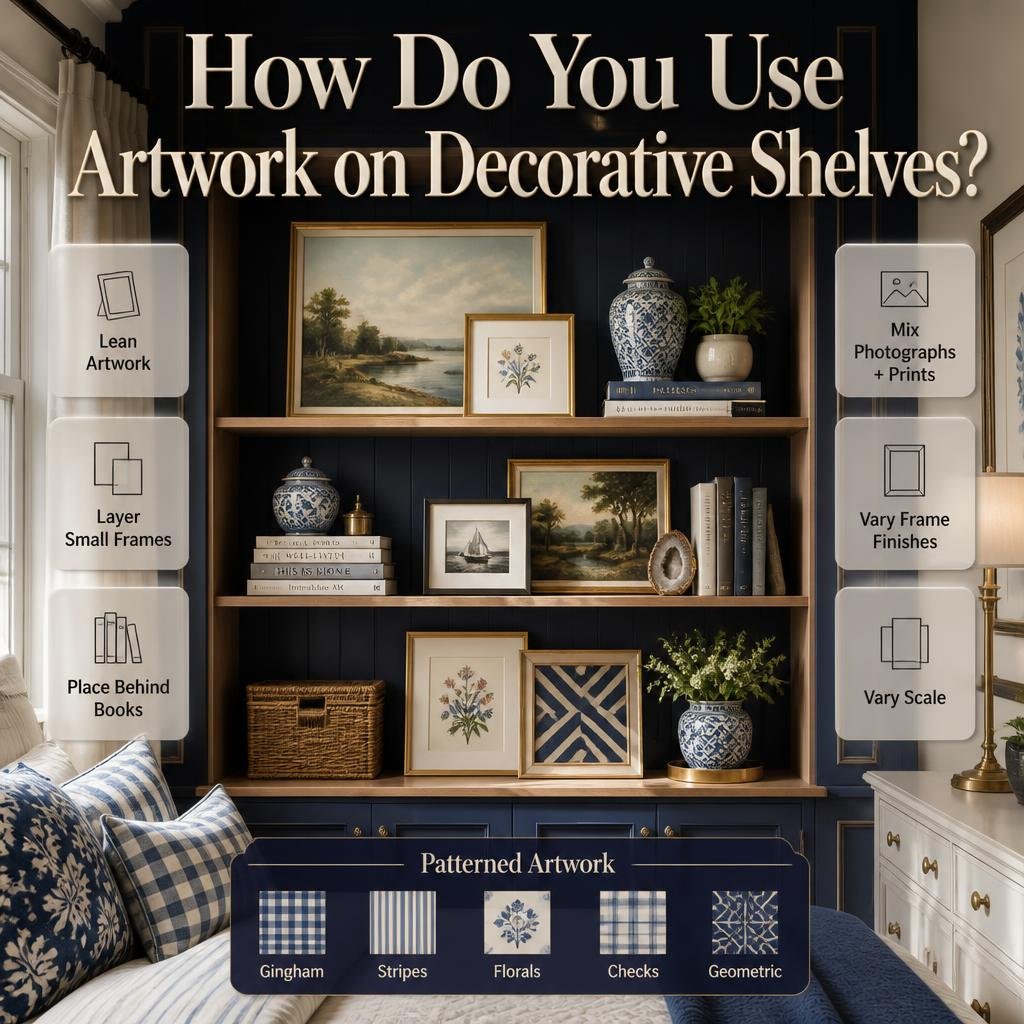
Artwork gives shelving a focal point.
You can:
- Lean artwork against the wall
- Layer a small frame in front
- Place artwork behind books
- Combine photographs with prints
- Mix different frame finishes
Avoid placing every frame at exactly the same height.
Varying scale makes the display more relaxed.
If you’re using multiple pieces of artwork around the room, shelving can become part of the larger visual story.
For a more extensive wall arrangement, explore Gallery Walls.
Decorative Shelves With Patterned Wall Art
Patterned artwork can work particularly well in rooms that already use textiles such as:
- Gingham
- Stripes
- Florals
- Checks
- Geometric patterns
The important thing is not to introduce every pattern at full strength.
If the bedding already has a strong pattern, the shelf artwork can be simpler.
If the room is mostly plain, patterned artwork can provide a small focal point.
For additional inspiration, see Patterned Wall Art.
How Do You Add Personal Objects Without Creating Clutter?
Personal objects are often the most valuable items on a shelf, but they can also become difficult to organize because they tend to accumulate.
Instead of displaying everything, select pieces with genuine meaning.
Examples include:
- A family photograph
- A small travel souvenir
- A handmade ceramic
- A childhood keepsake
- A meaningful book
- A small inherited object
Then give each item enough surrounding space.
A shelf doesn’t need to tell your entire life story.
One or two personal objects can make the entire arrangement feel more authentic.
How Do You Use Plants on Decorative Shelves?
Plants are useful because they introduce a shape that is completely different from books and frames.
Books are rectangular.
Frames are rectangular.
Shelves are horizontal.
Plants provide curves and organic movement.
However, don’t turn every shelf into a plant display.
A better strategy is to distribute greenery.
For example:
Top: Small trailing plant
Middle: No plant
Bottom: Compact upright plant
This creates repetition without becoming excessive.
When using real plants, consider:
- Available light
- Watering needs
- Pot drainage
- Shelf material
- Weight
- Moisture protection
Use a tray or waterproof container where necessary.
How Do You Use Decorative Shelves in a Preppy Room?
Preppy interiors can work beautifully with decorative shelving because the style often combines classic furniture, coordinated colors, books, artwork, traditional details, and personal accessories.
A preppy shelf might include:
- Navy books
- Cream ceramics
- Brass frames
- Botanical artwork
- Greenery
- Personal photographs
- Classic accessories
The key is coordination.
If you’re developing a traditional look, Classic Preppy Room can provide a useful stylistic foundation.
If you prefer cleaner lines and fewer accessories, explore Modern Preppy Room.
Decorative Shelves for Classic Preppy Style
Classic preppy shelving benefits from structure.
Consider:
- Traditional frames
- Navy and cream
- Wood
- Brass
- Books
- Botanical prints
- Traditional ceramics
You can use symmetry in some areas while allowing other shelves to remain asymmetrical.
The result should feel collected rather than perfectly manufactured.
Decorative Shelves for Modern Preppy Style
Modern preppy styling usually benefits from fewer, stronger objects.
Try:
- One large frame
- A clean stack of books
- A simple ceramic
- A small plant
- Minimal decorative accessories
Avoid filling every shelf.
A modern room often looks stronger when the accessories are allowed to breathe.
Decorative Shelves for Cute Preppy Rooms
Cute preppy rooms can use shelving to introduce personality.
Consider:
- Soft pink
- Light blue
- White
- Small photographs
- Playful artwork
- Small decorative objects
- Mini plants
Explore Cute Preppy Room and Cute Preppy Room Ideas for broader styling inspiration.
If the palette includes pink, Pink Preppy Room and Pink Preppy Room Ideas can help connect shelf colors with the wider room.
For a softer, more aesthetic direction, see Aesthetic Pink Preppy Room.
Decorative Shelves for Cozy Preppy Rooms
Cozy shelving should feel warm rather than formal.
Use:
- Books
- Warm wood
- Soft colors
- Small plants
- Personal photographs
- Ceramic objects
- Woven textures
A cozy room benefits from tactile materials.
Explore Cozy Preppy Room when building the larger room around this approach.
Decorative Shelves for Minimal Preppy Rooms
Minimal preppy styling requires discipline.
You don’t need to use every decorative object you own.
A shelf might contain:
Three books + one frame + one plant
That’s enough.
The goal is to make every object count.
See Minimal Preppy Room for a cleaner interpretation of preppy design.
How Do You Use Color on Decorative Shelves?
Color should connect the shelf to the room.
Instead of introducing five new colors, repeat colors that already exist.
For example, if the room includes navy bedding, you can repeat navy through:
- Books
- Artwork
- A small ceramic
- A frame
This creates continuity.
Navy and White
Navy and white is a classic combination.
Use:
- Navy books
- White ceramics
- Brass accents
- Natural wood
See Navy and White Preppy Room Ideas.
Blue and Cream
Blue and cream creates a softer atmosphere.
Use:
- Pale blue artwork
- Cream ceramics
- Natural wood
- Brass
- White books
See Blue and Cream Preppy Room.
Pink and White
Pink and white can be used through small accents rather than making every shelf pink.
Try:
- Pink artwork
- White ceramics
- Pale books
- Small floral elements
Explore Pink and White Preppy Room Ideas.
Green and Navy
Green and navy create a richer traditional palette.
Use:
- Greenery
- Navy books
- Botanical prints
- Brass
- Cream
See Green and Navy Preppy Room Ideas.
Light Blue and White
This combination works especially well in bright rooms.
Use:
- Light blue books
- White frames
- Pale ceramics
- Soft greenery
Explore Light Blue and White.
Red and Navy
Red can act as an accent rather than the dominant color.
For example:
- Navy books
- Cream frame
- Small red object
- Brass accessory
See Red and Navy Preppy Room Ideas.
Neutral and Classic Tones
If you want a quieter shelf, combine:
- Cream
- Beige
- White
- Warm wood
- Soft brown
- Brass
Explore Neutral and Classic Tones.
Multicolor Preppy Palettes
A multicolor room can still have coordinated shelving.
The trick is repetition.
Don’t put every color on every shelf.
Instead, distribute colors across the entire display.
See Multicolor Preppy Palettes for a broader approach.
How Do You Style Decorative Shelves Above Furniture?
The furniture below the shelf matters.
A shelf above a dresser should relate to the dresser.
A shelf above a desk should support the working environment.
A shelf above a console can act as part of an entryway composition.
Look at the entire vertical area.
For example:
Artwork / Shelf
↓
Decorative objects
↓
Furniture
The three areas should feel connected.
Avoid placing an extremely heavy shelf above delicate furniture.
Likewise, don’t use tiny accessories above an oversized console because they may disappear visually.
If you want to give your room more visual character without changing the entire space, explore these accent wall details for practical ideas on using color, patterns, artwork, paneling, and decorative elements to create a well-balanced focal point.
How Do You Style Decorative Shelves in a Bedroom?
Bedroom shelves should generally support a calm atmosphere.
Useful items include:
- Books
- Small artwork
- Photographs
- Small plants
- Decorative ceramics
- Soft-colored objects
- Small storage boxes
If the shelf is near the bed, avoid creating an arrangement that feels visually aggressive or overly busy.
A bedroom shelf can be quieter than a living-room display.
For broader bedroom styling, explore Preppy Room Bedroom and Preppy Room Bedroom Decor.
You can also connect the shelving to the wider furniture arrangement through Preppy Room Furniture.
How Do You Style Decorative Shelves in a Small Bedroom?
Small bedrooms require restraint.
Use:
- One main artwork
- A small stack of books
- One plant
- One personal item
Avoid:
- Large baskets
- Oversized sculptures
- Too many frames
- Heavy dark objects
- Multiple competing colors
The purpose is to make the room feel more organized, not more crowded.
If you’re redesigning the whole space, Preppy Room Makeover can help you think beyond the shelf itself.
How Do You Style Decorative Shelves in a Living Room?
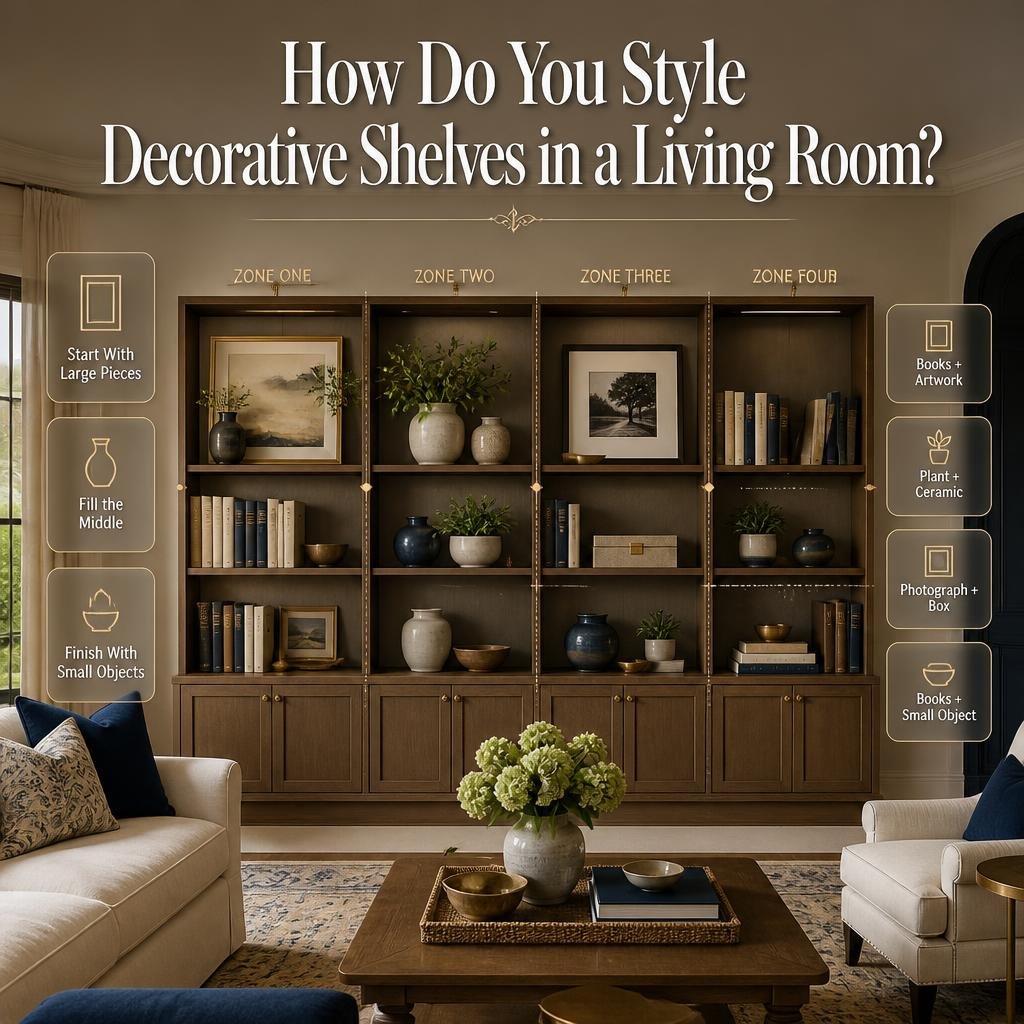
Living-room shelving can carry more visual weight because the room is usually larger.
You can combine:
- Books
- Artwork
- Plants
- Ceramics
- Photographs
- Baskets
- Decorative objects
Start with large pieces.
Then fill in the middle.
Finish with small objects.
This is much easier than starting with tiny accessories and trying to build the shelf outward.
How Do You Style Long Decorative Shelves?
Long shelves should be divided into visual zones.
Imagine the shelf as three or four separate areas.
Zone One
Books + artwork
Zone Two
Plant + ceramic
Zone Three
Photograph + decorative box
Zone Four
Books + small object
The zones shouldn’t all look identical.
Instead, repeat colors or materials throughout.
This creates unity without repetition.
How Do You Style Multiple Shelves?
Multiple shelves require attention to the entire unit rather than each shelf individually.
A common mistake is making every shelf look perfect by itself.
When viewed together, the result may become too symmetrical.
Instead:
- Put a tall object on one shelf
- Use horizontal books on another
- Place artwork on another
- Leave one area relatively open
- Repeat colors throughout
Think of the entire shelving unit as one composition.
How Do You Decorate Floating Shelves?
Floating shelves usually have a lighter visual appearance than large bookcases.
Because they are often narrower, keep accessories appropriately scaled.
A useful arrangement might be:
Frame + books + small plant
or:
Small vase + photograph + decorative object
Avoid placing too many tiny objects side by side.
Three strong objects can look more intentional than eight small ones.
How Do You Decorate Corner Shelves?
Corner shelves can solve an awkward wall problem.
Because corners naturally create a visual boundary, use objects that don’t make the space feel cramped.
Good options include:
- Small plants
- Narrow frames
- Small books
- Ceramics
- Decorative boxes
Keep the tallest pieces toward the back or outer area where appropriate, depending on the shelf shape.
How Do You Use Mirrors With Decorative Shelves?
Mirrors can add reflection and help a wall arrangement feel more open.
A small mirror can be paired with:
- Books
- Plants
- Ceramics
- Artwork
- Personal photographs
Avoid placing too many reflective pieces together.
If you’re interested in using mirrors elsewhere in the room, explore Mirrors.
Can Decorative Shelves Replace Wall Art?
Sometimes.
Shelving can become a wall feature in its own right.
A well-styled shelf can provide:
- Color
- Texture
- Artwork
- Vertical interest
- Personal details
However, shelving and wall art create different visual effects.
A large painting creates a strong single focal point.
Shelves create a layered focal area.
You can also combine them.
For example, hang one large piece of artwork above a low shelf and use the shelf for smaller supporting objects.
How Do You Use Decorative Shelves With Gallery Walls?
Shelves and gallery walls can work together when their visual weight is carefully managed.
Don’t create a gallery wall immediately beside an extremely busy shelving unit unless the rest of the room is calm.
Instead, repeat one or two elements.
For example:
- Same frame color
- Same accent color
- Similar artwork style
This helps the wall feel intentional.
Explore Gallery Walls for additional ways to organize artwork.
How Do You Make Decorative Shelves Look Expensive?
You don’t necessarily need expensive accessories.
A polished shelf usually comes from:
- Good proportion
- Fewer unnecessary objects
- Consistent colors
- Varied textures
- Meaningful accessories
- Good spacing
- Strong focal pieces
Mixing materials can also make the arrangement feel richer.
Try combining:
Wood + ceramic + glass + metal + greenery
The contrast between materials adds depth.
Recent interior-design guidance also emphasizes mixing textures and materials while preserving negative space instead of relying on a large number of accessories.
What Are the Most Common Decorative Shelf Mistakes?
Mistake 1: Filling Every Inch
This happens because empty space can initially feel unfinished.
But once every gap is filled, the shelf loses breathing room.
Solution: Remove 10–20% of the objects and reassess.
Mistake 2: Using Too Many Tiny Objects
Small objects are difficult to organize.
Individually they may look attractive, but together they can create visual noise.
Solution: Replace several tiny objects with one stronger accessory.
Mistake 3: Making Every Shelf Identical
Identical arrangements can feel mechanical.
Solution: Repeat colors and materials instead of exact layouts.
Mistake 4: Ignoring Scale
A small frame can disappear on a huge shelf.
A huge vase can overwhelm a narrow shelf.
Solution: Consider the size of the shelf, furniture, wall, and room together.
Mistake 5: Using Too Many Colors
Every new color introduces another visual relationship.
Solution: Start with the room’s existing palette.
Mistake 6: Buying Decor Before Planning
This is an expensive mistake.
People often buy attractive objects individually without thinking about how they will work together.
Solution: Measure the shelf first and identify what you already own.
Mistake 7: Copying Pinterest or Instagram Arrangements Exactly
A display that works in a large, bright room may not work in your bedroom.
Solution: Borrow principles, not exact arrangements.
Mistake 8: Ignoring Practical Function
A shelf can look beautiful but become annoying if you can’t reach the things you actually use.
Solution: Keep frequently used objects accessible and place decorative pieces around them.
How Do You Style Decorative Shelves Without Making Them Look Cluttered?
Start with fewer pieces.
This is the easiest rule.
Then build gradually.
Use the Three-Level Approach
For each visual area, try:
Tall object
Medium object
Small object
For example:
Tall frame + books + small ceramic
or:
Tall plant + basket + photograph
The difference in height gives the arrangement structure.
Leave Breathing Room
Don’t treat every empty area as a problem.
Repeat Colors
If three areas contain one repeated color, the display feels connected.
Mix Textures
Use:
- Paper
- Wood
- Ceramic
- Glass
- Metal
- Woven materials
- Plants
Texture adds depth without requiring more color.
How Do You Create a Decorative Shelf That Feels Personal?
A personal shelf doesn’t need to be full of sentimental objects.
Instead, choose a few meaningful pieces.
For example:
Books you love
One family photograph
A travel object
One plant
A piece of artwork
This combination feels lived-in because every item has a reason to exist.
You can connect this approach to Preppy Room Inspo and Preppy Room Aesthetic if you’re building a broader visual direction around the room.
How Do You Use Decorative Shelves With LED Lighting?
LED lighting can add atmosphere, particularly in bedrooms and modern spaces.
However, lighting should support the shelf rather than overwhelm it.
You can use subtle lighting to highlight:
- Artwork
- Books
- Decorative objects
- Plants
If the room already uses LED lighting, coordinate the shelf display with the wider lighting concept.
For a broader room direction, see Preppy Room With LED Lights.
Avoid making the shelf lighting the only visual feature.
How Do You Style Decorative Shelves for Girls’ Rooms?
For a softer preppy room, shelving can combine:
- Pink
- White
- Light blue
- Cream
- Floral artwork
- Personal photographs
- Small decorative objects
The important point is not to make every item equally feminine or colorful.
Use a few accents and allow neutral pieces to balance them.
You can explore Preppy Room Decor for Girls for broader room ideas.
Can You DIY Decorative Shelves?
Yes.
A simple DIY approach can involve:
- Basic wooden shelves
- Brackets
- Paint
- Decorative edging
- Small framed artwork
- Personal objects
If you’re planning a larger DIY project, DIY Preppy Room Decor offers a useful direction for coordinating handmade details with the rest of the room.
The key is to ensure the shelf is properly installed and suitable for the intended load.
A decorative shelf should never be overloaded simply because there is available space.
How Do You Organize Decorative Shelves for Everyday Use?
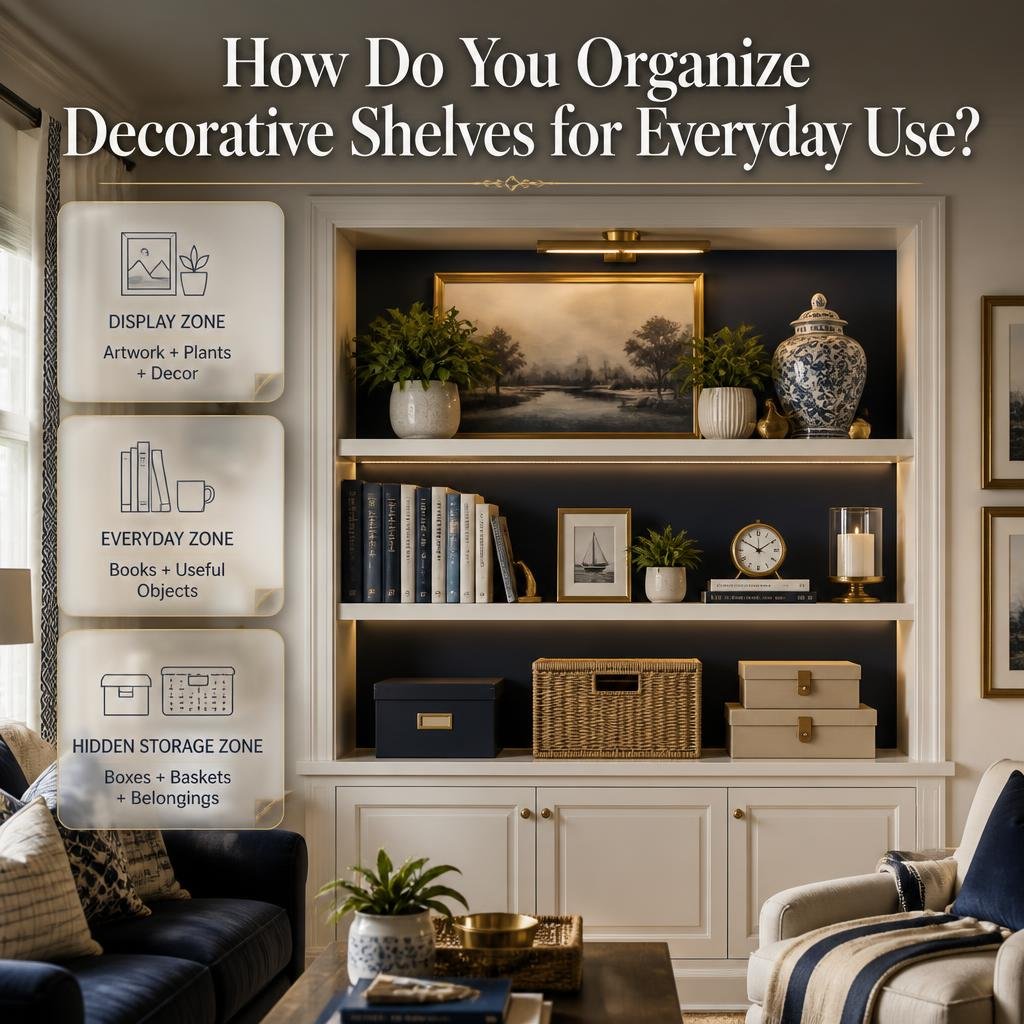
If the shelf is also storage, divide the items into categories.
For example:
Display Zone
Artwork + plants + decorative pieces
Everyday Zone
Books + frequently used objects
Hidden Storage Zone
Boxes + baskets + small belongings
This keeps the shelf attractive without sacrificing usefulness.
A shelf doesn’t have to be purely decorative to look polished.
How Do You Refresh Decorative Shelves Without Buying New Decor?
You can completely change the appearance by rearranging what you already own.
Try these changes:
Change Book Orientation
Move vertical books into horizontal stacks.
Swap Artwork
Move a frame from one shelf to another.
Change Plant Position
A plant can become the anchor on a different shelf.
Remove Accessories
Sometimes the best refresh is simply removing three objects.
Group Similar Materials
Put ceramics together.
Put books together.
Move metallic accents to different areas.
Rotate Personal Objects
Keep some pieces stored and bring them back later.
This prevents the room from feeling visually static.
How Often Should You Restyle Decorative Shelves?
There is no required schedule.
Restyle when:
- The arrangement feels cluttered
- The room’s colors change
- You acquire new artwork
- Seasonal decorations arrive
- You want a different atmosphere
- The shelf no longer serves its practical purpose
You don’t need to constantly change your room.
A good arrangement should be able to remain attractive for a long time.
What Should You Put on Decorative Shelves?
The best decorative shelves combine a few different types of items rather than displaying one category repeatedly. Books, framed artwork, small plants, personal photographs, ceramics, decorative boxes, and meaningful accessories are all useful because they provide different heights, textures, and visual weight.
Start with one larger item as the focal point, then build around it with medium-sized pieces and smaller accessories. For example, a framed print can sit behind a small stack of books, while a ceramic vase or plant adds texture beside it. This creates depth without making the shelf feel overcrowded.
The most important consideration is whether each item contributes something useful to the arrangement. A shelf doesn’t need to contain every decorative object you own. A smaller collection of well-chosen pieces usually looks more intentional than a large number of unrelated accessories.
Useful points:
Start with one large anchor piece.
Mix books, artwork, plants, and decorative objects.
Include one or two personal items for character.
Repeat colors already used in the room.
Leave some open space between groups.
Remove objects that don’t add function or visual value.
How Do You Style Decorative Shelves Without Making Them Look Cluttered?
The easiest way to prevent decorative shelves from looking cluttered is to focus on visual balance rather than filling every available space. Begin with fewer objects than you think you need, then gradually add pieces while keeping enough empty space around the main items.
Varying height is particularly important. A tall frame, medium stack of books, and small ceramic object will usually look more interesting than three objects of exactly the same size. You can also create small groups instead of spreading individual objects evenly across the entire shelf.
Color control makes an equally important difference. If the room already uses navy, cream, green, or pink, repeat those colors through a few shelf accessories rather than introducing many unrelated shades.
Useful points:
Don’t fill every shelf completely.
Combine tall, medium, and small objects.
Create small visual groups.
Use a limited color palette.
Mix textures instead of adding more objects.
Step back and look at the shelf from across the room.
Remove one or two pieces if the display feels busy.
How Do You Make Decorative Shelves Look Stylish and Professionally Designed?
A professionally styled shelf usually depends more on proportion, repetition, and editing than on expensive decorations. Start by choosing one or two strong focal pieces, then add books, artwork, plants, or smaller accessories that support those pieces instead of competing with them.
A useful approach is to create visual repetition throughout the shelving unit. For example, navy books on one shelf, a navy frame on another, and a small navy accessory elsewhere can make the entire display feel connected. The objects don’t need to match exactly; they simply need to share a visual relationship.
Texture is another important element. Combining wood, ceramic, glass, metal, paper, and greenery prevents the arrangement from looking flat. The result feels more collected because different materials interact with each other.
Useful points:
Establish a clear focal point.
Use different heights and shapes.
Repeat selected colors across the shelves.
Combine several textures and materials.
Mix vertical and horizontal books.
Layer artwork behind smaller objects.
Keep some negative space visible.
Edit the arrangement instead of continually adding more decor.
How Do You Decorate Shelves in a Preppy Room?
Decorative shelves work especially well in a preppy room because they provide space for classic accessories, books, artwork, greenery, photographs, and coordinated colors. The best approach is to connect the shelf with the room’s existing palette rather than creating an entirely separate color scheme.
For a classic preppy look, navy, white, cream, wood, brass, botanical artwork, and traditional accessories can create a polished foundation. A more modern preppy room can use fewer objects, cleaner frames, neutral books, simple ceramics, and carefully positioned greenery.
You can also adapt the shelf according to the room’s color direction. Navy and white create a classic appearance, blue and cream feel softer, while green and navy can provide a richer traditional combination. Pink and white can work well when you want a softer or more feminine accent without making the entire shelf pink.
Useful points:
Repeat colors already present in the room.
Use books and framed artwork for a classic foundation.
Add brass or wood for traditional warmth.
Use greenery to introduce natural texture.
Keep patterns controlled when the room already has patterned bedding.
Match shelf styling with the wider room rather than treating it separately.
Use personal photographs to make the display feel lived-in.
How Many Items Should You Put on Decorative Shelves?
There isn’t a universal number of items that works for every shelf. The right amount depends on the shelf’s width, depth, height, the size of the objects, and the overall style of the room. A small floating shelf may look complete with three carefully selected pieces, while a large bookcase can accommodate several different groups.
Instead of counting individual objects, think about visual groupings. One group might contain books and a small accessory, while another could combine artwork with a plant. This makes a large shelf easier to organize and prevents the arrangement from looking like a row of unrelated objects.
The most useful test is to step away from the shelf after styling it. If you can clearly identify the main pieces and there is still visible breathing room, the amount is probably appropriate. If everything seems to compete for attention, remove something before adding anything else.
Useful points:
Don’t use a fixed number as a strict rule.
Consider the shelf’s size and depth.
Think in visual groups rather than individual objects.
Start with large pieces before adding smaller accessories.
Leave intentional empty space.
Remove unnecessary items when the shelf feels crowded.
Let the room’s overall style determine how full the shelves should be.
Conclusion
Decorative shelves are one of the simplest ways to add personality, structure, and visual interest to a room without making the space feel overly decorated. The key is not to fill every available shelf with accessories, but to create a thoughtful arrangement where books, artwork, plants, photographs, decorative objects, and meaningful personal pieces work together.
A successful shelf display should feel connected to the rest of the room. Consider the existing color palette, furniture style, wall space, lighting, and overall atmosphere before choosing your decorative pieces. In a preppy room, classic details such as framed artwork, books, patterned accents, personal photographs, brass-inspired details, and coordinated colors can create a polished yet welcoming look.
Most importantly, give your shelves room to breathe. Vary the height and size of objects, create visual layers, repeat a few colors, and leave intentional empty space between groups. These simple decisions can make even an ordinary shelf look more balanced and professionally styled.
Whether your preference is classic, modern, cute, cozy, or minimal, decorative shelves can be adapted to suit your personality and the way you use your space. Start with a few pieces you genuinely like, arrange them with purpose, and make small adjustments until the display feels natural.
The best decorative shelves are not simply filled shelves—they are carefully arranged spaces that tell something about the room and the person who lives in it.