Introduction
Minimal Preppy Room Ideas | Creating a preppy room can be surprisingly difficult when you love classic patterns, beautiful colors, cozy textures, and decorative details but don’t want the space to feel crowded. It’s easy to add another striped pillow, another framed print, another accessory, and eventually realize that the room no longer feels calm or organized.
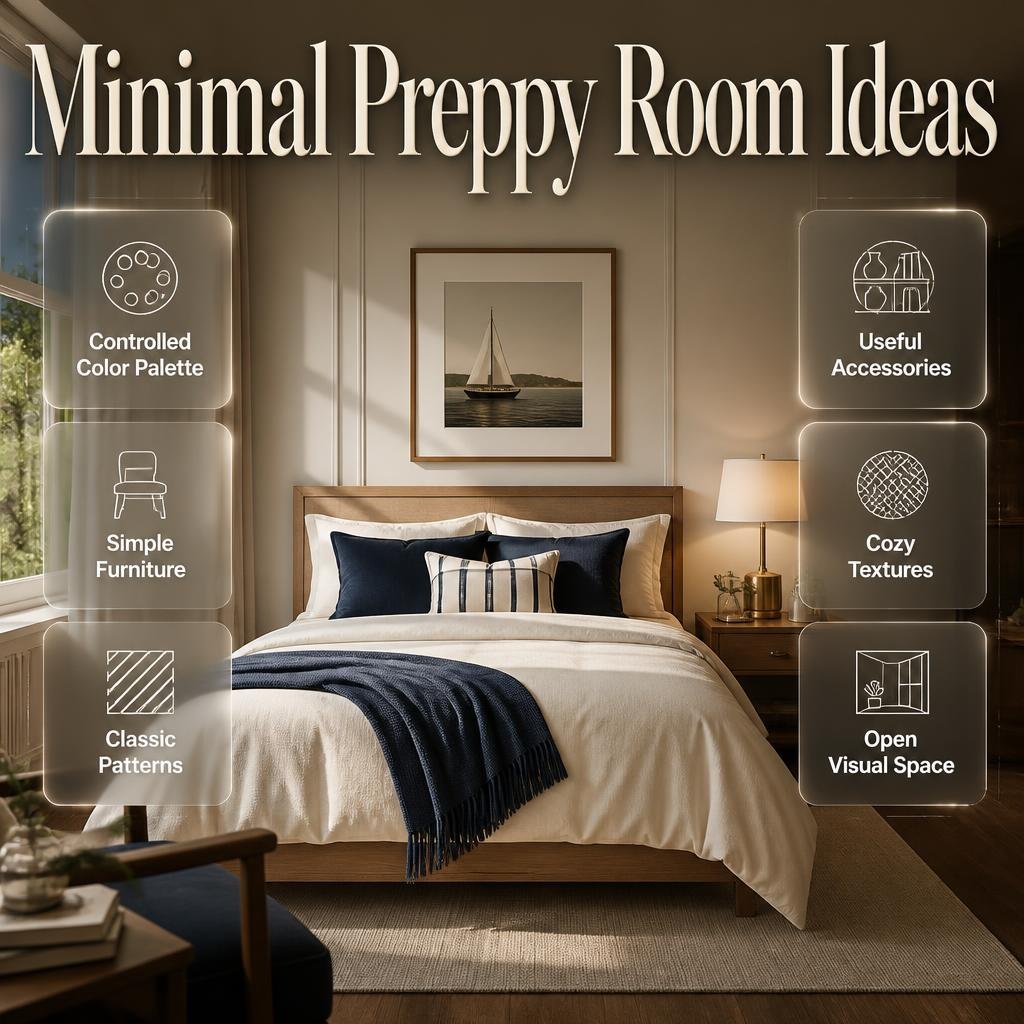
That’s where minimal preppy room ideas become especially useful. This approach keeps the recognizable personality of preppy design while removing unnecessary visual noise. Instead of decorating every surface, you focus on a controlled color palette, simple furniture, one or two classic patterns, useful accessories, and enough empty space for the room to breathe.
If you’re looking for a broader starting point, the Preppy Room homepage brings together different directions of the style, including classic, modern, cute, cozy, and minimal approaches.
In this guide, you’ll learn how to create a minimal preppy room from the beginning, choose colors, select furniture, style bedding, use patterns, decorate walls, organize small spaces, create a study area, add warmth, decorate on a budget, and avoid the mistakes that commonly make minimalist rooms feel either boring or cluttered.
What Is a Minimal Preppy Room?
A minimal preppy room combines the classic character of preppy interior design with the simplicity, organization, and restraint associated with minimalist decorating.
Traditional preppy interiors often use recognizable elements such as navy, white, cream, stripes, plaid, gingham, floral patterns, polished furniture, brass details, natural wood, and layered textiles. A minimalist interpretation doesn’t eliminate these characteristics. Instead, it uses fewer of them and gives each one more visual importance.
The result should feel:
- Clean
- Coordinated
- Comfortable
- Classic
- Organized
- Personal
- Visually balanced
The key difference is editing.
A heavily decorated preppy room might use several patterns, multiple accent colors, numerous accessories, and large collections of artwork. A minimal preppy room might use the same design language with just one striped textile, one accent color, a simple piece of artwork, and a few carefully selected accessories.
That doesn’t make the room less preppy.
It makes the individual design choices easier to notice.
What Makes a Room Look Preppy?
There isn’t one specific object that automatically makes a room preppy. The style usually comes from the relationship between colors, patterns, furniture, materials, and accessories.
Common preppy characteristics include:
- Navy and white combinations
- Stripes
- Plaid
- Gingham
- Botanical prints
- Classic floral patterns
- Traditional furniture
- Natural wood
- Brass accents
- Framed artwork
- Tailored textiles
- Layered bedding
- Organized decorative accessories
However, you don’t need all of these.
For example, a room with warm white walls, a navy upholstered bed, striped bedding, natural wood, one brass lamp, and a framed botanical print can already communicate a strong preppy identity.
The secret is coordination rather than quantity.
Why Choose a Minimal Preppy Style?
Minimal preppy design is useful for people who enjoy traditional or classic interiors but don’t want their room to feel overly formal or decorated.
It also works particularly well in bedrooms, dorm rooms, apartments, study rooms, and smaller spaces where excessive furniture and accessories can quickly become overwhelming.
A minimalist approach can make it easier to:
- Keep the room organized
- Clean surfaces quickly
- Change accent colors later
- Highlight favorite furniture
- Display meaningful accessories
- Maintain a cohesive color scheme
- Make smaller rooms feel more open
- Avoid unnecessary purchases
The style also gives you more flexibility.
Suppose you start with a cream, navy, and natural wood foundation. A few months later, you might introduce sage, dusty blue, or burgundy without replacing all your furniture.
A strong neutral foundation allows the room to evolve.
How Do You Start a Minimal Preppy Room?
The easiest way to create this style is to work from large elements toward small details.
Don’t begin by buying decorative accessories.
Start with the structure of the room.
Step 1: Understand the Space
Before choosing anything, look at the room itself.
Consider:
- Room dimensions
- Window locations
- Door placement
- Natural light
- Existing furniture
- Storage
- Floor space
- Wall space
- Electrical outlets
- Walking paths
A beautiful piece of furniture isn’t useful if it makes the room difficult to move through.
Professional-looking interiors depend heavily on proportion.
Step 2: Choose Your Color Direction
Decide whether you want the room to feel:
- Classic
- Soft
- Modern
- Cozy
- Youthful
- Sophisticated
- Colorful
Then choose two or three main colors.
Step 3: Select the Main Furniture
Choose the bed, desk, dresser, nightstand, or other large pieces.
Keep their shapes relatively simple.
Step 4: Establish Textiles
Bedding, curtains, rugs, and cushions can introduce the preppy character.
Step 5: Add One Main Pattern
Choose stripes, gingham, plaid, floral, or another classic pattern.
Step 6: Finish With Accessories
Only after the room already works should you introduce smaller decorative pieces.
This order prevents you from filling the room before you understand its visual balance.
How Do You Choose Colors for a Minimal Preppy Room?
Color is one of the easiest ways to establish the style.
The most reliable approach is to select a dominant color, a supporting color, and one or two small accents.
A useful starting point is:
60% dominant color + 30% supporting color + 10% accent
This isn’t a strict rule. It’s simply a way to prevent every color from competing for attention.
Classic Navy and Cream
Navy and cream are natural partners for a classic preppy room.
Try:
- Cream walls
- Navy bedding
- Natural wood furniture
- Brass lighting
- White or beige textiles
This combination feels traditional without requiring many decorations.
Sage and Warm White
Sage gives preppy design a softer, more relaxed appearance.
Combine it with:
- Warm white
- Cream
- Light wood
- Small brass accents
- Botanical artwork
This is particularly effective when you want the room to feel calm rather than formal.
Dusty Blue and Beige
Dusty blue can provide a softer alternative to navy.
Use beige or cream for the larger surfaces, then repeat dusty blue through bedding, artwork, curtains, or cushions.
Pink and Navy
For a more youthful room, soft pink can be paired with navy.
The navy provides visual structure while pink adds personality.
Keep the pink concentrated in a few areas rather than using it on every surface.
Forest Green and Cream
Forest green gives the room a richer, more traditional appearance.
Pair it with:
- Cream
- Natural wood
- Brass
- Soft beige
This works particularly well with botanical or traditional artwork.
If you want to create a more refined and sophisticated preppy interior, explore these luxury preppy room ideas for practical inspiration on combining elegant materials, tailored furniture, layered textures, and carefully coordinated decorative details.
Should a Minimal Preppy Room Be Mostly White?
Not necessarily.
White can be an excellent foundation, but a minimalist room doesn’t have to look completely white.
Warm cream, beige, soft blue, pale sage, and muted neutrals can all provide a quieter background.
The important thing is that the background doesn’t compete with the room’s strongest features.
For example:
Warm cream wall + navy bedding + light wood furniture + striped cushion
creates visual hierarchy without needing many decorative objects.
If you use a strong wall color, simplify the rest of the room.
How Do You Choose Furniture for a Minimal Preppy Room?
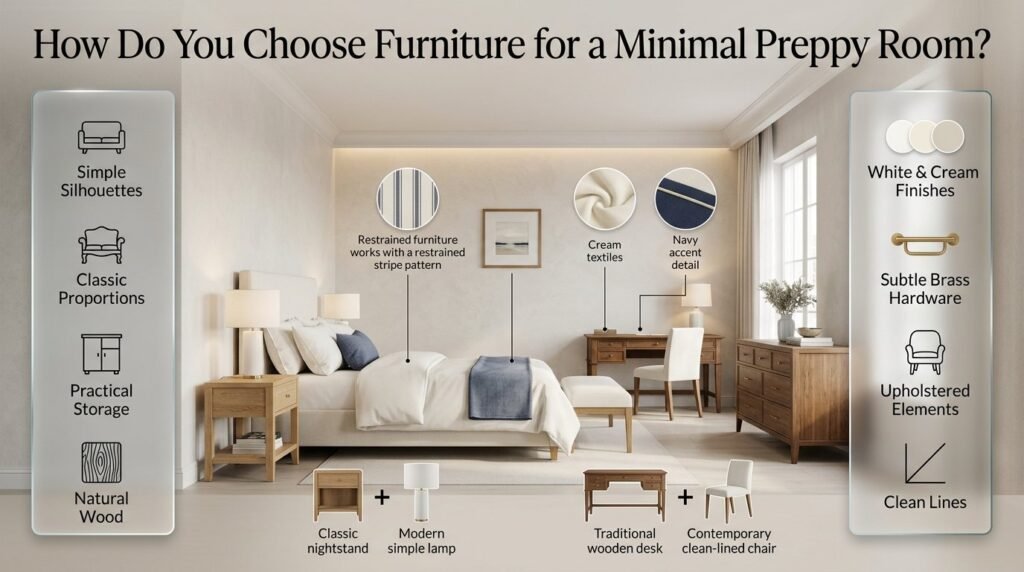
Furniture creates the foundation, so it should be chosen carefully.
Look for pieces with:
- Simple silhouettes
- Classic proportions
- Practical storage
- Natural wood
- White or cream finishes
- Subtle brass hardware
- Upholstered elements
- Clean lines
You don’t need furniture that looks extremely traditional.
In fact, mixing classic furniture with simpler contemporary pieces can make the room feel fresher.
For example:
Classic wooden nightstand + modern lamp
or:
Traditional desk + simple contemporary chair
creates contrast without losing the preppy identity.
Why Simple Furniture Works
If your furniture is already highly decorative, adding patterned bedding and detailed artwork may make the room visually heavy.
Simple furniture gives you more freedom with textiles and accessories.
How Should You Style the Bed?
In a bedroom, the bed is usually the largest visual feature.
That makes bedding one of the most important design decisions.
A minimal preppy bed might include:
- Solid cream duvet
- Navy striped pillow
- One patterned cushion
- Quilted blanket
- Simple throw
You don’t need ten decorative pillows.
The goal is layered comfort without excessive decoration.
Example 1: Classic
Cream bedding + navy stripe + brass detail
Example 2: Soft
White bedding + sage throw + botanical cushion
Example 3: Youthful
White bedding + soft pink accents + navy pattern
Example 4: Traditional
White quilt + navy plaid throw + classic floral cushion
The strongest option depends on the colors already present in the room.
How Many Patterns Should You Use?
For a minimal room, one dominant pattern is usually enough.
You can add a second subtle pattern if the colors and scales work together.
For example:
Dominant: navy-and-cream stripe
Supporting: small gingham cushion
The patterns feel related without competing equally.
Preppy design naturally encourages patterns, but minimal design asks you to control them.
That balance is important.
Understanding Pattern Scale
Pattern scale refers to how large or small the visual elements are.
A large floral pattern attracts immediate attention.
A small check is quieter.
A practical combination might be:
- Large-scale stripe on bedding
- Small botanical print on artwork
- Tiny check on one cushion
Avoid placing several large patterns next to each other.
Expert Tip: If you’re unsure whether two patterns work together, keep their colors closely related and vary their scale. Similar colors make pattern mixing much easier.
How Do You Use Stripes in a Minimal Preppy Room?
Stripes are one of the easiest ways to introduce preppy character.
You can use them on:
- Bedding
- Curtains
- Cushions
- Rugs
- Upholstery
- Artwork
The easiest approach is to let one striped element become the visual anchor.
For example, striped bedding can establish the room’s entire preppy direction.
You can then repeat the stripe colors in smaller details.
This is more effective than using stripes everywhere.
Can You Use Plaid and Gingham?
Yes, but use them strategically.
Plaid can add warmth and traditional character.
Gingham can feel lighter and more youthful.
If you use plaid bedding, consider solid cushions and a simple rug.
If you use gingham curtains, keep the bedding quieter.
The goal isn’t to avoid patterns.
The goal is to give patterns room to be noticed.
How Do You Add Warmth Without Creating Clutter?
One problem with minimalist interiors is that too much white, glass, or smooth furniture can make the room feel cold.
The solution isn’t necessarily more decoration.
Use texture.
Consider:
- Cotton bedding
- Linen curtains
- Wool or woven rugs
- Quilted blankets
- Upholstered furniture
- Woven baskets
- Natural wood
- Soft cushions
Texture gives the eye something to experience without adding lots of visual objects.
This is particularly useful if your color palette is very simple.
Why Is Natural Wood Useful in Preppy Rooms?
Natural wood adds warmth and works with many preppy color combinations.
It can appear through:
- Bed frames
- Nightstands
- Desks
- Shelves
- Picture frames
- Small stools
- Storage furniture
Light wood pairs particularly well with:
- Cream
- Navy
- Sage
- Powder blue
- Soft pink
Darker wood can create a more traditional atmosphere.
Don’t feel that every wooden item needs to have exactly the same finish. Similar warmth and tone are often enough to create cohesion.
How Do You Decorate the Walls?
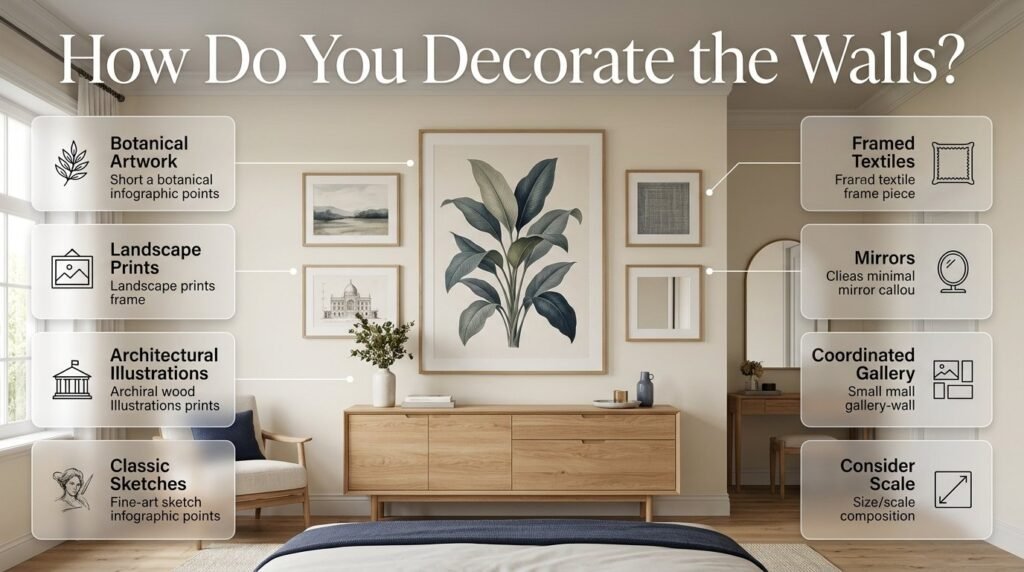
Minimal wall decoration requires more editing than a traditional gallery-style approach.
You can use:
- Botanical artwork
- Landscape prints
- Architectural illustrations
- Classic sketches
- Framed textiles
- Mirrors
- A small coordinated gallery
The important thing is scale.
One large artwork piece can sometimes look more sophisticated than five tiny prints scattered across a wall.
If you’re planning a larger wall treatment, our Preppy Room Wall Decor Ideas can provide a useful next step.
Should You Use a Gallery Wall?
You can, but you don’t have to.
A gallery wall works best when there is a clear relationship between the pieces.
Coordinate through:
- Frame color
- Artwork style
- Color palette
- Subject matter
- Spacing
Don’t feel obligated to fill an entire wall.
Leaving some negative space helps preserve the minimalist feeling.
Minimal Preppy Room Ideas
If you prefer a clean and organized space without losing the classic character of preppy design, explore our Minimal Preppy Room Ideas for practical inspiration. This guide explains how to use a restrained color palette, simple furniture, subtle patterns, natural textures, and carefully selected accessories to create a room that feels polished without looking cluttered. It is especially helpful for anyone who wants to keep preppy details while achieving a calm, balanced, and modern overall look.
How Do You Use Mirrors?
A mirror can be both decorative and practical.
In smaller rooms, a strategically placed mirror can help reflect natural light and create a greater sense of openness.
Choose a frame that relates to the room.
For example:
- Brass frame for a refined look
- Natural wood for warmth
- Black frame for a more contemporary approach
- White frame for a softer appearance
The mirror should support the overall design rather than become an unrelated focal point.
How Do You Choose Curtains?
Curtains should support the room rather than compete with the bedding.
If your bedding already has a strong pattern, choose:
- Cream
- White
- Beige
- Soft blue
- Solid pastel
- Subtle stripe
If the rest of the room is mostly solid, curtains can introduce a restrained pattern.
Curtain length also matters.
Curtains that extend visually toward the floor can make a room feel more finished, while poorly proportioned curtains may make the room feel less intentional.
How Do You Choose a Rug?
A rug adds texture and helps connect furniture visually.
For a minimal preppy room, consider:
- Cream
- Beige
- Navy
- Soft blue
- Subtle geometric patterns
- Traditional low-contrast designs
If the bedding already contains a strong pattern, choose a quieter rug.
If the bedding is mostly solid, the rug can provide a subtle pattern.
The rug doesn’t need to match the bedding exactly.
It simply needs to belong to the same color family.
How Do You Add Lighting?
Lighting is often underestimated.
A room can have excellent furniture and colors but still feel unfinished if the lighting is harsh.
Use multiple sources where possible:
- Ceiling light
- Bedside lamp
- Desk lamp
- Floor lamp
- Small ambient light
Warm-toned lighting generally works well with cream, navy, natural wood, and brass.
The goal is to create different levels of light rather than relying on one bright source.
How Do You Style Nightstands?
A nightstand should remain useful.
A simple arrangement could include:
- One lamp
- One book
- Small tray
- Small decorative object
That’s enough.
Don’t fill the surface simply because there’s room.
The empty area is useful.
It gives the lamp and other objects more visual importance.
How Do You Create a Minimal Preppy Study Area?
A study area should prioritize function.
Start with:
- Desk
- Comfortable chair
- Task lighting
- Storage
- Small organizer
- One decorative element
Keep frequently used supplies accessible but controlled.
Closed drawers are especially useful for items that don’t need to be displayed.
A desk with too many decorative objects may look attractive for a photograph but become frustrating during everyday use.
If you want a broader preppy decorating foundation before planning your study space, the Preppy Room Ideas guide covers furniture, colors, patterns, and different room directions.
How Can You Make a Small Room Look Minimal and Preppy?
Small rooms benefit from restraint.
The biggest mistake is trying to fit a full-size version of every decorating idea into a limited space.
Instead, choose the elements that matter most.
Prioritize:
- Bed
- Storage
- Lighting
- One main textile pattern
- One or two decorative features
- Personal details
Keep the floor as open as possible.
Use Vertical Space
Floating shelves can provide storage without taking up floor space.
Use them for:
- Books
- Small plants
- One framed picture
- A few meaningful objects
Don’t fill every inch.
Choose Multifunctional Furniture
Useful options include:
- Storage beds
- Desk-storage combinations
- Storage ottomans
- Floating shelves
- Narrow nightstands
- Under-bed containers
A small room becomes easier to manage when furniture performs more than one job.
How Do You Create a Modern Minimal Preppy Room?
Modern preppy design works particularly well when you prefer cleaner lines.
Use:
- Warm white
- Navy
- Sage
- Natural wood
- Black or brass accents
- Simple furniture
- Limited patterns
- Contemporary lighting
The modern element comes mainly from the simplicity of the furniture and layout.
The preppy character comes through the colors, patterns, textiles, and classic details.
If this direction interests you, you can continue with Modern Preppy Room Ideas.
How Do You Create a Classic Minimal Preppy Room?
A classic version can use more traditional furniture while still remaining restrained.
Try:
- Navy
- Cream
- White
- Dark wood
- Brass
- Stripes
- Plaid
- Framed artwork
Symmetry can also help.
For example, matching nightstands and similar lamps on both sides of the bed can create an organized appearance.
If you want more traditional inspiration, explore Classic Preppy Room.
The important part is not to make every element traditional.
Mixing one or two contemporary pieces can keep the room fresh.
How Do You Make a Cute Minimal Preppy Room?
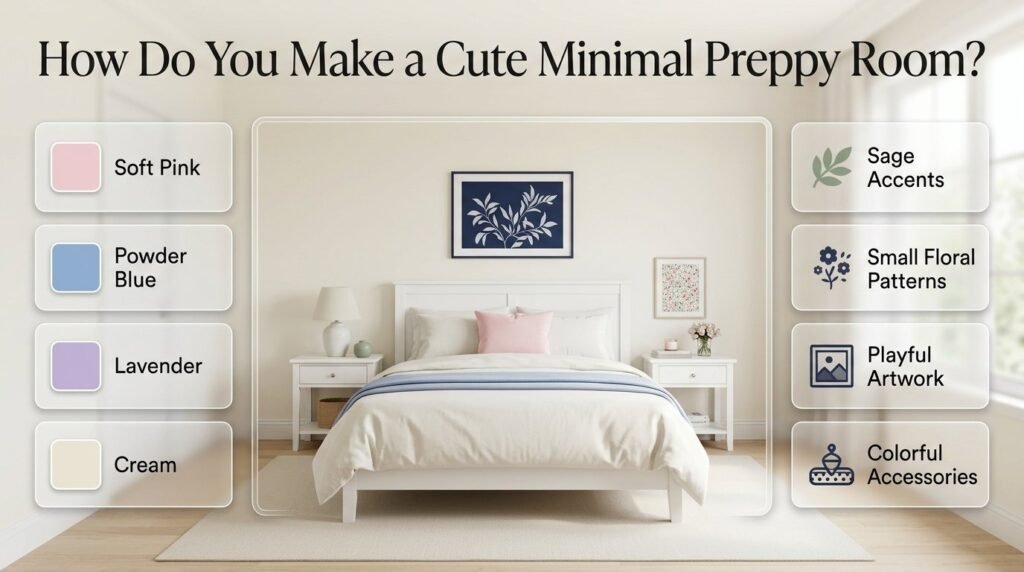
Cute preppy design can work beautifully with minimalism because the clean foundation prevents playful details from becoming overwhelming.
Use:
- Soft pink
- Powder blue
- Lavender
- Cream
- Sage
- Small floral patterns
- Playful artwork
- A few colorful accessories
The trick is to select a few charming details rather than making everything colorful.
For example:
Cream walls + white bed + pink cushion + navy artwork + small floral print
can feel cute while remaining polished.
For more inspiration in this direction, explore Cute Preppy Room Ideas.
How Do You Make a Minimal Preppy Room Cozy?
Minimalism doesn’t mean the room has to feel cold.
Comfort comes from materials, lighting, and layering.
Use:
- Quilted bedding
- Soft throws
- Cushions
- Rugs
- Curtains
- Upholstered furniture
- Warm lamps
- Natural wood
A simple color palette can still feel extremely comfortable when several textures are layered.
For example:
Cream bedding + navy accent + woven rug + linen curtains + warm wood
creates depth without visual clutter.
If comfort is your main priority, Cozy Preppy Room is a natural next direction for exploring that style.
How Can You Decorate on a Budget?
A minimal preppy room doesn’t require an expensive makeover.
In fact, minimalism can help reduce spending because you don’t need large quantities of accessories.
Start with what you already own.
Rearrange Furniture
A better layout can change the room without costing anything.
Refresh the Bedding
A new duvet cover or quilt can establish a new color direction.
Update Hardware
Changing drawer pulls can give an ordinary dresser a more coordinated appearance.
Reframe Existing Artwork
A consistent frame can make existing prints look more connected.
Declutter
Removing unnecessary items costs nothing and can have a major visual impact.
DIY Small Details
You can also personalize storage boxes, frames, cushions, or small decorative pieces.
For practical ideas, DIY Preppy Room Decor can help you approach the makeover creatively without relying entirely on new purchases.
How Do You Use Accessories Without Creating Clutter?
Every accessory should contribute something.
Ask:
Does this object provide color, texture, function, personality, or visual balance?
If the answer is no, you probably don’t need it.
Useful accessories include:
- Books
- Small plants
- Trays
- Decorative boxes
- Lamps
- Framed artwork
- Small baskets
- Personal photographs
Group objects rather than scattering them randomly.
For example:
Two books + small plant + decorative object
can create a simple shelf arrangement.
Then leave the rest of the shelf empty.
How Do You Create a Personalized Minimal Preppy Room?
A room shouldn’t look like a showroom.
Your personality should still be visible.
Use:
- Favorite books
- Meaningful photographs
- Artwork you genuinely like
- Travel memories
- Small collections
- Favorite colors
- Handmade objects
The key is selection.
You don’t need to display everything you own.
Choose the things that contribute to the room and have some meaning to you.
This makes the room feel designed rather than staged.
How Do You Mix Classic and Modern Elements?
This is one of the easiest ways to make a minimal preppy room feel current.
Try combinations such as:
Classic: Navy-and-white stripes
Modern: Simple white bed
Classic: Brass hardware
Modern: Minimal desk lamp
Classic: Botanical print
Modern: Clean black frame
Classic: Traditional wooden nightstand
Modern: Contemporary chair
The contrast prevents the room from becoming too formal.
It also gives you more freedom when shopping from different furniture styles.
How Do You Coordinate Colors Throughout the Room?
Color repetition creates cohesion.
Suppose your primary colors are cream, navy, and sage.
You might use:
- Cream walls
- Navy bedding
- Sage cushion
- Navy artwork
- Cream rug
- Natural wood furniture
- Small sage detail on a shelf
The colors don’t need to appear in equal amounts.
They simply need to appear often enough for the eye to recognize the relationship.
This principle is especially useful when working with several colors.
What Are the Most Common Minimal Preppy Room Mistakes?
Mistake 1: Using Too Many Patterns
Preppy design encourages patterns, but that doesn’t mean every surface needs one.
Why it happens: Patterns instantly make a room feel decorated.
Why it causes problems: Strong patterns compete for attention.
Better approach: Choose one dominant pattern and one or two quiet supporting patterns.
Mistake 2: Using Too Many Colors
A colorful room can quickly become visually fragmented.
Why it happens: People want the room to feel cheerful and interesting.
Why it causes problems: There is no clear visual hierarchy.
Better approach: Start with two or three main colors and add accents gradually.
Mistake 3: Filling Every Empty Space
Empty space can feel unfinished to beginners.
Why it happens: People assume every shelf, wall, or tabletop needs decoration.
Why it causes problems: The room loses its calm feeling.
Better approach: Treat negative space as an intentional design element.
Mistake 4: Choosing Furniture Before Measuring
A furniture piece can look perfect online but overwhelm a real room.
Better approach: Measure the room, doorways, walking paths, and existing furniture first.
Mistake 5: Making Everything Match
Perfectly matching furniture can sometimes make a room feel flat.
Better approach: Coordinate colors and materials rather than making every object identical.
Mistake 6: Confusing Minimal With Empty
Removing everything doesn’t automatically create good minimalist design.
A room still needs:
- Comfort
- Texture
- Personality
- Function
- Visual interest
Minimalism is about intentional selection, not simply having fewer objects.
Expert Advice for a Professional-Looking Minimal Preppy Room
Professional-looking rooms usually depend on consistency rather than expensive pieces.
Repeat Colors
If navy appears in the bedding, repeat it subtly in artwork or a cushion.
Repeat Materials
If natural wood appears in the desk, repeat a similar warmth through a frame or shelf.
Coordinate Metal Finishes
If you choose brass, repeat it in two or three small details.
Control Pattern Scale
Don’t put multiple large patterns next to each other.
Keep Large Surfaces Calm
Walls, major furniture, and large textiles should generally be quieter than small accessories.
Create Visual Rest
Not every wall needs artwork.
Not every chair needs a cushion.
Not every shelf needs decoration.
Prioritize Function
A beautiful room still needs to work for everyday life.
If a decorative object constantly gets in your way, it doesn’t belong in the room simply because it looks attractive.
Pro Tip: Before purchasing another accessory, stand at the doorway and look at the entire room. If your eye already has several strong places to land, editing may improve the design more than adding something new.
A Practical Minimal Preppy Room Formula

If you’re unsure where to start, use this simple formula:
Base
Warm white, cream, beige, or another quiet neutral.
Main furniture
Simple bed, dresser, nightstand, and desk if required.
Primary accent
Navy, sage, dusty blue, forest green, or soft pink.
Pattern
One stripe, plaid, gingham, or floral.
Texture
Quilt, rug, curtains, wood, or woven basket.
Metal
One consistent finish such as brass.
Artwork
One large piece or a small coordinated arrangement.
Accessories
Only useful or meaningful objects.
This formula gives you enough structure to begin without forcing you into one exact design.
Minimal Preppy Room Ideas for Different Personalities
For Someone Who Loves Classic Style
Choose navy, cream, dark wood, brass, stripes, and traditional artwork.
Keep the furniture structured and use symmetry.
For Someone Who Likes Modern Design
Use warm white, navy, sage, natural wood, simple furniture, and contemporary lighting.
Keep patterns limited.
For Someone Who Loves Color
Choose one neutral foundation and introduce several controlled accents.
Avoid giving every color equal importance.
For Someone Who Loves Cozy Rooms
Prioritize texture.
Use quilts, rugs, soft lighting, wood, and comfortable seating.
For Someone Who Likes Cute Details
Use pastel colors, small floral patterns, playful artwork, and a few charming accessories.
Keep the foundation simple so the cute elements stand out.
How Do You Refresh a Minimal Preppy Room?
You don’t need a complete makeover every time the room starts feeling repetitive.
Change one category at a time.
Change the Bedding
A new pattern can alter the room immediately.
Change the Artwork
One new framed piece can introduce a different accent color.
Change the Lighting
A new lamp can change both function and atmosphere.
Change Textiles
Replace a throw, cushion, or rug.
Rearrange Accessories
Sometimes simply moving objects into new groups makes the room feel different.
Remove Items
Refreshing doesn’t always mean adding.
Removing outdated or unnecessary objects can make the entire room feel cleaner.
A Room-by-Room Minimal Preppy Checklist
Bedroom
- Simple bed
- Coordinated bedding
- One dominant pattern
- Two or three main colors
- Practical nightstand
- Warm lighting
- One artwork arrangement
- Comfortable rug
Study Area
- Functional desk
- Comfortable chair
- Task lighting
- Organized storage
- Limited desktop accessories
- One personal decorative element
Walls
- Appropriate artwork scale
- Coordinated frames
- Enough negative space
- One clear focal area
Storage
- Closed storage where useful
- Open shelves kept selective
- Everyday objects easy to access
- Unnecessary items removed
How Do You Make a Minimal Preppy Room Look Stylish Without Making It Feel Cluttered?
The key is to use recognizable preppy elements selectively instead of decorating every available surface. Start with a restrained color palette, simple furniture, and one dominant pattern such as stripes, plaid, or gingham. Then introduce personality through a few carefully chosen accessories, artwork, and textiles.
A professional-looking room usually has a clear visual hierarchy. The bed, desk, or another major furniture piece should establish the main focus, while smaller decorative elements support it rather than competing for attention.
Practical points:
Choose two or three main colors and repeat them throughout the room.
Use one dominant pattern and keep supporting patterns subtle.
Leave intentional empty space on shelves, walls, and furniture.
Keep everyday items organized or stored out of sight.
Use texture through rugs, quilts, curtains, and natural wood instead of adding more decorations.
Remove an unnecessary item when the room starts feeling visually busy.
What Colors Work Best for a Minimal Preppy Room?
The strongest color palettes usually combine a calm neutral foundation with one recognizable preppy accent and a smaller supporting color. Classic combinations include navy and cream, sage and warm white, dusty blue and beige, forest green and cream, and soft pink with navy.
The important factor isn’t simply choosing “preppy” colors. It’s controlling how much of each color appears. A neutral such as cream or warm white can cover the largest surfaces, while navy, sage, or another accent can appear through bedding, artwork, cushions, rugs, or small accessories.
Practical points:
Use warm white or cream for larger surfaces when you want a softer appearance.
Use navy when you want a more traditional preppy character.
Try sage or dusty blue for a calmer interpretation.
Repeat an accent color in at least two or three areas.
Avoid introducing a completely unrelated color with every accessory.
Consider the natural lighting of the room before choosing very dark colors.
How Many Patterns Should You Use in a Minimal Preppy Room?
A good starting point is one dominant pattern, with one or two quieter patterns used only when they clearly coordinate. Stripes, plaid, gingham, and classic floral designs are all appropriate, but using several strong patterns at the same visual scale can quickly make a minimalist room feel busy.
Pattern scale is just as important as pattern quantity. A large striped duvet, for example, already attracts attention, so smaller patterns can be used in cushions or artwork without competing with it.
Practical points:
Choose one pattern as the main visual feature.
Use smaller patterns as supporting details.
Keep related patterns within the same color family.
Vary pattern scale when mixing designs.
Avoid placing several large, high-contrast patterns beside one another.
If the room already has patterned flooring or curtains, simplify the bedding.
How Can You Make a Small Bedroom Look Minimal and Preppy?
A small bedroom benefits from the same principles that make minimal preppy design work: fewer competing elements, practical furniture, controlled colors, and intentional open space. Instead of trying to fit every traditional preppy feature into the room, choose the elements that create the strongest visual impact.
Start with a simple bed and practical storage, then use bedding, artwork, and one or two classic patterns to establish the style. Vertical storage can also help preserve floor space, while a light background can make the room feel more open.
Practical points:
Choose furniture that provides storage whenever possible.
Keep walking areas clear.
Use floating shelves instead of adding unnecessary floor furniture.
Keep large surfaces relatively quiet.
Use mirrors strategically to reflect light.
Choose one strong pattern rather than several competing prints.
Keep decorative objects selective instead of filling every shelf.
Use under-bed storage for items that aren’t needed every day.
How Do You Make a Minimal Preppy Room Look More Expensive and Professional?
A sophisticated-looking room usually comes from consistency, proportion, and restraint rather than simply buying expensive decorations. Coordinate the color palette, repeat materials, choose furniture that fits the room properly, and give important pieces enough space around them.
Natural wood, quality-looking textiles, coordinated frames, warm lighting, and subtle brass details can add refinement without making the room feel overly decorated. The most important professional trick is knowing when to stop adding things.
Practical points:
Repeat the same accent color in different parts of the room.
Coordinate wood tones rather than using completely unrelated finishes.
Repeat a metal finish such as brass in small details.
Choose artwork that relates to the existing color palette.
Invest more attention in bedding, lighting, and rugs because they have large visual impact.
Avoid overcrowding shelves and tabletops.
Use appropriately sized furniture rather than simply choosing the largest pieces available.
Leave negative space around important objects so they remain visually noticeable.
Conclusion
Creating a beautiful minimal preppy room is less about adding more decoration and more about choosing the right elements with intention. A simple color palette, classic pattern, practical furniture, natural textures, and carefully selected accessories can give the room a polished preppy character without making it feel crowded.
Start with the foundation first: choose two or three coordinating colors, establish a comfortable furniture layout, and introduce one main preppy pattern such as stripes, plaid, or gingham. From there, add warmth through natural wood, soft textiles, artwork, and subtle decorative details.
The most important thing is to maintain balance. Leave some surfaces open, avoid using too many competing patterns, and repeat colors or materials throughout the room to create a connected appearance. If something feels unnecessary, removing it may improve the room more than adding another decoration.
Whether you’re decorating a small bedroom, study space, dorm, or larger room, minimal preppy design gives you plenty of flexibility. You can keep the look classic with navy and cream, make it softer with sage and warm white, or introduce a more youthful personality through carefully controlled pastel accents.
Ultimately, a successful minimal preppy room should feel clean, comfortable, personal, and thoughtfully designed. When every piece has a purpose and the overall palette remains cohesive, you can create a space that feels stylish today while remaining easy to update in the future.