Introduction
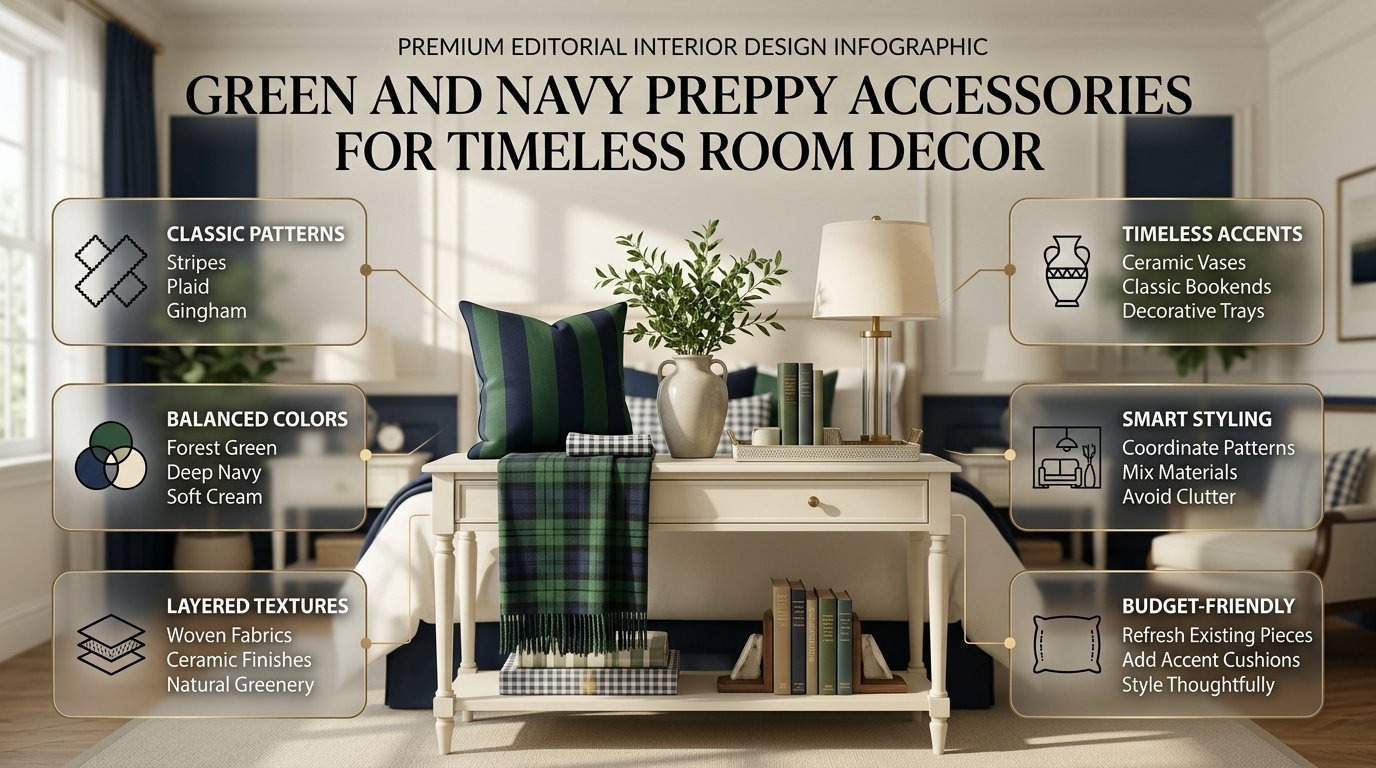
Green and Navy Preppy Accessories | Green and navy preppy accessories can transform an ordinary bedroom, living room, or study into a polished space without requiring expensive furniture or a complete makeover. However, choosing the wrong patterns, mixing too many shades, or filling every surface with decorations can make this beautiful color combination feel cluttered rather than coordinated.
The secret is knowing which accessories deserve attention, how to balance green and navy, and where to introduce patterns, textures, and finishing details. From striped cushions and plaid throws to ceramic vases, decorative trays, lampshades, and classic bookends, the right pieces can create a timeless preppy atmosphere that feels comfortable and personal.
In this guide, you’ll discover how to choose green and navy preppy accessories, coordinate different materials, style decorative objects, select affordable alternatives, and avoid common decorating mistakes. You’ll also learn how to create a consistent color scheme without making every item look identical.
Whether you’re updating a bedroom, styling a desk, refreshing a reading corner, or adding character to existing furniture, these practical ideas will help you make confident decorating decisions.
What Are Green and Navy Preppy Accessories?
Green and navy preppy accessories are decorative and functional objects that combine shades of green, navy blue, traditional patterns, and classic materials. They bring a coordinated appearance to a room through details such as striped textiles, plaid fabrics, botanical illustrations, ceramic ornaments, structured storage, and carefully selected metallic accents.
Unlike a complete room makeover, accessorizing focuses on smaller changes that work with your existing furniture, wall colors, and layout.
Popular examples include:
- Navy-and-green striped cushion covers
- Forest-green plaid blankets
- Sage-green ceramic vases
- Navy decorative trays
- Botanical prints in classic frames
- Brass bookends and lamp bases
- Green and navy fabric storage boxes
- Patterned lampshades
- Decorative books and small ornaments
- Coordinated bedding accessories
These pieces work because navy introduces depth, while green provides freshness and natural character. Cream, ivory, natural wood, and subtle metallic finishes help connect the two colors.
For example, a cream bedroom can feel more traditionally preppy with navy striped cushions, a sage-green throw, and framed botanical illustrations. A study with a wooden desk can achieve a similar effect through green bookends, a navy desk mat, and a brass-colored lamp.
If you’re developing a wider decorating theme, the Preppy Room website provides a starting point for exploring different approaches to this interior style.
Why Do Green and Navy Work So Well Together?
Green and navy create a versatile combination because they provide contrast without requiring completely different color families. Navy offers a structured, traditional foundation, while green introduces a natural element that can feel soft, rich, or energetic depending on the shade.
The combination also works across different decorating preferences. Sage and navy can create a relaxed atmosphere, whereas forest green and navy often feel more traditional. Emerald and navy can provide a bolder, more dramatic appearance.
Navy Adds Structure and Definition
Navy is useful when you want an accessory to create a clear visual anchor. It works particularly well on objects with defined shapes, including picture frames, lamp bases, trays, cushion borders, and decorative boxes.
Consider using navy in these ways:
- A striped cushion on a cream sofa
- A navy lamp base on a light bedside table
- A dark blue tray on a wooden coffee table
- Navy bookends on an open bookshelf
- A patterned navy lampshade in a reading corner
Navy can also help connect several smaller accessories across a room. Repeating the color in three or four locations often creates a stronger result than concentrating it in one isolated corner.
Green Introduces Freshness and Variation
Green provides flexibility because its different shades produce different effects.
| Green shade | Best accessory choices | Decorating effect |
|---|---|---|
| Sage green | Cushion covers, ceramic vases, throws | Soft and relaxed |
| Forest green | Plaid textiles, lampshades, bookends | Traditional and cozy |
| Emerald green | Velvet cushions, decorative boxes | Rich and expressive |
| Olive green | Woven accents, pottery, textured fabrics | Earthy and warm |
| Mint green | Small ornaments, light textiles | Fresh and playful |
| Kelly green | Striped cushions, selected decorative details | Bright and energetic |
You don’t need to use every shade. Choose one main green and, if appropriate, one supporting shade.
For a bedroom with cream bedding, sage-green accessories may be the easiest option. For a traditional study with dark wood furniture, forest green can create a more established, heritage-inspired appearance.
Traditional Patterns Reinforce the Preppy Style
Preppy interiors often use patterns associated with classic textiles and traditional furnishings. Stripes, plaid, gingham, and botanical prints can all work with green and navy.
The key is variety rather than repetition.
A broad navy stripe, a smaller green gingham pattern, and a solid cream textile provide three different visual experiences while maintaining a common palette.
Expert tip: Before buying patterned accessories, identify one dominant pattern and one supporting pattern. Use plain fabrics and simple materials to prevent the room from feeling visually crowded.
Which Green and Navy Preppy Accessories Should You Choose First?
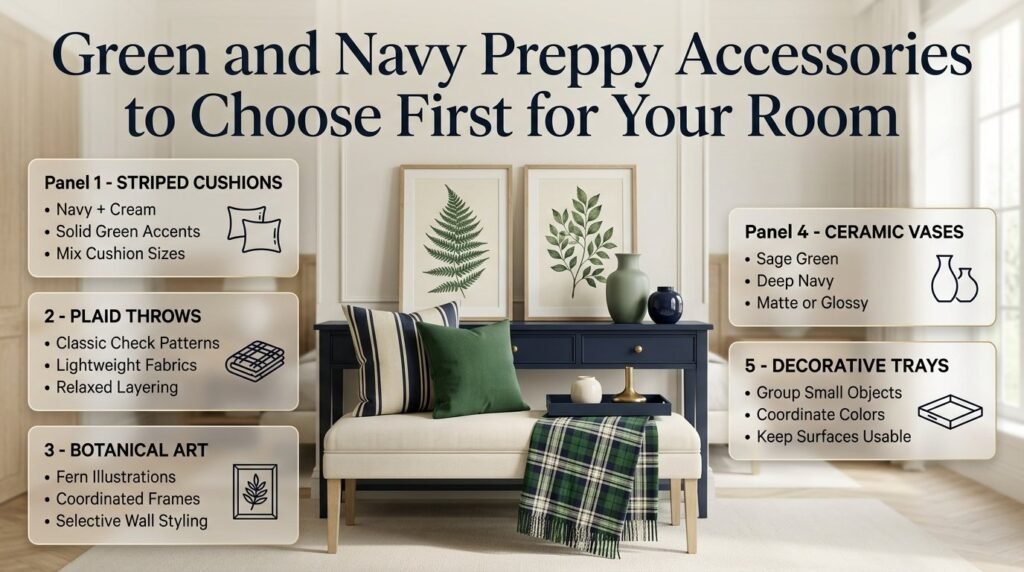
The most useful accessories are those that introduce the color scheme while fitting the way you use the room. Start with textiles and functional objects before purchasing small decorative ornaments that may have little practical value.
1. Striped Decorative Cushions
Striped cushions are one of the simplest ways to introduce a preppy color scheme. They can be placed on a bed, sofa, armchair, or window seat without changing the existing furniture.
Choose navy-and-cream stripes with a solid green cushion, or combine a green striped design with a navy cushion in a different texture.
To make the arrangement look intentional, vary the sizes of the cushions rather than selecting several identical pieces.
How to style them: Use two larger cushions at the back, one smaller patterned cushion in front, and a plain cushion to provide contrast.
2. Green and Navy Plaid Throws
Plaid throws introduce traditional character and a layer of texture. They are especially useful when a room already contains plain bedding or upholstery.
A forest-green, navy, and cream plaid can complement a wooden bed frame, while a softer sage-and-navy pattern may suit a lighter room.
Drape the throw over the end of a bed, fold it across an armchair, or place it in a woven basket beside a reading chair.
Choose a fabric that suits the climate and the amount of maintenance you’re comfortable with. A lightweight cotton throw may be more practical for everyday use than a heavy, textured blanket.
3. Botanical Artwork and Framed Illustrations
Botanical artwork is a natural companion to green and navy accessories because it introduces leafy shapes and softer details.
Consider fern illustrations, vintage plant prints, botanical sketches, or artwork featuring green foliage against cream backgrounds.
Navy frames can connect the artwork to striped cushions or dark blue furniture accents. Natural wood frames may work better when the room already contains several dark accessories.
Use artwork selectively. A pair of coordinated prints can be more effective than filling every available wall with small pictures.
4. Ceramic Vases and Decorative Pottery
Ceramic objects provide color without requiring additional patterns. A sage-green vase can soften a navy tray, while a navy ceramic vessel can anchor a light-colored shelf.
Try arranging objects of different heights:
- One medium-height vase
- A smaller ceramic ornament
- A short stack of books
- A little empty space around the arrangement
Matte finishes usually create a quieter appearance, while glossy ceramics can introduce a more noticeable accent.
If you want to display flowers or foliage, choose a vase with a suitable opening and stable base rather than selecting it solely for its color.
5. Decorative Trays
A decorative tray can organize smaller objects and create a defined arrangement on a coffee table, dresser, or bedside table.
Navy trays work well with cream ceramics and green accents. Green trays can be paired with navy books or a brass-colored decorative object.
A tray is particularly useful when several small accessories would otherwise appear scattered across a surface.
However, make sure the tray doesn’t occupy so much space that the table becomes difficult to use.
6. Patterned Lampshades and Table Lamps
Lighting accessories can introduce color while serving a practical purpose.
A navy lamp base with a cream shade creates a classic look, while a green patterned shade can provide a more distinctive accent. You can also choose a neutral lamp and repeat green and navy through nearby objects.
Consider the scale of the lamp in relation to the furniture. A large lamp may overwhelm a narrow bedside table, while a small lamp can look disproportionate on a wide console.
Always choose a lamp and shade that are compatible with each other and follow the manufacturer’s safety and bulb recommendations.
7. Decorative Books and Bookends
Books can help connect the color scheme across shelves, desks, and coffee tables.
Arrange books with navy or green covers beside a cream ornament, wooden object, or brass-colored bookend. The arrangement will feel more natural if you vary the heights and leave some open space.
Decorative book styling should not interfere with access to books you actually use.
Choose pieces that reflect your interests, rather than buying an entire collection simply because the covers match your room.
8. Woven Baskets and Fabric Storage Boxes
Storage accessories help maintain a tidy appearance while contributing to the overall palette.
Natural woven baskets complement both green and navy because their warm texture softens the cooler colors. Navy fabric boxes can organize stationery, cables, and small belongings, while green baskets can hold folded throws or reading materials.
Use baskets for items you need to access regularly and boxes for objects you prefer to keep out of sight.
A coordinated room should be easy to maintain, not just attractive in photographs.
How Do You Balance Green and Navy Accessories?
A balanced arrangement distributes color throughout the room without allowing one shade or pattern to dominate every surface.
Start by looking at the largest existing elements, including walls, flooring, bedding, upholstery, and furniture. These features will influence how much green and navy you need to introduce.
Use a Flexible Color Ratio
A useful starting point is the 60-30-10 approach.
- 60% dominant color: Cream, ivory, warm white, or another light neutral.
- 30% supporting color: Navy or green, depending on your preferred look.
- 10% accent color: A secondary green shade, brass, or another restrained complementary detail.
This is a visual guideline rather than a strict decorating formula. You don’t need to calculate the exact percentage of every cushion or ornament.
For example, a cream bedroom might use navy cushions and frames as the main contrast, green textiles as the supporting accent, and brass hardware as a small finishing detail.
In a room with navy walls, the arrangement may need more cream textiles and lighter accessories to preserve visual balance.
Repeat Colors Across Different Surfaces
A color can look disconnected when it appears only once in an otherwise unrelated arrangement.
If you choose sage-green cushions, repeat the shade in a vase or a small detail in the artwork. If navy appears in a tray, repeat it through a picture frame or lamp base.
The accessories don’t need to match exactly. Repeating a color in different materials creates unity without making the room look like a matching set.
Allow Neutral Colors to Connect the Arrangement
Cream, ivory, beige, and natural wood provide visual breathing room between stronger colors.
For example, a green cushion beside a navy cushion may create a strong contrast. Adding a cream cushion between them can soften the transition and help the arrangement feel more deliberate.
Neutral accessories also make it easier to update the room later. If you change the shade of green, you may be able to keep the same cream textiles and wooden accents.
How Should You Mix Patterns and Textures?
The most successful preppy arrangements combine patterns of different scales with plain fabrics and varied materials.
You don’t need to avoid mixing patterns. Instead, make sure each pattern has a clear role.
Combine Patterns of Different Sizes
Try this combination:
- Large navy stripes on a cushion
- Small green gingham on another textile
- A simple cream throw
- A botanical print with a relatively uncluttered background
The broad stripes provide structure, the gingham adds traditional detail, and the plain throw prevents the arrangement from becoming too busy.
If your main accessory already has a complicated plaid, choose simpler supporting pieces.
Introduce Texture Through Materials
Texture creates interest even when the colors remain consistent.
| Material | Useful accessories | Visual contribution |
|---|---|---|
| Cotton | Cushion covers, bedding | Clean and practical |
| Linen | Throws, curtains, cushions | Relaxed and natural |
| Velvet | Accent cushions, selected upholstery | Rich and tactile |
| Ceramic | Vases, bowls, ornaments | Solid, clean shapes |
| Natural wood | Trays, frames, bookends | Warmth and structure |
| Woven fibers | Baskets, storage | Soft, organic texture |
| Brass-toned metal | Lamp bases, frames | Warm decorative contrast |
Choose materials according to how the room is used. A frequently used family sofa may benefit from durable, washable cushion covers, while a decorative reading corner may accommodate more delicate fabrics.
Avoid Repeating the Same Pattern Everywhere
Using the same stripes on cushions, curtains, throws, and lampshades can make the room feel repetitive.
Instead, repeat the colors while varying the patterns.
For example, use striped cushions, a solid green throw, a plaid storage basket, and botanical artwork. The colors connect the arrangement, while the different patterns create variety.
How Can You Style Green and Navy Accessories in a Bedroom?
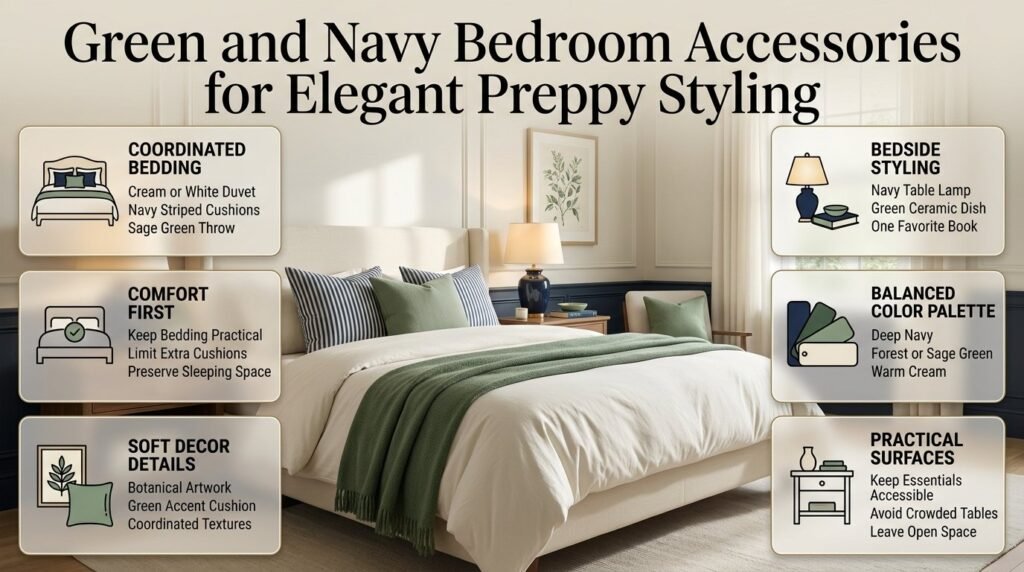
Bedroom accessories should create a comfortable atmosphere while keeping the space practical for sleeping, dressing, and everyday routines.
Start with the bedding, then coordinate the bedside tables, lighting, and wall details.
Coordinate Bedding and Cushions
If your duvet cover is cream or white, introduce navy through striped cushions and green through a throw or smaller decorative pillow.
For a bolder approach, choose navy bedding and balance it with sage cushions, cream sheets, and a lighter throw.
Avoid placing too many decorative cushions on a bed if they make it difficult to use the bedding comfortably.
Style the Bedside Table
A bedside table needs enough room for essentials such as a book, glasses, or a phone.
Try a navy lamp, a small green ceramic dish, and one book with a complementary cover. Keep the remaining surface clear.
This creates a coordinated display without turning a practical surface into a crowded decorative arrangement.
Add Soft Details Around the Room
A fabric storage box, a simple botanical print, or a green cushion on a reading chair can connect the bedroom’s different areas.
If you’re exploring the larger bedroom theme, Green and Navy Bedroom Decor offers a relevant starting point for considering how accessories fit into the overall room design.
Keep this accessories guide focused on individual decorative objects rather than treating it as a complete bedroom layout or furniture-planning guide.
How Can You Use Green and Navy Accessories in a Living Room?
In a living room, accessories should connect the sofa, coffee table, shelving, and lighting without making the space difficult to use.
If you have a cream sofa, navy cushions can establish contrast while green textiles introduce a softer accent. If the sofa is navy, use green cushions, lighter textiles, and natural materials to balance the darker upholstery.
Create a Coffee Table Arrangement
A simple coffee-table arrangement can include a navy tray, two books, and a small green vase.
Keep the arrangement low enough to preserve visibility across the table. Leave space for cups, remotes, or other items you use daily.
If your coffee table is small, one tray and one decorative object may be enough.
Coordinate Accessories With Existing Furniture
Dark wood furniture often works well with forest green, navy, and brass-colored details. Lighter wood can create a fresher combination with sage, cream, and softer navy.
Avoid introducing several unrelated finishes without a clear connection. Repeat existing wood or metal finishes when possible.
For broader styling inspiration, explore Green and Navy Room Decor. That topic provides wider room-level context, while the present guide concentrates on selecting and coordinating accessories.
Use Cushions to Refresh the Room
Cushions can be changed more easily than furniture, making them a practical way to experiment with different combinations.
Try navy stripes with a solid green cushion, or use green plaid with a simple cream pillow.
If you already have patterned curtains or a patterned rug, select calmer cushions so the room doesn’t become visually overloaded.
Which Accessories Work Best in a Study or Reading Corner?
A study or reading corner is particularly suitable for preppy accessories because books, structured patterns, wood finishes, and practical storage already fit naturally into the setting.
The goal is to create a visually coordinated workspace without sacrificing the surface area needed for studying or other activities.
Choose Functional Desk Accessories
Useful choices include:
- A navy desk mat
- A green pen holder
- A brass-colored task lamp
- A wooden bookend
- A cream or green storage box
- A small framed botanical illustration
These items can establish the palette while helping you organize everyday belongings.
Keep the most frequently used objects close at hand. Place purely decorative items toward the back of a desk or on nearby shelving.
Style a Reading Corner
A reading corner can use a green cushion, navy throw, small wooden side table, and adjustable lamp.
A woven basket can hold books or spare blankets. One framed illustration can connect the corner to the rest of the room.
Avoid filling the floor with unnecessary decorative objects, especially if the space is narrow.
How Can You Choose Accessories for Different Room Sizes?
Room size influences how much visual weight an accessory can carry.
Large objects, strong patterns, and dark colors naturally attract attention. The challenge is to choose pieces that complement the available space.
Small Rooms
In a compact bedroom or study, prioritize smaller accessories with clear functions.
Choose a few cushions, a compact lamp, a narrow tray, or a small framed print. Use cream or other light neutrals to keep the arrangement from feeling crowded.
Avoid large collections of ornaments on narrow shelves.
Medium-Sized Rooms
Medium-sized rooms can support more variation in pattern and material.
You might combine striped cushions, a plaid throw, a larger vase, and coordinated artwork. Spread the accessories across the room rather than concentrating every green and navy object on one table.
Large Rooms
Larger rooms can accommodate more substantial accessories, including oversized cushions, floor baskets, larger lamps, and grouped artwork.
However, scale still matters. A large room with many small objects may look scattered, while a few appropriately sized accessories can create stronger visual anchors.
Quick tip: Photograph the room from the entrance. If the accessories appear crowded or one color dominates the image, simplify the arrangement before purchasing more items.
How Can You Decorate With Green and Navy Accessories on a Budget?
You don’t need to purchase a complete collection to achieve a coordinated preppy look. A few carefully selected accessories can introduce the palette while allowing you to keep existing furniture and useful belongings.
Begin With the Highest-Impact Items
Start with cushion covers, a throw, and a small piece of artwork.
These items are generally easier to change than larger furnishings and can establish the color scheme quickly.
Choose colors that work with your existing room rather than buying items that require several additional purchases to look coordinated.
Reuse Accessories You Already Own
Look for neutral vases, books, baskets, frames, and trays that can be incorporated into the new arrangement.
A cream vase can work with green foliage. Existing navy books can be grouped beside a wooden ornament, while a plain basket can hold a folded plaid throw.
Rearranging objects between rooms may also provide a fresh appearance without additional spending.
Try Simple DIY Projects
Affordable decorating projects include:
- Sewing new covers for existing cushions.
- Framing botanical illustrations you have permission to reproduce.
- Organizing books by complementary colors.
- Adding suitable removable fabric accents to storage boxes.
- Reusing existing frames for coordinated artwork.
- Arranging small objects on a tray instead of buying new display furniture.
Choose projects that suit your materials and skills. Check care instructions before painting, gluing, or modifying furniture and decorative surfaces.
Use This Budget Priority List
| Priority | Accessory | Why it is useful |
|---|---|---|
| 1 | Cushion covers | Establish the main colors |
| 2 | Throw or blanket | Introduces texture and pattern |
| 3 | Framed artwork | Connects the palette visually |
| 4 | Vase or tray | Completes a shelf or table |
| 5 | Storage basket | Adds practical organization |
| 6 | Lamp or lampshade | Combines function and style |
Purchase accessories in stages. Live with the first few changes before deciding whether the room needs additional color or simply a better arrangement.
What Are the Most Common Decorating Mistakes?

Green and navy accessories can become difficult to coordinate when every item competes for attention. Most problems can be avoided by planning the color balance, checking measurements, and choosing accessories that suit the room’s existing furnishings.
Mistake 1: Using Too Much Navy
Navy is visually strong, particularly in dimly lit rooms.
Using it on every cushion, curtain, decorative object, and storage box may make the room feel heavier than intended.
How to avoid it: Introduce cream, ivory, light wood, and softer green accents to balance the darker elements.
Mistake 2: Mixing Too Many Patterns
Stripes, plaid, gingham, and floral prints can all suit preppy interiors, but using too many large patterns together can make the arrangement look chaotic.
How to avoid it: Select one dominant pattern, one supporting pattern, and several plain accessories.
Mistake 3: Choosing Incompatible Green Shades
Sage, olive, emerald, and forest green have different undertones and levels of intensity.
Combining several shades without a clear plan may make the accessories look unrelated.
How to avoid it: Choose one main green, compare samples in the room’s lighting, and introduce a second shade only when it complements the first.
Mistake 4: Buying Accessories Without Measuring
Oversized lamps, trays, and baskets can crowd small furniture or interfere with movement.
How to avoid it: Measure the surface or space before purchasing. Consider the object’s height, width, and the room needed around it.
Mistake 5: Matching Everything Too Closely
An arrangement where every item has the same shade and identical pattern can look overly coordinated.
How to avoid it: Combine patterned fabrics with plain textiles, natural wood, ceramics, and personal objects.
Mistake 6: Ignoring Functionality
Decorative accessories become frustrating when they occupy surfaces needed for everyday tasks.
How to avoid it: Give every item a clear role, whether decorative, practical, or sentimental. Keep essential surfaces accessible.
Mistake 7: Ignoring Lighting
Green and navy may appear different under daylight and artificial lighting.
How to avoid it: Compare samples at different times of day and avoid buying multiple expensive items before checking their appearance in the actual room.
What Do Professional Stylists Recommend?
A well-coordinated room usually depends on repetition, restraint, and thoughtful material choices rather than the number of accessories.
Repeat Colors Without Repeating Every Pattern
If navy appears in a cushion, repeat it in a frame or lamp base. If green appears in a throw, introduce the shade in a vase or artwork.
This creates continuity while allowing each accessory to have its own character.
Mix Matte and Reflective Finishes
A matte ceramic vase beside a slightly glossy tray can introduce contrast without requiring additional colors.
Wood and woven materials provide warmth, while brass-toned details introduce a subtle metallic accent.
Avoid using too many different finishes in a single small arrangement.
Check Accessories in Their Actual Setting
An accessory that looks attractive in a product photograph may not work with your existing furniture.
Place fabric samples beside the bedding or upholstery. Compare the size of a tray with the available tabletop. Check whether a decorative object can be cleaned easily.
These simple checks can prevent unnecessary purchases.
Prioritize Comfort and Personal Meaning
A room should support the way you live, not simply reproduce a photograph.
Keep useful books accessible, choose comfortable textiles, and include objects that reflect your interests. A meaningful photograph or favorite decorative piece can make a coordinated room feel much more personal.
For additional ideas focused specifically on decorative wall elements, see Green and Navy Wall Decor.
How do you decorate a room with green and navy preppy accessories without making it look too dark?
The best way to decorate with green and navy accessories is to balance these rich colors with lighter neutrals, natural textures, and carefully selected patterns. Cream, ivory, and warm white create a brighter foundation, while navy and green add depth through cushions, throws, lamps, and decorative objects. This approach works particularly well in bedrooms, small living rooms, and study areas where too many dark accessories can make the space feel visually heavy.
For a balanced arrangement, start with a few key pieces and distribute the colors throughout the room instead of concentrating them in one corner.
Choose light neutrals: Use cream bedding, light upholstery, or pale-colored surfaces to balance darker accessories.
Introduce green gradually: Sage green creates a softer effect, while forest green and emerald provide stronger contrast.
Add reflective and natural materials: Glass, light wood, and subtle brass details can make the arrangement feel more open.
Check the lighting: Compare your accessories in daylight and artificial light before purchasing additional pieces.
What are the best green and navy preppy accessories for creating a classic, elegant look?
The most effective accessories combine traditional patterns, quality-looking textures, and practical decorative details. Navy-striped cushions, green plaid throws, botanical artwork, ceramic vases, and brass-finished bookends are excellent choices because they introduce the color palette without requiring matching furniture. The key is to choose accessories that complement one another while allowing each piece to contribute something different.
A coordinated arrangement might include navy-and-cream striped cushions, a forest-green throw, a sage ceramic vase, and framed botanical illustrations. Natural wood and cream textiles can connect these pieces without making the room feel overly formal.
For a bedroom: Choose coordinated cushions, a textured throw, and a simple bedside lamp.
For a living room: Combine patterned cushions with a decorative tray and a ceramic vase.
For a study: Use navy desk accessories, green bookends, and a brass-toned task lamp.
For shelving: Arrange books with complementary covers alongside a few carefully selected ornaments.
Which patterns and textures work best with green and navy preppy accessories?
Stripes, plaid, gingham, and botanical prints are particularly suitable for green and navy preppy interiors. These patterns create a traditional appearance, while materials such as cotton, linen, velvet, ceramic, and natural wood add texture and prevent the room from looking repetitive. The most important consideration is pattern scale: several large, high-contrast patterns can compete for attention, even when they share the same colors.
A practical approach is to select one dominant pattern, one smaller supporting pattern, and a few solid-colored accessories. For example, broad navy stripes can complement a small green gingham cushion, while a plain cream throw creates a visual break.
Stripes: Best for cushions, bedding accents, and lampshades.
Plaid: Works well on throws, blankets, and selected textile accessories.
Gingham: Adds a playful traditional touch to smaller decorative pieces.
Botanical prints: Connect green accents with natural shapes and classic artwork.
Textured materials: Linen, velvet, and woven fibers introduce depth without adding another pattern.
How can you decorate with green and navy preppy accessories on a budget?
You can create a coordinated green and navy look without replacing your furniture or purchasing a complete decorative collection. Focus on affordable changes that make a visible difference, such as cushion covers, a throw, framed artwork, or a small ceramic accent. Reusing neutral accessories you already own can also help you achieve the desired appearance while keeping spending under control.
Instead of buying everything at once, introduce a few pieces and evaluate the arrangement before deciding what is missing. This prevents unnecessary purchases and makes it easier to identify which colors and materials work best in your room.
Start with cushion covers: They can introduce the main colors without replacing existing cushions.
Reuse neutral decorations: Cream vases, wooden frames, and woven baskets can complement the palette.
Create simple artwork displays: Use suitable botanical illustrations and frames you already have.
Shop gradually: Purchase additional accessories only when they improve the overall arrangement.
Prioritize useful items: Choose storage boxes, trays, and throws that combine decoration with everyday function.
How do you choose the right green and navy accessories for a small bedroom or study?
In a small bedroom or study, choose accessories that provide color and personality without occupying too much space. Smaller cushions, compact lamps, narrow trays, framed prints, and practical storage boxes can introduce the preppy palette while keeping surfaces accessible. The aim is to create visual interest without making the room feel crowded.
Begin by identifying the room’s existing colors and the available space on furniture. If the walls and larger furnishings are light, navy accessories can provide contrast, while sage-green details soften the arrangement. In a room with darker furniture, cream accents and lighter green textiles can help maintain balance.
Measure before buying: Check the dimensions of lamps, trays, baskets, and decorative objects.
Use vertical space thoughtfully: Small framed prints or organized shelving can add interest without occupying the floor.
Choose multifunctional accessories: Storage baskets and decorative boxes help keep everyday belongings organized.
Limit strong patterns: One striped cushion and one smaller patterned accent may be enough.
Keep surfaces usable: Leave room on desks and bedside tables for the items you need daily.
Conclusion: Create a Timeless Look with Green and Navy Preppy Accessories
Green and navy preppy accessories are an effective way to bring classic style, visual balance, and personality into your home without making major decorating changes. From striped cushions and soft throws to decorative trays, ceramic vases, elegant lamps, and coordinated storage, the right accessories can make a room feel more polished while keeping it comfortable and practical.
The key is to use both colors thoughtfully. Let navy add depth, use green to introduce freshness, and balance them with neutral shades such as cream, white, beige, or warm wood. Mixing stripes, plaid, subtle botanical prints, and different textures can create the layered look that makes preppy interiors distinctive.
Before purchasing new accessories, consider your room’s size, lighting, existing furniture, and everyday needs. Start with a few coordinated pieces, then add complementary details gradually rather than filling every surface with decorations.
For more inspiration, explore our guides to Green and Navy Preppy Room Ideas and Green and Navy Preppy Decor. You can also visit Preppy Room for more interior styling ideas.
Ultimately, the best green and navy preppy accessories are those that work together naturally, reflect your personal taste, and make your space feel inviting. With a thoughtful combination of colors, patterns, and practical decorative pieces, you can create a timeless preppy look that feels both sophisticated and uniquely yours.