Introduction
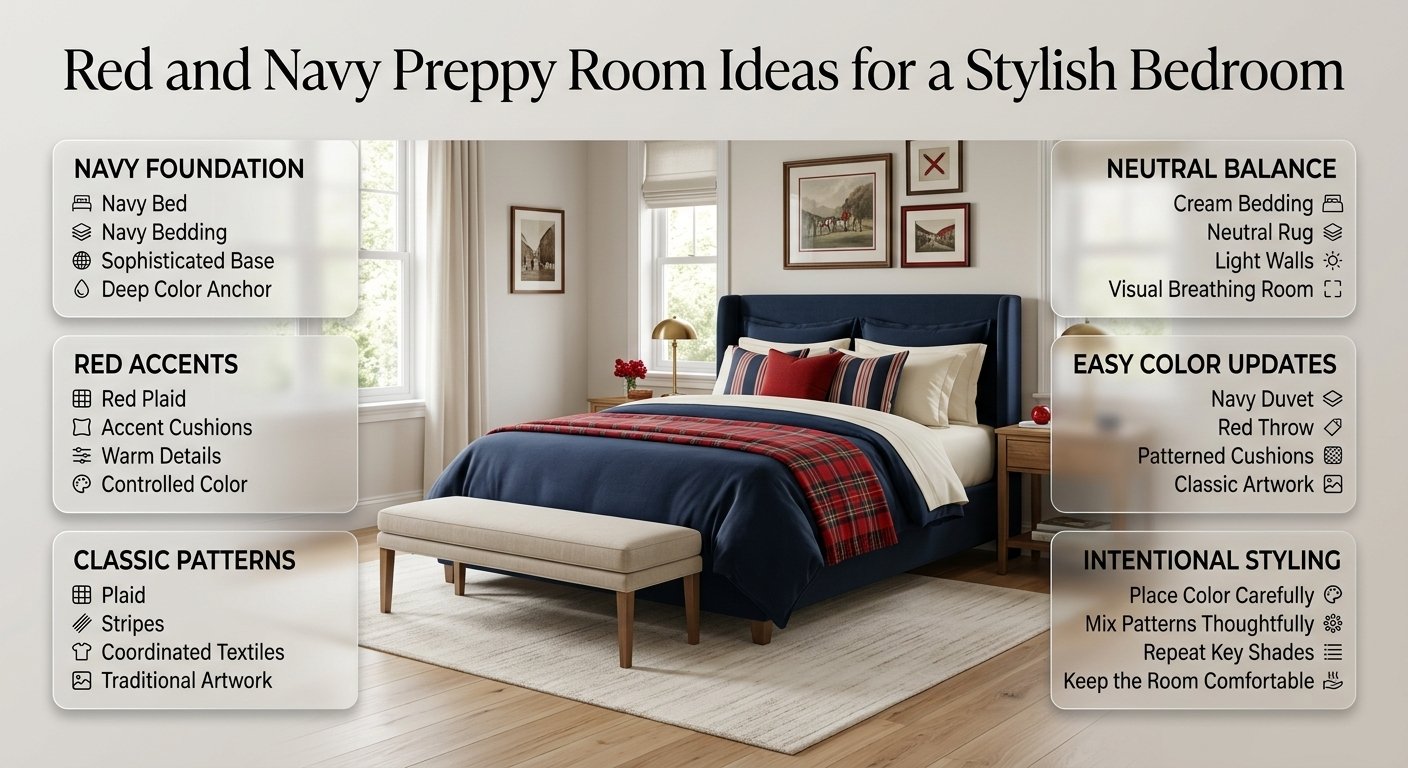
Red and Navy Preppy Room Ideas | Choosing colors for a bedroom sounds simple until you start putting everything together. A navy bed may look beautiful on its own, while a red plaid pillow may also look great in a store, but combining strong colors successfully requires a little more planning. The goal isn’t simply to use red and navy everywhere. It’s to create a room where both colors feel intentional, balanced, and comfortable.
If you’re exploring different decorating styles, Preppy Room inspiration can help you understand how classic patterns, coordinated colors, furniture, and accessories work together. Within that broader style, red and navy preppy room ideas offer one of the most recognizable combinations because navy provides a sophisticated foundation while red adds warmth, energy, and personality.
The good news is that you don’t need a complete renovation to achieve the look. A navy duvet, red plaid throw, striped cushions, classic artwork, or even a few carefully chosen accessories can transform a neutral bedroom. The key is knowing where to place color, how much red to use, which patterns work together, and when to let neutral tones take over.
In this guide, you’ll discover practical ways to create a red and navy preppy room from the ground up. We’ll cover walls, bedding, furniture, rugs, curtains, artwork, lighting, pattern mixing, small bedrooms, cozy designs, modern variations, minimal approaches, common mistakes, and step-by-step decorating strategies.
What Are Red and Navy Preppy Room Ideas?
Red and navy preppy room ideas combine deep navy blue and red with traditional or polished decorating details such as stripes, plaid, checks, tailored furniture, layered bedding, framed artwork, and neutral backgrounds.
The colors themselves don’t create the preppy style.
The overall design does.
For example, a room with navy walls and red furniture could look dramatic and contemporary. Add striped bedding, a traditional wood nightstand, framed artwork, a plaid throw, and crisp white accents, and the same color combination begins to feel much more preppy.
The best approach is therefore to think about color + pattern + texture + proportion rather than color alone.
Why Are Red and Navy Such a Good Combination?
Navy and red naturally create contrast.
Navy is deep, calm, and visually grounding. Red is warm, energetic, and attention-grabbing. When used together, the two colors create a room with personality.
However, both are strong enough to become overwhelming if they’re used without a neutral foundation.
That’s why white, cream, beige, light gray, and natural wood are so important.
Think of the room like this:
Light neutral foundation
↓
Navy as the main color
↓
Red as the accent
↓
Patterns and textures for personality
This structure makes the room easier to decorate and much easier to adjust later.
How Do You Balance Red and Navy in a Bedroom?
The simplest strategy is to choose one dominant color and one supporting accent.
For most bedrooms, navy is easier to use as the dominant color because it works well on larger surfaces.
You can use navy for:
- Bedding
- Curtains
- Rugs
- Headboards
- Chairs
- Cabinets
- Accent walls
- Cushions
Red usually works better in smaller amounts.
You can use it for:
- Pillows
- Throws
- Artwork
- Plaid fabrics
- Small accessories
- Desk items
- Decorative objects
A useful starting point is:
| Color | Approximate Role |
|---|---|
| White/Cream | 40–50% |
| Navy | 25–35% |
| Red | 10–15% |
| Wood/Other Materials | 5–15% |
These aren’t strict rules. They’re simply a way to visualize balance.
If the room already has dark flooring or furniture, you may want even more light neutral space.
💡 Pro Tip: When you’re uncertain about a strong color, don’t start with paint. Start with removable items such as pillows, blankets, artwork, or curtains. This lets you test the color combination before making a permanent decision.
What Colors Go With Red and Navy?
Red and navy are both powerful colors, so the supporting colors should generally make the room easier to look at.
White
White is the most classic companion.
It gives navy a crisp appearance and prevents red from becoming too heavy.
White works particularly well with:
- Stripes
- Plaid
- Navy bedding
- Red accessories
- Traditional furniture
Cream
Cream is softer than white.
If you want the room to feel warm and comfortable rather than crisp and formal, cream can be a better option.
Beige
Beige provides a relaxed neutral background.
It works especially well when your room contains warm wood furniture.
Light Gray
Light gray can make the palette feel more contemporary.
Use it carefully if your navy is already very cool.
Natural Wood
Natural wood adds warmth and texture.
It also helps prevent the room from looking like every object was selected from the same color palette.
If you’re interested in learning how different shades can work together more intentionally, the Coordinated Colors guide can provide additional inspiration for building a balanced room palette.
Soft Pastel Combinations
Soft pastel combinations can give a preppy room a fresh, calm, and cheerful appearance while keeping the overall design elegant and balanced. Shades such as powder blue, blush pink, soft sage, lavender, pale yellow, and creamy white work beautifully together when used thoughtfully. Instead of using several pastel colors equally, choose one or two as the main palette and introduce the others through bedding, cushions, curtains, rugs, artwork, or small decorative accents. Adding white, cream, or light wood helps separate the colors and prevents the room from feeling overly busy. This approach creates a soft preppy atmosphere that feels welcoming, polished, and easy to personalize.
If you want to create a softer and more balanced preppy room, explore our complete Soft Pastel Combinations guide for practical ideas on pairing shades such as blush pink, powder blue, sage green, lavender, cream, and soft yellow while maintaining a polished and cohesive look.
60+ Red and Navy Preppy Room Ideas

1. Navy Bedding With Red Accent Pillows
Start with a navy duvet or comforter.
Add white sheets and two or three red pillows.
This is one of the simplest ways to establish the color palette without changing the walls.
The bed becomes the main focal point while the red accents create contrast.
For an even more traditional look, use one red plaid pillow instead of several solid red pillows.
2. White Walls With Navy Curtains
White walls provide a bright background.
Navy curtains then frame the windows and establish the darker color.
Add red through bedding, artwork, or a throw.
This arrangement works especially well in bedrooms with good natural light.
It also gives you flexibility because the walls remain neutral.
3. Navy Accent Wall Behind the Bed
A navy accent wall can create an impressive focal point.
The wall behind the bed is usually the most natural place because the bed already attracts attention.
Keep the remaining walls white, cream, or light beige.
Then add red through smaller details.
A white headboard against the navy wall can create particularly strong contrast.
4. Red and Navy Plaid Bedding
Plaid is one of the easiest ways to introduce red and navy together.
Rather than using solid red bedding, look for a plaid pattern that combines:
- Red
- Navy
- White
- Cream
Use the plaid on one major textile.
Then keep the rest of the bedding relatively simple.
This prevents the room from becoming visually crowded.
5. Navy and White Striped Bedding With Red Accents
Navy and white stripes immediately create a classic preppy feeling.
Add a red cushion or throw for contrast.
The formula is simple:
Navy + white stripes + red accent + neutral furniture
If you particularly like the crisp navy-and-white side of the style, explore these Navy and White room ideas for more ways to work with the lighter version of the palette.
6. White Headboard Against Navy Walls
A white headboard can visually separate the bed from a dark navy wall.
Add red pillows and a cream blanket.
This creates three layers:
Navy background → white structure → red accent
The arrangement feels balanced because each color has a different role.
7. Natural Wood Furniture With Navy and Red
Natural wood is a particularly useful addition.
Try:
- Medium wood nightstands
- Navy bedding
- Cream blanket
- Red plaid cushion
- White walls
The wood adds warmth and stops the room from becoming too color-heavy.
8. Navy Accent Chair With a Red Cushion
A navy chair can become a small focal point.
Place a red patterned cushion on it.
You don’t need red furniture throughout the room.
One small red detail can be enough to connect the chair to the bed or artwork.
9. Red and Navy Gallery Wall
Instead of searching for artwork that perfectly matches the bedding, create a small collection.
Use frames and artwork containing:
- Navy
- Red
- White
- Cream
- Wood tones
The artwork doesn’t need to be identical.
Repeating the same color family is usually enough to make the collection feel connected.
10. Navy Dresser With Red Accessories
A navy dresser can provide a strong focal point.
Keep the wall behind it light.
Then place only a few objects on top:
- Neutral lamp
- Red decorative box
- Framed print
- Small plant
- Simple tray
Avoid filling the entire dresser surface.
11. Red Plaid Throw at the Foot of the Bed
If your room is mostly neutral, a red and navy plaid throw can immediately introduce the palette.
This is an inexpensive way to experiment.
You can also change the throw seasonally without changing the entire room.
12. Navy Rug With Small Red Details
A navy rug can anchor the furniture.
If it includes small red details, it can connect the floor with the bedding.
However, if your bed already has plaid or another strong pattern, choose a quieter rug.
The goal is balance.
13. Red Desk Accessories in a Navy Study Area
A study corner doesn’t need to be decorated like the bedroom.
Use:
- White desk
- Navy chair
- Red organizer
- Navy lamp
- Red notebook holder
- Neutral artwork
This creates a coordinated workspace without making the room feel overly themed.
14. Navy Bedding With Cream Layers
You can create a beautiful room with very little red.
Try:
- Navy duvet
- White sheets
- Cream blanket
- Navy cushions
- One small red accent
The cream layer softens the navy and allows the red to stand out.
15. Red Artwork Above a Navy Headboard
Artwork is a simple way to introduce red.
Choose artwork where red appears as a detail rather than the entire background.
This makes the color feel integrated.
A navy frame or neutral mat can connect the artwork with the rest of the room.
16. Navy Roman Shades
Navy Roman shades can create a tailored appearance.
They work particularly well with:
- White walls
- Traditional furniture
- Red plaid bedding
- Cream rugs
Because Roman shades have a structured appearance, they can reinforce the classic side of preppy decorating.
17. Red Gingham Pillows
Gingham works especially well as a small accent.
A red gingham pillow can sit on a navy duvet or white bedding.
Because the pattern is already distinctive, you don’t need many other red patterns.
18. Navy Walls With White Trim
This is a more dramatic traditional approach.
The white trim creates definition around the navy walls.
Keep the furniture lighter and use red selectively.
A red plaid cushion or blanket can be enough.
19. Red and Navy With Warm Metallic Details
Small metallic details can add polish.
Use them on:
- Lamp bases
- Drawer handles
- Picture frames
- Decorative objects
Don’t introduce too many finishes.
One consistent metallic accent is usually enough.
20. White Furniture With Navy and Red Textiles
White furniture works particularly well in smaller rooms.
Try:
White dresser + navy bedding + red plaid pillow + cream rug
The furniture remains visually light while the textiles provide personality.
How to Choose the Right Red
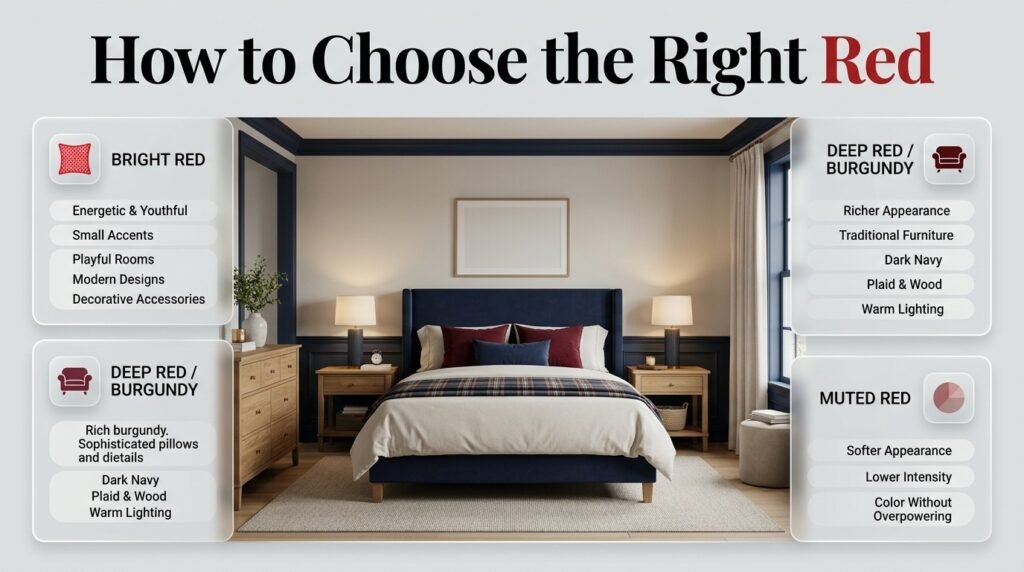
Not all reds produce the same effect.
Bright Red
Bright red is energetic and youthful.
It works best in:
- Small accents
- Playful rooms
- Modern designs
- Decorative accessories
Deep Red
Deep red or burgundy feels richer.
It works particularly well with:
- Traditional furniture
- Dark navy
- Plaid
- Wood
- Warm lighting
Muted Red
Muted red can create a softer appearance.
It’s useful when you want color without too much intensity.
Which Red Should You Choose?
Think about the atmosphere you want.
Energetic → brighter red
Traditional → deeper red
Soft and cozy → muted red
The right shade also depends on the amount of natural light in the room.
How to Choose the Right Navy
Navy can range from relatively bright blue to extremely deep blue.
A dark navy can create a sophisticated atmosphere, but it may also make a small or poorly lit room feel heavier.
A slightly lighter navy can be easier to use across larger surfaces.
Before choosing wall paint or expensive furniture, test the color in the actual room.
Look at it during:
- Morning
- Afternoon
- Evening
- Artificial lighting
- Cloudy conditions
⭐ Expert Tip: A color that looks perfect under a store’s bright lighting can look completely different in your bedroom. Always evaluate larger samples in the actual space.
How to Mix Patterns in a Red and Navy Preppy Room
Pattern mixing is one of the most important parts of preppy design.
The trick isn’t choosing patterns that are identical.
It’s choosing patterns that have a visual relationship.
A simple hierarchy is:
Large Pattern
Use a large stripe or bold plaid.
Medium Pattern
Add a medium check or geometric print.
Small Pattern
Finish with a small gingham or subtle motif.
For example:
Large navy-and-white stripe
Medium red-and-navy plaid
Small cream check
Because the patterns have different scales, they don’t compete equally.
Should Every Pattern Contain Red and Navy?
No.
This is one of the easiest mistakes to make.
If every pillow, blanket, curtain, and rug contains red and navy, the room may feel artificially coordinated.
Instead, let each piece perform a different role.
For example:
- Bedding → navy
- Pillow → red plaid
- Rug → cream
- Curtains → white
- Artwork → navy and red
- Furniture → wood
The room still feels connected without becoming repetitive.
How to Style the Bed
The bed is usually the largest visual object in a bedroom.
Start with a neutral foundation.
Layer 1: Sheets
Choose white or cream.
Layer 2: Main Bedding
Choose navy.
Layer 3: Pattern
Add plaid or stripes.
Layer 4: Accent
Add one or two red cushions.
Layer 5: Texture
Finish with a soft throw.
The result should look layered but still practical.
Don’t add so many pillows that the bed becomes difficult to use.
Red and Navy Preppy Room Ideas for Small Bedrooms
Small rooms require careful use of visual weight.
A simple strategy is:
Light walls + navy focal point + red accents + light furniture
Avoid putting dark color on every major surface.
For example, don’t combine:
- Navy walls
- Navy curtains
- Navy rug
- Navy bed
- Dark furniture
unless the room receives plenty of light and you deliberately want a dramatic look.
Instead, allow white, cream, and natural wood to occupy significant areas.
Small Bedroom Checklist
- Keep walls light.
- Choose one main navy feature.
- Use red selectively.
- Avoid oversized furniture.
- Keep the floor visible.
- Use layered lighting.
- Limit competing patterns.
- Keep surfaces organized.
How Can You Make a Small Room Feel Larger?
Color helps, but layout matters just as much.
Try:
- Using light-colored walls
- Choosing furniture that fits the room
- Keeping pathways clear
- Using mirrors strategically
- Hanging curtains higher
- Choosing furniture with visible legs
- Reducing unnecessary accessories
- Using lighter rugs
A small room doesn’t need to be completely white.
It simply needs enough visual breathing room.
Red and Navy Ideas for Large Bedrooms
Large bedrooms provide more flexibility.
You can use:
- Navy accent walls
- Larger rugs
- Statement headboards
- Navy chairs
- Patterned curtains
- Multiple artwork pieces
- Stronger red accents
However, avoid using every idea simultaneously.
A large room still benefits from a clear hierarchy.
Choose one focal point.
Then allow the other elements to support it.
How to Create a Cozy Red and Navy Bedroom
Cozy design comes from texture as much as color.
Add:
- Quilted bedding
- Soft blankets
- Woven baskets
- Fabric lampshades
- Cushioned seating
- Natural wood
- Soft rugs
- Cream textiles
Red plaid works particularly well because it naturally gives the room a warm, traditional feeling.
A good cozy formula is:
Navy duvet + cream blanket + red plaid throw + wood furniture
For more ideas focused specifically on warmth and comfort, explore Cozy Preppy Room inspiration.
How to Create a Modern Red and Navy Preppy Room
Traditional red and navy can sometimes look formal.
If you prefer a more contemporary version, simplify the room.
Use:
- Clean-lined furniture
- Solid navy textiles
- Small red accents
- White walls
- Simple artwork
- Light wood
- Minimal accessories
Reduce the number of traditional patterns.
One stripe or plaid item may be enough.
The Modern Preppy Room approach is useful if you want to maintain the preppy personality while giving the space a cleaner, more current appearance.
How to Create a Minimal Red and Navy Room
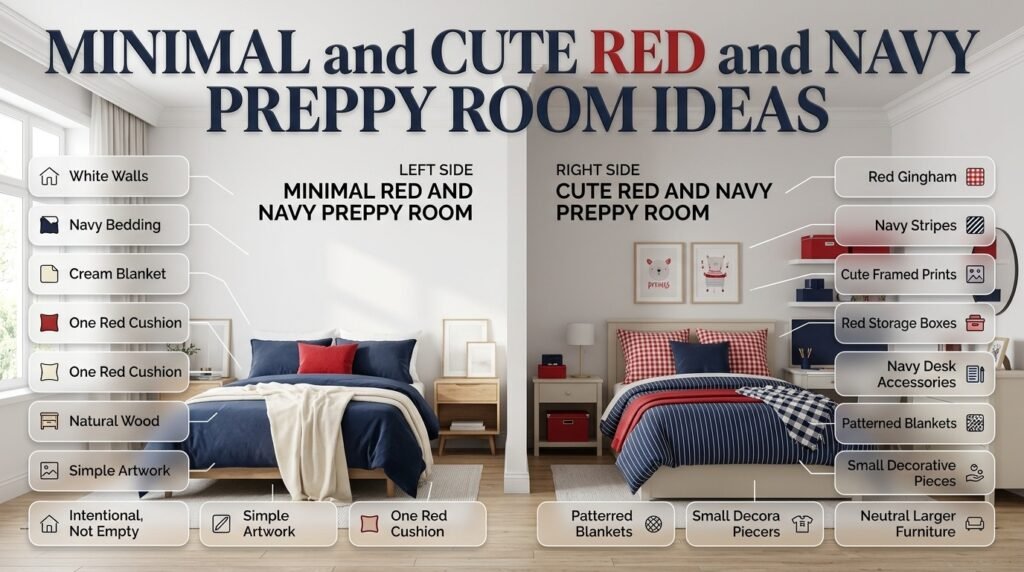
Minimal preppy design depends on restraint.
A simple example could be:
White walls
Navy bedding
Cream blanket
One red cushion
Natural wood nightstand
Simple framed artwork
That’s enough.
You don’t need a large collection of accessories.
The room should feel intentional rather than empty.
If you prefer a cleaner approach, Minimal Preppy Room ideas can help you simplify patterns, furniture, and decorative elements while maintaining the preppy character.
Cute Red and Navy Preppy Room Ideas
A playful room can use the same palette in a lighter way.
Try:
- Red gingham pillows
- Navy striped bedding
- Cute framed prints
- Red storage boxes
- Navy desk accessories
- Patterned blankets
- Small decorative pieces
Keep larger furniture neutral.
That way, accessories can change as your preferences change.
For more playful decorating ideas, the Cute Preppy Room style offers another way to use patterns and color without making the entire room feel overly formal.
Classic Red and Navy Preppy Room Ideas
The classic version relies heavily on timeless details.
Consider:
- Traditional wood furniture
- Navy upholstery
- Red plaid
- White trim
- Striped bedding
- Framed artwork
- Tailored curtains
- Classic lamps
The goal is not to make the room look old-fashioned.
Instead, focus on pieces that are less dependent on short-term trends.
If this is your preferred direction, explore Classic Preppy Room ideas for additional inspiration on traditional patterns, furniture, and timeless room arrangements.
Navy and Red Curtains: What Works Best?
Curtains can become a major part of the room’s visual balance.
Navy Curtains
Use them when:
- Walls are light.
- You want navy to be more dominant.
- The room has enough natural light.
White Curtains
Use them when:
- The room is small.
- You want maximum brightness.
- Bedding already contains strong colors.
Cream Curtains
Choose them when you want:
- A warmer atmosphere
- A softer appearance
- Better connection with wood furniture
Patterned Curtains
Use them carefully.
If the bedding already contains plaid or stripes, a simple curtain is usually better.
How to Choose a Rug for a Red and Navy Room
A rug should connect the furniture rather than compete with it.
If the bedding is mostly solid navy, you can use a stronger patterned rug.
If the bedding contains plaid, choose a quieter rug.
Good choices include:
- Navy and cream
- Red and navy
- Beige with navy
- Cream with red details
- Traditional neutral patterns
For smaller rooms, lighter rugs can help maintain a more open appearance.
Wall Art for Red and Navy Bedrooms
Artwork gives you an opportunity to repeat the palette in a less obvious way.
Consider:
- Botanical prints
- Nautical-inspired artwork
- Architectural drawings
- Classic landscapes
- Geometric prints
- Traditional illustrations
- Abstract artwork
The artwork doesn’t have to literally depict the colors everywhere.
A mostly neutral print with a small red detail can be enough.
Lighting Ideas for Red and Navy Rooms
Lighting is especially important when using navy.
A room should ideally have multiple lighting layers.
Ambient Lighting
Provides general illumination.
Task Lighting
Useful for reading, studying, or working.
Accent Lighting
Adds atmosphere and highlights specific areas.
Bedside lamps are particularly useful.
Choose lamps with shades that distribute light comfortably.
Warm lighting can make cream, wood, and red accents feel more inviting.
⚠ Common Mistake: Using dark navy furniture and a single weak ceiling fixture. The room may feel much darker at night than expected.
How to Use Accessories
Accessories should reinforce the design rather than fill every empty surface.
A dresser might need only:
- One lamp
- One framed print
- One decorative box
- One small plant
A nightstand may need:
- Lamp
- Book
- Small personal object
The goal is to create enough detail without visual clutter.
Red and Navy With Greenery
Plants can introduce a natural element into the room.
Green works surprisingly well with navy and red because it adds an organic quality.
Use greenery around:
- Windows
- Desks
- Dressers
- Reading corners
- Shelves
You don’t need many plants.
One or two well-placed plants can be enough.
How to Make Red and Navy Look More Sophisticated
Sophisticated design is mostly about proportion and restraint.
Focus on:
Balanced Colors
Don’t let red dominate.
Quality-Looking Textures
Layer fabrics rather than relying on color alone.
Natural Materials
Wood and woven materials add warmth.
Consistent Hardware
Keep metallic finishes reasonably consistent.
Clean Surfaces
Avoid excessive decoration.
Proper Furniture Scale
Large furniture should fit the room.
The room doesn’t need expensive objects to feel polished.
Red and Navy With Traditional Wood Furniture
Traditional wood furniture pairs naturally with navy and red.
The warmth of wood softens the cooler navy.
Try:
Wood bed + navy bedding + cream sheets + red plaid cushion
This is a particularly reliable formula because the wood acts as a bridge between the strong colors.
Red and Navy With White Furniture
White furniture creates a brighter appearance.
It’s especially useful for:
- Small bedrooms
- Rooms with limited sunlight
- Youthful spaces
- Modern preppy rooms
Navy can then be used on the bedding or curtains, while red remains a small accent.
Red and Navy With Black Accents
Black can work, but it should be used sparingly.
Because navy is already dark, too much black can make the room feel heavy.
Use black for:
- Picture frames
- Hardware
- Lamp bases
- Small decorative objects
Keep larger surfaces lighter.
Red and Navy With Alternative Color Palettes
You don’t have to stay with red forever.
If you love navy but eventually want a softer room, blue and cream can create a calmer atmosphere. The Blue and Cream palette is especially useful when you want to maintain a classic preppy feeling while reducing the contrast created by red.
For a much lighter and more playful direction, Pink and White ideas can show how a preppy room changes when strong navy is replaced with softer, brighter tones.
Another option is Green and Cream, which creates a more natural and relaxed atmosphere while still working with traditional patterns and classic furniture.
These alternatives are useful because they demonstrate an important design principle: the underlying preppy style can remain the same even when the color palette changes.
Red and Navy Preppy Room Ideas for a Home Office
The palette works well in a study or home office.
Try:
- White or wood desk
- Navy chair
- Red desk accessories
- White wall
- Navy curtains
- Framed artwork
- Warm desk lamp
Keep the workspace functional.
Decorative pieces shouldn’t interfere with the surface you actually need for studying or working.
Red and Navy Reading Corner

A reading corner can use the colors in a very small area.
Choose:
- Navy chair
- Cream blanket
- Red cushion
- Small wood table
- Warm lamp
Because the area is small, you can use stronger colors without changing the atmosphere of the entire room.
Red and Navy Guest Bedroom
A guest bedroom should generally feel comfortable rather than overly personalized.
Try:
White walls + navy bedding + cream blanket + subtle red artwork
Avoid filling the room with too many patterns.
Guests should have enough visual calm to make the room feel relaxing.
How to Make the Room Feel Personal
A polished room should still reflect the person using it.
Add:
- Favorite artwork
- Books
- Photographs
- Travel memories
- Personal collections
- Handmade objects
Don’t force everything to match.
Personal objects often make a room feel more authentic.
How to Design the Room Step by Step
Step 1: Measure the Room
Measure:
- Width
- Length
- Ceiling height
- Windows
- Doors
- Existing furniture
This prevents furniture from overwhelming the room.
Step 2: Identify the Focal Point
Usually the bed is the focal point.
If the room has a fireplace, large window, or architectural feature, that may take priority.
Step 3: Choose the Neutral Foundation
Select white, cream, beige, or another light neutral.
This gives you flexibility.
Step 4: Choose the Navy Feature
Pick one major navy element.
For example:
- Bed
- Headboard
- Accent wall
- Curtains
- Rug
- Chair
Step 5: Add Red
Start with two or three red accents.
Don’t immediately add red everywhere.
Step 6: Choose Your Main Pattern
Select plaid, stripes, gingham, checks, or another preppy pattern.
Make this your strongest pattern.
Step 7: Add a Secondary Pattern
If necessary, add a smaller pattern.
Make sure it has a different scale.
Step 8: Add Texture
Use:
- Wood
- Woven materials
- Quilted fabrics
- Soft blankets
- Rugs
- Upholstery
Step 9: Layer the Lighting
Use ceiling lighting plus bedside or task lighting.
Step 10: Edit the Room
This final step is important.
Look around and ask:
- Is there too much red?
- Is there too much navy?
- Are the patterns competing?
- Does the room feel dark?
- Are surfaces too crowded?
Remove unnecessary items before buying more.
Common Mistakes When Decorating With Red and Navy
Using Too Much Red
Red attracts attention quickly.
If it’s on the walls, bedding, curtains, furniture, and accessories, the room can become overwhelming.
Better approach: Use red as an accent.
Using Too Much Navy
Navy can look sophisticated, so it’s easy to keep adding it.
But navy walls, bedding, curtains, rug, and furniture can create too much visual weight.
Better approach: Break navy up with white, cream, beige, and wood.
Using Too Many Patterns
Stripes, plaid, checks, florals, and geometric patterns can all look good separately.
Together, they may compete.
Better approach: Choose one dominant pattern and one or two supporting patterns.
Matching Everything Exactly
When every item has the same colors and pattern, the room can feel staged.
Better approach: Coordinate colors without making every object identical.
Ignoring Lighting
A navy room can look dramatically different at night.
Better approach: Use multiple light sources.
Choosing Oversized Furniture
Large furniture can make a room feel cramped.
Better approach: Measure first and leave enough circulation space.
Forgetting Texture
A room can have beautiful colors but still feel flat.
Better approach: Add wood, textiles, rugs, woven pieces, and layered bedding.
Using Red Only Once
If red appears in one isolated location, it may look accidental.
Better approach: Repeat small amounts of red in two or three places.
Using Red Everywhere
The opposite problem is equally common.
Better approach: Allow neutral areas to remain neutral.
Following the Style Too Literally
A preppy room doesn’t need every classic symbol or pattern.
Better approach: Use preppy design principles while keeping the room personal.
How to Make a Red and Navy Room Look Expensive

You don’t need a huge budget.
Instead, focus on:
Proportion
Furniture should fit the room.
Consistency
Repeat colors naturally.
Texture
Mix smooth, soft, woven, and natural materials.
Lighting
Good lighting can improve the appearance of even simple furniture.
Organization
A clean room usually looks more polished.
Restraint
Avoid buying decorations simply because an empty surface exists.
A well-designed room often has fewer things than expected.
10 Easy Red and Navy Room Formulas
Formula 1
White walls + navy bedding + red plaid pillow + wood furniture.
Formula 2
Navy accent wall + white bed + red artwork + cream rug.
Formula 3
White furniture + navy curtains + red throw + beige rug.
Formula 4
Cream walls + navy headboard + red cushions + medium wood.
Formula 5
Navy duvet + white sheets + red gingham + natural wood.
Formula 6
White walls + navy rug + neutral furniture + red accessories.
Formula 7
Navy chair + white desk + red accessories + framed artwork.
Formula 8
Navy walls + white trim + cream bedding + small red details.
Formula 9
Neutral bedroom + navy curtains + red plaid blanket.
Formula 10
White walls + navy furniture + one strong red accent.
Red and Navy Room Ideas for Different Styles
Traditional
Use deeper red, dark navy, wood furniture, plaid, stripes, and classic artwork.
Modern
Use clean-lined furniture, solid navy, white surfaces, and small red accents.
Cozy
Use cream textiles, warm wood, plaid throws, and layered bedding.
Minimal
Use white walls, one navy focal point, one or two red accents, and limited accessories.
Playful
Use brighter red, gingham, stripes, and fun decorative pieces.
The same color combination can therefore produce very different results.
How to Keep the Room Fresh Over Time
One of the best strategies is to keep permanent pieces relatively timeless.
Use neutral colors for:
- Walls
- Large furniture
- Flooring
- Major lighting
Then change:
- Pillows
- Throws
- Artwork
- Small accessories
- Decorative objects
This makes it much easier to update the room without starting over.
For example, you could eventually replace red accents with cream, green, pink, or another color while keeping the navy foundation.
Professional Tips for Better Results
Start With the Largest Pieces
Choose the bed, walls, flooring, and major furniture before buying accessories.
Work With What You Already Own
If you already have wood furniture, incorporate it.
Repeat Colors Carefully
A color should appear more than once but doesn’t need to appear everywhere.
Vary Texture
Texture prevents the room from feeling flat.
Keep One Area Quiet
If the bed is highly patterned, keep another area simpler.
Don’t Rush the Accessories
Live with the main pieces for a while before deciding what is missing.
⭐ Expert Tip: If a room feels unfinished, don’t automatically buy more decorations. First check the balance of color, scale, texture, and lighting. Often the solution is moving or removing something rather than adding another item.
Red and Navy Preppy Room Ideas: Final Checklist
Before you consider the room finished, review these areas.
Color
- Is navy the dominant color?
- Is red controlled?
- Are there enough light neutrals?
- Does the palette feel comfortable?
Furniture
- Does everything fit?
- Is there enough walking space?
- Are the furniture styles compatible?
Patterns
- Is one pattern dominant?
- Are the pattern scales different?
- Are there enough solid surfaces?
Lighting
- Is there enough natural light?
- Are there multiple light sources?
- Does the navy still look good at night?
Accessories
- Are the pieces useful or meaningful?
- Are surfaces overcrowded?
- Does red appear naturally in several areas?
Texture
- Are there soft materials?
- Is there natural wood?
- Does the room feel comfortable?
How do you balance red and navy in a preppy bedroom?
The easiest way to make red and navy work together is to let navy act as the visual foundation and use red as a controlled accent. Navy has enough depth to work on larger elements such as bedding, curtains, a headboard, or an accent wall, while red is usually more effective on pillows, throws, artwork, plaid patterns, or smaller accessories. Adding white, cream, beige, or natural wood keeps the combination from becoming too heavy.
The important point is that the room doesn’t need equal amounts of red and navy. Equal distribution can actually make the space feel overly coordinated. A stronger design gives each color a specific purpose.
A practical combination is:
Navy for the main furniture or bedding
White or cream for the visual breathing space
Red for smaller decorative accents
Natural wood for warmth
Plaid or stripes for classic preppy character
Professional tip: If you’re unsure about the amount of red, start with removable pieces such as cushions and throws. It’s much easier to increase or reduce an accent color than to repaint a wall or replace major furniture.
What colors go best with a red and navy preppy room?
White and cream are two of the safest supporting colors because they soften the contrast between red and navy while keeping the room bright. Beige and warm neutrals work particularly well when the bedroom contains wood furniture, while muted greens or soft blues can be introduced when you want a more layered palette. The key is to use supporting colors to create balance rather than adding another dominant shade.
A well-planned palette might look like navy + white + red + warm wood, with cream used in bedding or textiles. This gives you enough contrast to make the room interesting without creating too many competing colors.
Good supporting choices include:
White: crisp and traditional
Cream: warmer and softer
Beige: relaxed and natural
Light blue: fresh and airy
Muted green: adds an organic touch
Natural wood: introduces warmth and texture
The important thing is to establish a hierarchy. Choose one dominant color, one accent color, and supporting neutrals rather than giving every color equal visual importance.
What patterns work best with red and navy preppy room decor?
Stripes, plaid, gingham, checks, and selected geometric patterns are particularly effective because they naturally reinforce the classic preppy aesthetic. The trick is not simply choosing several patterns that contain the same colors. You need to control their scale so that the patterns complement rather than compete with one another.
For example, a larger navy-and-white stripe can work as the primary pattern on bedding, while a smaller red plaid pillow introduces contrast. A subtle check can then appear elsewhere without becoming another major focal point.
A simple pattern strategy is:
Choose one large or dominant pattern
Add one medium-scale pattern
Use a small pattern only if necessary
Keep some major surfaces solid
Repeat colors instead of repeating identical patterns
This approach gives the room the layered character associated with preppy interiors while avoiding the cluttered appearance that happens when every textile has a different bold print.
Expert advice: If your duvet already has a strong plaid pattern, let the pillows and curtains become quieter. Pattern needs contrast in scale and visual weight, not constant competition.
How can you make a red and navy preppy bedroom look modern instead of old-fashioned?
A modern red and navy preppy bedroom comes down to editing. Keep the recognizable preppy elements—navy, red accents, stripes, plaid, tailored details—but combine them with cleaner furniture, simpler artwork, fewer accessories, and more open space. You don’t have to remove the traditional character; you simply reduce the amount of visual clutter.
For example, instead of using several patterned pillows, choose one strong red-and-navy plaid cushion and combine it with solid navy and cream bedding. Pair that with a simple wood or white nightstand and contemporary lighting.
To modernize the palette:
Use clean-lined furniture
Keep walls white, cream, or softly neutral
Choose one statement pattern
Use red in small, intentional areas
Avoid excessive themed accessories
Mix traditional textiles with contemporary shapes
Leave some surfaces visually quiet
This creates a room that still feels unmistakably preppy but doesn’t look like a recreation of a specific era.
The current preference for richer colors, layered patterns, natural materials, and more personal interiors also makes this balanced approach particularly relevant to contemporary decorating.
What is the easiest way to create a red and navy preppy room on a budget?
The most practical approach is to keep expensive or permanent elements neutral and introduce red and navy through textiles and accessories. You don’t need to replace the bed, repaint every wall, or purchase a complete matching furniture set to create the look. A few carefully selected changes can establish the palette surprisingly well.
Start with what you already have. If your furniture is white, wood, beige, or another neutral, keep it. Then introduce navy through bedding or curtains and add red through one or two pillows, a throw, artwork, or a small decorative piece.
A budget-friendly starting list could include:
Navy duvet or comforter
White or cream sheets
One red plaid pillow
Simple navy or neutral curtains
Small framed artwork
Textured throw blanket
Existing wood or white furniture
One small decorative accent
The advantage of this approach is flexibility. If you later decide that you want less red, you can simply replace the red accessories without redesigning the whole bedroom.
Best rule to follow: Spend more attention on arrangement, proportion, and color balance than on the number of decorations. A simple room with well-chosen pieces usually looks more intentional than an expensive room filled with unrelated accessories.
Conclusion
Creating a beautiful red and navy preppy room isn’t about using both colors everywhere. The real difference comes from balance, proportion, pattern, and texture. Navy can provide the strong foundation, while red adds warmth and personality through carefully selected pillows, throws, artwork, plaid, or smaller decorative details.
The most successful rooms also give lighter colors enough space to breathe. White, cream, beige, and natural wood can soften the deeper tones and keep the bedroom feeling comfortable rather than visually heavy. Stripes, plaid, gingham, and checks can then bring in the classic preppy character without making every part of the room compete for attention.
Whether you prefer a traditional, cozy, modern, minimal, or more playful look, the same red and navy palette can be adapted to suit your style. Start with the largest elements, introduce your main navy feature, add red gradually, and finish with textures and personal details that make the room feel like your own.
Most importantly, coordinate instead of matching everything perfectly. A thoughtfully arranged room with a few strong design choices will always feel more natural than a space filled with too many matching decorations. Take your time, experiment with the palette, and let the room develop around the pieces you genuinely love.
Leave a Reply