
Introduction
Green and Navy Preppy Room Ideas | Creating a room around two strong colors can sound easy until you actually start choosing the walls, bedding, furniture, curtains, rugs, and accessories. Green and navy look beautiful together in inspiration photos, but using too much of either color can make a room feel dark, crowded, or overly coordinated.
That’s why green and navy preppy room ideas are really about balance rather than simply putting green and navy items into the same room.
Navy brings structure, depth, and a classic feeling. Green adds freshness, softness, and a natural connection to the outdoors. When you combine them with warm neutrals, classic patterns, natural materials, and carefully selected furniture, the result can feel polished without looking like a showroom.
In this guide, you’ll learn how to build a green and navy preppy room from the ground up. We’ll cover color selection, walls, bedding, furniture, patterns, lighting, accessories, small bedrooms, large rooms, study areas, budget decorating, common mistakes, and practical ways to make the finished room feel personal.
If you are still developing the overall style of your space, the Preppy Room homepage can help you explore the wider preppy decorating concept before narrowing your palette down to green and navy.
What Is a Green and Navy Preppy Room?
A green and navy preppy room combines the rich depth of navy with the natural character of green while using recognizable preppy design elements such as stripes, plaid, gingham, tailored textiles, classic furniture, framed artwork, layered bedding, and balanced color repetition.
The important point is that preppy style isn’t created by color alone.
You could paint a bedroom navy and add green cushions, but that doesn’t automatically make it preppy. The room becomes more convincingly preppy when the colors are supported by classic patterns, thoughtful proportions, layered textures, and furniture that feels intentional.
For example, imagine a bedroom with:
- A cream upholstered bed
- Navy-and-white striped bedding
- Sage-green cushions
- A botanical print
- Natural wood nightstands
- A woven rug
- A brass table lamp
- A small gingham accent
None of these elements needs to look overly decorative on its own. Together, however, they establish a recognizable visual language.
The best green and navy rooms usually have one additional quality: restraint.
You don’t need green on every wall, navy on every piece of furniture, and a different pattern on every cushion. In fact, the room often looks more sophisticated when some areas are deliberately quiet.
Why Do Green and Navy Work So Well Together?
Green and navy share a certain visual depth, which allows them to sit comfortably together without looking random.
Navy feels structured and traditional. Green feels organic and refreshing.
That contrast creates interest.
Navy can provide the architectural or visual anchor of the room, while green can soften the overall appearance through textiles, artwork, curtains, plants, or upholstery.
The combination also works with several decorating personalities.
For a Traditional Room
Use:
- Deep navy
- Forest green
- Cream
- Walnut wood
- Brass
- Plaid
- Stripes
This creates a more established and sophisticated atmosphere.
For a Relaxed Room
Use:
- Sage green
- Medium navy
- Warm white
- Light oak
- Linen
- Simple botanical prints
This keeps the palette comfortable and approachable.
For a Youthful Room
Use:
- Mint or soft green
- Medium navy
- White
- Gingham
- Small floral patterns
- Simple furniture
This creates a lighter interpretation without losing the classic color relationship.
For a Dramatic Room
Use:
- Forest green
- Deep navy
- Cream
- Dark wood
- Brass
- Velvet or heavier textiles
This works particularly well in rooms with good natural light.
Pro Tip: Before buying anything, decide which color will be the visual leader. If navy is already going to dominate the bed, curtains, and rug, green should usually be introduced more selectively.
How Do You Choose the Right Shades of Green and Navy?
The words “green” and “navy” cover a surprisingly large range of shades.
A muted sage green and a bright emerald green will create completely different rooms, even if both are technically green.
The same applies to navy.
A traditional navy can feel crisp and classic, while an almost-black navy can feel much more dramatic.
Sage Green + Classic Navy
This is one of the easiest combinations for beginners.
Sage is muted enough to balance navy without competing with it.
It works particularly well with:
- Cream
- White
- Light oak
- Linen
- Brass
- Natural fibers
Use sage through curtains, cushions, bedding, artwork, or an upholstered chair.
Forest Green + Deep Navy
This combination is richer and more dramatic.
It can look beautiful in a large bedroom with plenty of natural light.
Because both colors are dark, add generous amounts of cream, ivory, or warm white.
Olive Green + Navy
Olive introduces an earthy quality.
It pairs especially well with:
- Walnut
- Beige
- Tan
- Cream
- Leather
- Woven materials
This is a good option if you want the room to feel sophisticated without becoming overly formal.
Emerald Green + Navy
Emerald is much more saturated.
Rather than using it across multiple large surfaces, consider it an accent.
A green velvet chair, decorative pillow, artwork, or small throw can be enough.
Mint Green + Navy
Mint creates more contrast and feels lighter.
It works well for:
- Smaller rooms
- Youthful bedrooms
- Cute preppy spaces
- Bright rooms
- Fresh summer-inspired decorating
The key is keeping the navy from becoming too dominant.
Should Green or Navy Be the Main Color?
Neither color has to be the main color. You can also make cream, white, or another neutral the dominant foundation.
However, choosing a visual hierarchy makes decorating much easier.
Make Navy the Main Color If You Want:
- A classic look
- Stronger contrast
- A sophisticated atmosphere
- Traditional preppy character
- More visual depth
Make Green the Main Color If You Want:
- A softer feeling
- A natural atmosphere
- More freshness
- A relaxed room
- A less formal interpretation
Make a Neutral the Main Color If You Want:
- A brighter room
- More flexibility
- Easier seasonal changes
- A visually open space
- Less risk of overusing dark colors
For example:
Cream foundation + navy furniture + sage accents
is an easy formula for a balanced bedroom.
Another option is:
Warm white foundation + sage bedding + navy accessories
Both approaches clearly communicate the green-and-navy palette without forcing the two colors to occupy equal amounts of space.
What Is the Best Color Ratio for Green and Navy?

There is no mandatory decorating formula, but a simple ratio can help when you’re unsure where to begin.
Try thinking in three levels:
Main foundation → supporting color → small accent
For example:
- 60% cream or warm white
- 25% navy
- 15% green
Or:
- 60% warm white
- 25% sage
- 15% navy
The exact percentages aren’t important.
What matters is that the room has a clear visual hierarchy.
If everything is equally dark and equally colorful, the eye has nowhere to rest.
If the room is mostly neutral with carefully repeated green and navy details, the colors become more noticeable because they’re surrounded by quieter surfaces.
How Do You Use Green and Navy on the Walls?
Wall color is one of the biggest decisions because it covers such a large visual area.
You have several options.
Option 1: Keep the Walls Neutral
This is the safest approach.
Use:
- Cream
- Warm white
- Soft beige
- Very light gray
Then introduce green and navy through furniture and accessories.
This works especially well in small rooms.
Option 2: Paint One Wall Green
A muted sage or forest green accent wall can create a strong focal point.
Place the bed, desk, or main furniture against it.
If the green is dark, keep the surrounding furniture and textiles lighter.
Option 3: Use Navy on the Walls
Navy walls can look sophisticated, particularly in a bedroom.
However, balance them with:
- Cream bedding
- Light curtains
- Light wood
- Bright artwork
- Good layered lighting
Avoid combining navy walls with a navy bed, dark wood, and a dark rug unless the room is large and receives plenty of daylight.
Option 4: Use Wallpaper
Wallpaper can introduce both colors at once.
Consider:
- Botanical designs
- Small-scale plaid
- Traditional stripes
- Geometric patterns
- Subtle floral designs
If the wallpaper is busy, keep the rest of the room simpler.
Expert Tip: Always judge a wall color at different times of day. A shade that looks perfect in bright afternoon light can appear considerably darker under warm artificial lighting at night.
How Do You Decorate the Bed in a Green and Navy Room?
The bed is usually the largest visual element in a bedroom, so it is a natural place to establish the color palette.
A simple layered arrangement might look like this:
Cream sheets → navy duvet → green cushions → patterned lumbar pillow → textured throw
This gives you several opportunities to repeat the colors without making every item identical.
Navy Bedding
Navy bedding creates a strong anchor.
Balance it with:
- Cream sheets
- Sage cushions
- White pillowcases
- Light-colored throw
- Natural wood furniture
Green Bedding
Green bedding feels softer and more nature-inspired.
If you choose forest or emerald green, use lighter pillows and sheets around it.
Patterned Bedding
A navy-and-green plaid or stripe can establish the preppy style immediately.
If the bedding is strongly patterned, don’t put another large competing pattern directly beside it.
Instead, use solid cushions and one smaller print.
What Bedding Colors Work Best With Green and Navy?
The safest bedding colors are:
- Cream
- Warm white
- Navy
- Sage
- Muted green
- Light blue
- Soft beige
Cream is particularly useful because it connects dark colors with lighter furniture.
If the bed itself is navy, cream bedding can prevent the bed from looking too heavy.
If the bed is cream, navy bedding can become the main focal point.
If both bed and bedding are neutral, green and navy can be introduced through pillows, throws, curtains, and artwork.
How Do You Mix Plaid, Stripes, Gingham, and Florals?
Patterns are one of the strongest tools for creating a preppy atmosphere.
But pattern mixing requires more thought than simply finding several fabrics with the same colors.
The easiest approach is to vary pattern scale.
Large Pattern
Use this as the primary visual statement.
Examples:
- Wide navy stripe
- Large plaid
- Oversized botanical
Medium Pattern
Use this to support the primary pattern.
Examples:
- Medium floral
- Smaller stripe
- Medium-scale check
Small Pattern
Use this as an accent.
Examples:
- Tiny gingham
- Small check
- Narrow stripe
For example:
Large navy stripe + medium green botanical + small cream gingham
can feel layered without being chaotic.
The patterns don’t need to match perfectly.
They simply need enough shared color and enough variation in scale to avoid competing.
Explore Green and Navy Room Ideas
If you want to use green and navy beyond a specifically preppy bedroom, it is helpful to understand how this color combination can work across different room types and decorating styles. Green brings a natural, fresh quality to an interior, while navy adds depth, structure, and a more refined character. The key is to select shades that suit the room’s natural light, size, furniture, and overall mood rather than treating green and navy as equal colors everywhere. For a broader guide to this combination, explore Green and Navy Room Ideas, where you can learn how to pair shades such as sage, olive, emerald, forest, and mint with different navy tones. The guide also covers practical ways to distribute the colors across walls, furniture, bedding, curtains, rugs, artwork, and accessories while using cream, white, beige, natural wood, and other supporting finishes to maintain visual balance. Whether you are designing a bedroom, living room, study, guest room, or another space, these ideas can help you create a coordinated interior that feels intentional, comfortable, and stylish without making the room look overly dark or heavily color-matched.
How Many Patterns Should a Preppy Room Have?
There is no fixed number, but three clearly different pattern scales are usually enough to create visual interest.
You could use:
- Striped duvet
- Botanical cushion
- Gingham throw
Then keep the rug, curtains, walls, and larger furniture relatively simple.
This creates contrast without making the room look busy.
A common beginner mistake is assuming that every preppy room needs plaid, gingham, stripes, florals, checks, and geometric patterns simultaneously.
It doesn’t.
Preppy style is about recognizable design language, not maximum decoration.
Create a Balanced Green and Navy Bedroom
If you want to bring the green and navy palette specifically into a bedroom, focus on balance, layering, and pattern coordination rather than using both colors equally throughout the space. A navy headboard or quilt can provide structure, while sage, olive, or softer green accents can add freshness through pillows, throws, artwork, or curtains. Cream, white, and natural wood are useful supporting elements because they keep the room from feeling too dark or visually crowded. For more practical inspiration on choosing bedding, wall colors, furniture, patterns, and decorative accents, explore these green and navy preppy bedroom ideas. This approach makes it easier to create a bedroom that feels coordinated, comfortable, and distinctly preppy without making every element match exactly.
What Furniture Looks Best With Green and Navy?
Furniture determines whether the room feels light, traditional, modern, or dramatic.
Light Wood
Light oak and similar finishes work beautifully with sage green and navy.
They keep the palette warm without competing with the colors.
Medium Wood
Medium wood creates a more traditional atmosphere.
It works especially well with:
- Forest green
- Navy
- Cream
- Brass
Dark Wood
Walnut and other darker woods create a richer appearance.
Because the furniture is already visually heavy, use enough light-colored textiles to maintain balance.
White Furniture
White furniture keeps the room bright and is particularly useful in smaller bedrooms.
It works well with:
- Navy
- Sage
- Mint
- Botanical patterns
- Light rugs
Upholstered Furniture
An upholstered headboard or chair can become a major color element.
For example:
Navy upholstered headboard + cream bedding + sage cushions
creates a strong preppy foundation without requiring a colorful wall.
How Do You Choose a Rug for a Green and Navy Room?
A rug should support the palette rather than compete with it.
Good options include:
- Cream
- Beige
- Natural fiber
- Navy-and-cream pattern
- Green-and-cream pattern
- Small traditional motif
If your bedding already has a bold pattern, a simpler rug is usually better.
If the bedding is mostly solid, the rug can provide more visual interest.
In a small room, lighter rugs can help maintain an open appearance.
In a large room, a larger patterned rug can help connect separate furniture zones.
How Should Curtains Be Used?
Curtains cover a large vertical area, so they can significantly influence the room’s color balance.
Green Curtains
Green curtains can reinforce a sage or olive palette.
They work well with neutral walls and navy bedding.
Navy Curtains
Navy curtains create a stronger appearance.
Use them carefully in smaller rooms.
Cream Curtains
Cream is the safest option if you already have plenty of green and navy elsewhere.
They allow the stronger colors to remain the focal points.
Patterned Curtains
Patterned curtains work best when the rest of the room is relatively calm.
A botanical curtain can connect green with natural themes, while a subtle stripe can reinforce classic preppy character.
How Do You Use Artwork in a Green and Navy Room?
Artwork is one of the easiest ways to connect colors that appear in different areas.
Look for:
- Botanical prints
- Traditional landscapes
- Nautical-inspired artwork
- Classic illustrations
- Abstract pieces containing green and navy
- Simple typography if appropriate for the room
- Framed fabric or textile art
A gallery wall can contain several different frame styles, but keeping one common finish can make the arrangement feel more organized.
For example:
- Natural wood frames
- Brass frames
- Black frames
- White frames
Choose one main direction rather than mixing every finish.
How Can You Use Plants Without Making the Room Too Green?
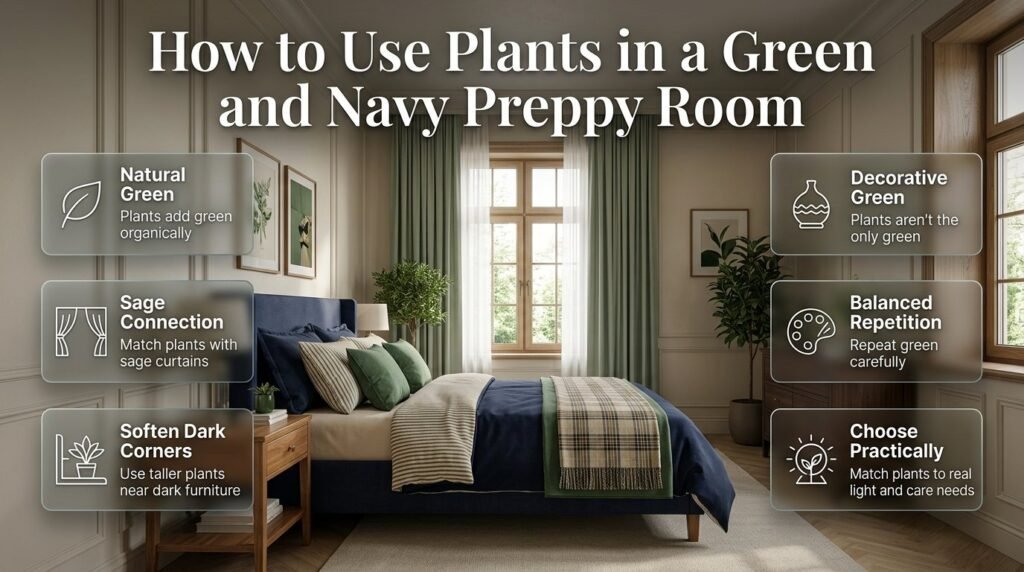
Plants are useful because they naturally introduce green without making the color feel artificially repeated.
A small plant on a nightstand can connect with sage curtains.
A taller plant can soften the corner of a room containing dark furniture.
However, plants shouldn’t become the only source of green.
Use decorative green elements as well if green is an important part of the palette.
Also choose plants based on actual lighting and care requirements rather than choosing them only because they look good in a photo.
What Lighting Works Best With Green and Navy?
Lighting can completely change how dark colors appear.
A room with navy and forest green needs enough illumination to prevent the colors from feeling muddy.
Use several layers of lighting.
Ambient Lighting
This provides general illumination.
Task Lighting
A desk lamp or reading lamp provides focused light.
Accent Lighting
A small lamp, wall light, or decorative fixture can add atmosphere.
Warm bulbs often make cream, wood, and brass feel inviting.
Cooler lighting can make navy and green appear more crisp but may also make the room feel less warm.
Quick Tip: Don’t judge your color palette only during the daytime. Turn on your actual lamps at night and see whether the green and navy still look balanced.
Explore Green and Navy Room Inspiration
Choosing the right combination of green and navy is easier when you can see how these colors work together in different room settings. If you are still deciding on the right balance between the two shades, our green and navy room inspiration guide is a helpful next step. It explores different ways to combine green and navy with lighter neutrals, natural materials, classic patterns, and carefully selected accents so the room feels coordinated rather than visually overwhelming. You can use these ideas to compare softer combinations such as sage and navy with deeper options such as olive, forest green, or emerald paired with dark navy. The guide can also help you think beyond wall color by considering how bedding, rugs, curtains, furniture, artwork, and smaller decorative pieces contribute to the overall palette. This is especially useful if you want to create a preppy room that feels polished and layered while still remaining comfortable and practical. Before purchasing major furniture or accessories, reviewing a variety of green and navy combinations can give you a clearer idea of which color balance, pattern style, and supporting neutral will work best for your own space.
How Do You Decorate a Small Green and Navy Preppy Room?
Small rooms can absolutely use dark colors.
The key is controlling where those colors appear.
A useful arrangement is:
Light walls + navy focal point + green accents + light furniture
For example:
- Warm white walls
- Navy headboard
- Cream bedding
- Sage cushions
- Light oak nightstand
- Cream rug
- Small navy artwork
- Green plant
This gives the room a clear identity without making every surface dark.
What Should You Avoid?
Avoid combining too many heavy elements:
- Dark green walls
- Navy furniture
- Dark wood
- Dark rug
- Heavy navy curtains
One or two of these can work beautifully.
All of them together may make a small room feel visually compressed.
Mirrors can also help reflect light, especially when placed opposite a window or light source.
How Do You Decorate a Large Green and Navy Bedroom?
Large rooms give you more freedom.
You can use deeper shades and larger patterns because there is more visual space between the elements.
For example:
- Forest green accent wall
- Navy upholstered bed
- Cream bedding
- Large patterned rug
- Green curtains
- Walnut furniture
- Brass lighting
You can also divide the room into zones.
Sleeping Zone
Navy bed + cream bedding + green cushions.
Reading Zone
Green chair + wooden side table + brass lamp.
Window Zone
Green curtains + neutral rug + small plant.
The same palette connects all three zones without requiring every piece to match.
Can Green and Navy Work in a Preppy Study Area?
Absolutely.
A study area is a great place to use navy and green in smaller quantities.
Try:
- Navy desk chair
- Green desk accessories
- Cream or wood desk
- Botanical artwork
- Brass desk lamp
- Navy storage box
- Green notebook or organizer
You can also use a green upholstered chair as the main accent and repeat navy through artwork and accessories.
This creates a coordinated workspace without making it feel like a bedroom extension.
How Can You Make Green and Navy Look More Modern?
The modern version of this palette is mostly about editing.
Keep the colors but simplify the room.
Choose:
- Clean-lined furniture
- Muted sage
- Deep navy
- Warm white
- Light oak
- Minimal artwork
- One strong pattern
- Simple lighting
Avoid filling every shelf with decorative objects.
A modern preppy room can still have stripes or plaid, but those patterns should have space around them.
The goal is not to remove the preppy personality.
It is to make the personality more controlled.
Create a Balanced Green and Navy Preppy Interior
For a polished preppy space, it is important to think beyond simply combining two attractive colors. A successful green and navy preppy interior depends on choosing the right shades, balancing darker tones with warm neutrals, and introducing patterns, natural wood, brass accents, and comfortable textures in a controlled way. If you want to understand how these elements work together across bedrooms, living rooms, studies, and other spaces, explore our detailed guide to Green and Navy Preppy Interior. It provides practical ideas for selecting green and navy shades, deciding which color should dominate, mixing classic preppy patterns, and keeping the overall room stylish without making it feel too dark or visually busy.
How Can You Make the Room Feel More Classic?
For a traditional interpretation, introduce stronger preppy references.
Use:
- Deep navy
- Forest green
- Ivory
- Walnut
- Brass
- Plaid
- Stripes
- Botanical artwork
- Traditional furniture
A navy upholstered bed with ivory bedding and forest-green plaid cushions is an excellent starting point.
A brass lamp and wooden nightstand can reinforce the traditional character.
The room doesn’t need antique furniture.
Classic style is often more about proportion, materials, pattern, and repetition than the age of individual pieces.
How Can You Make Green and Navy Feel Cozy?
Color alone doesn’t create coziness.
Texture does much of the work.
Layer:
- Quilted bedding
- Knitted throws
- Woven baskets
- Soft rugs
- Linen curtains
- Upholstered furniture
- Natural wood
- Warm lighting
Sage green is especially effective for a cozy room because its muted quality feels softer than highly saturated green.
If the room feels cold, add warm wood and cream before introducing another strong color.
How Can You Create a More Elegant Green and Navy Room?
Elegance usually comes from restraint.
Instead of adding more decoration, improve the quality and relationship of the existing elements.
For example:
- Deep navy upholstery
- Muted forest green
- Cream bedding
- Walnut wood
- Brass lighting
- One large artwork
- One carefully selected patterned textile
Avoid using too many small decorative objects.
Large, well-proportioned pieces often look more refined than numerous inexpensive accents.
What Accent Colors Can Be Added?
Green and navy don’t have to remain the only colors.
However, additional colors should have a clear purpose.
Cream
The safest supporting color.
Warm White
Excellent for creating contrast.
Beige
Adds warmth.
Tan
Works particularly well with olive and navy.
Brass
Adds traditional sophistication.
Blush
Can soften the palette when used sparingly.
Light Blue
Can create a fresh layered color story.
Terracotta
A small amount can introduce warmth, particularly with olive green.
The mistake is adding too many accents at once.
If you already have green, navy, cream, wood, and brass, you probably don’t need five more colors.
How Do You Decorate on a Budget?
You don’t need to replace an entire bedroom to create a green and navy preppy look.
Start with the pieces you already own.
Change the Bedding
A new duvet cover or pillow covers can immediately alter the room.
Change the Curtains
Curtains create a large color block and can dramatically shift the appearance.
Update Small Accessories
Try:
- Lampshades
- Cushions
- Throws
- Frames
- Storage boxes
- Desk accessories
Repaint One Piece
A small side table, chair, or shelf can become a new accent.
Rearrange Furniture
Sometimes the room feels wrong because of layout rather than color.
Move the bed, desk, chair, or storage pieces and reassess the visual balance.
Shop Your Existing Home
You may already have items that fit the palette.
A wooden frame from another room, a cream throw, or a brass lamp may work perfectly.
How Do You Create a Green and Navy Room Without Making Everything Match?
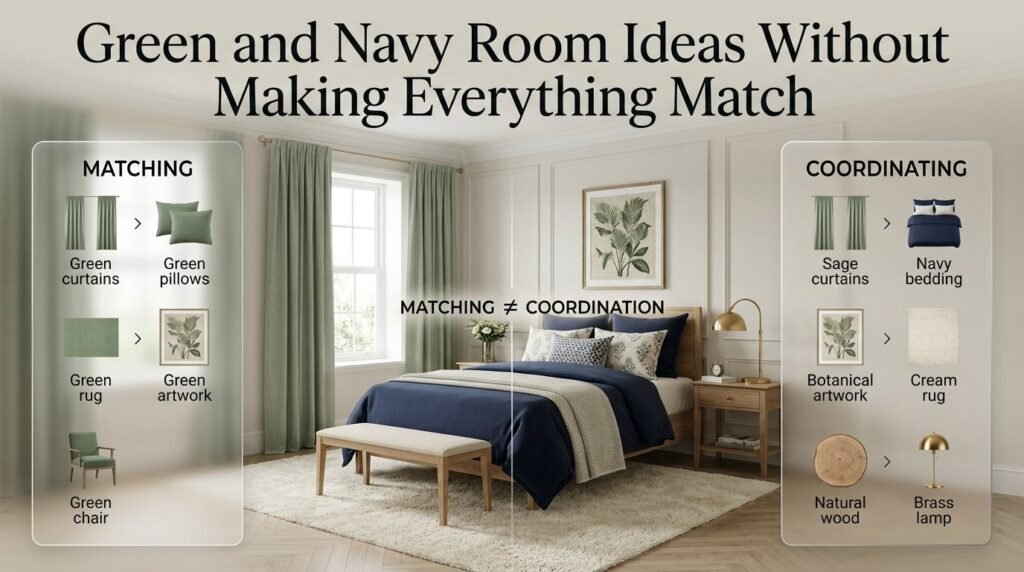
This is one of the most important decorating principles.
Coordination is not the same as matching.
Matching might look like:
- Green curtains
- Green pillows
- Green rug
- Green artwork
- Green chair
Coordination could look like:
- Sage curtains
- Navy bedding
- Botanical artwork
- Cream rug
- Natural wood
- Brass lamp
The second approach is usually more sophisticated.
The colors repeat, but the materials, patterns, and surfaces are different.
This creates a room that feels collected rather than purchased as one set.
How Do You Create Balance Across the Room?
Imagine looking at your room from the doorway.
Where does your eye go first?
If everything dark is concentrated on one side, the room may feel unbalanced.
For example, if you have:
- Navy bed
- Navy rug
- Navy chair
all on one side, introduce small navy details elsewhere.
You might repeat navy through:
- Artwork
- A cushion
- Lamp base
- Small decorative object
The same principle applies to green.
The color doesn’t need to appear equally everywhere.
It simply needs to appear often enough to feel intentional.
Common Green and Navy Decorating Mistakes
Mistake 1: Using Too Much Navy
Navy is a classic preppy color, but that doesn’t mean every major surface needs to be navy.
Why it happens: Navy feels safe and timeless.
Why it causes problems: Too much can make the room feel visually heavy.
Better solution: Use navy for one or two major anchors and repeat it through smaller accents.
Mistake 2: Choosing Two Extremely Dark Shades
Deep forest green and almost-black navy can look beautiful together, but they require strong lighting and lighter supporting colors.
Better solution: Add cream, warm white, light wood, and reflective surfaces.
Mistake 3: Making Every Item Green and Navy
This can make the room look artificially themed.
Better solution: Use neutral furniture and supporting materials.
Mistake 4: Ignoring Pattern Scale
Five patterns of the same visual strength can compete.
Better solution: Use one large pattern, one medium pattern, and one small pattern.
Mistake 5: Forgetting the Floor
The floor occupies a large visual area.
A dark floor combined with dark walls and dark furniture can make the room feel heavier.
A lighter rug can help create separation.
Mistake 6: Buying Decor Before Choosing the Main Pieces
Small accessories cannot fix a weak foundation.
Choose the walls, bed, major furniture, and large textiles first.
Then add decorative pieces.
Mistake 7: Following Inspiration Photos Too Literally
A beautiful photograph may have completely different:
- Natural light
- Room size
- Ceiling height
- Flooring
- Window placement
Use inspiration for ideas, not as a precise shopping list.
How Can You Plan the Room Before Buying Anything?
Create a simple planning board.
Collect images of:
- Wall color
- Bed
- Bedding
- Rug
- Curtains
- Furniture
- Lighting
- Artwork
- Accessories
Put them together and look at them as one composition.
Ask:
- Is there too much navy?
- Is the green too bright?
- Are there enough light surfaces?
- Are the patterns competing?
- Does the wood finish work?
- Does the room still look comfortable?
This simple step can prevent expensive mistakes.
A Practical Green and Navy Room Formula
If you’re completely unsure where to start, use this formula:
Foundation
Warm white or cream walls.
Main Furniture
Natural wood, white, or upholstered furniture.
Main Color
Navy on the bed, chair, or another major focal point.
Secondary Color
Sage green through curtains, cushions, artwork, or upholstery.
Pattern
One navy stripe or plaid.
Texture
Woven basket, quilted bedding, soft rug, or knitted throw.
Accent
Small brass details.
This formula is flexible enough to work in different room sizes and budgets.
Green and Navy Ideas for Different Personalities
The Traditional Style
Choose:
- Forest green
- Deep navy
- Ivory
- Walnut
- Brass
- Plaid
- Stripe
The result should feel established and classic.
The Modern Style
Choose:
- Sage
- Deep navy
- Warm white
- Light oak
- Minimal patterns
Keep the furniture clean and the accessories limited.
The Cozy Style
Choose:
- Olive
- Navy
- Cream
- Natural wood
- Quilted textiles
- Woven materials
Focus on softness.
The Playful Style
Choose:
- Mint
- Medium navy
- White
- Gingham
- Small florals
Keep dark colors controlled.
The Minimal Style
Choose:
- Muted sage
- Small navy accents
- Warm white
- Light wood
- Very limited decoration
Let empty space become part of the design.
How Can You Make the Room Feel Personal?
A successful room shouldn’t look like a catalog.
Add things that reflect the person using the room.
Consider:
- Books
- Personal photographs
- Favorite artwork
- Travel memories
- Collections
- Handmade objects
- Meaningful gifts
- Favorite textiles
These items don’t need to perfectly match the palette.
A little variation can make the room feel authentic.
If every object has been selected only because it matches green and navy, the result can feel staged.
Preppy interiors work particularly well when they combine order with personality.
How Do You Know When the Room Is Finished?
This is harder than it sounds.
A common decorating mistake is continuing to add things because a shelf, wall, or corner looks “empty.”
Empty space isn’t necessarily a problem.
Ask yourself:
- Does the room feel balanced?
- Can I move around comfortably?
- Is the main focal point clear?
- Are the colors repeated naturally?
- Do the patterns have different scales?
- Is there enough light?
- Does the room feel like me?
If the answer is yes, stop.
More decoration won’t automatically improve it.
A Green and Navy Preppy Room Checklist
Before considering the room finished, check each area.
Color
- One dominant color is clear
- Green and navy are repeated naturally
- Enough cream, white, or another neutral is present
- Dark colors aren’t concentrated in one area
Furniture
- Furniture proportions suit the room
- Wood finishes don’t clash
- Large furniture doesn’t overwhelm the palette
Bedding
- Bedding has a clear color relationship
- Patterns aren’t competing
- Neutral layers provide visual rest
Patterns
- One pattern acts as the focal point
- Supporting patterns are smaller
- Solid fabrics balance patterned ones
Lighting
- The room has general lighting
- There is useful task lighting
- Evening lighting doesn’t make the room too dark
Accessories
- Accessories repeat the main colors
- Personal items are included
- Shelves aren’t overcrowded
Final Check
Stand at the doorway and look at the room as one composition.
That’s often more useful than examining individual pieces.
Expert Tips for Getting the Palette Right

Start With the Largest Surface
If the walls are already painted, work around them rather than fighting them.
If you’re starting from scratch, decide on the wall color before choosing small accessories.
Choose the Pattern Early
A favorite plaid or botanical fabric can become the inspiration for the entire room.
Pull green, navy, cream, and supporting colors directly from it.
Use Natural Materials
Wood, linen, cotton, woven fibers, and rattan can prevent the palette from feeling too polished or artificial.
Repeat Colors in Different Materials
Navy doesn’t always have to be fabric.
It can appear in:
- Ceramic
- Artwork
- Upholstery
- Books
- Metal-painted furniture
Green can appear in:
- Textiles
- Artwork
- Plants
- Glass
- Ceramics
This makes the palette feel more sophisticated.
Don’t Chase Exact Color Matching
Different shades can work together.
A muted sage doesn’t have to exactly match the green in a botanical print.
A slightly different navy can actually create more depth.
What Are the Best Green and Navy Combinations?
Here are several starting palettes you can use.
Soft and Fresh
Sage + Navy + Warm White + Light Wood
Best for relaxed bedrooms.
Classic
Forest Green + Navy + Ivory + Walnut + Brass
Best for traditional rooms.
Earthy
Olive + Navy + Beige + Natural Wood
Best for cozy spaces.
Youthful
Mint + Medium Navy + White + Light Wood
Best for cheerful rooms.
Elegant
Emerald + Deep Navy + Cream + Brass
Best when used as controlled accents.
Calm
Muted Green + Soft Navy + Cream + Linen
Best for a comfortable bedroom.
The important thing is to choose one palette and develop it rather than trying to combine all six.
What colors go best with green and navy in a preppy room?
Green and navy already create a rich and sophisticated foundation, so the best supporting colors are those that provide lightness and warmth without competing with the main palette. Cream, warm white, beige, natural wood, and brass are particularly effective. Cream is especially useful because it softens the contrast between deep navy and green while keeping the room welcoming rather than overly dark.
For a more traditional preppy room, combine navy and forest green with ivory, walnut wood, and small brass details. For a softer bedroom, sage green, navy, warm white, and light oak create a much more relaxed appearance.
Practical ways to balance the palette:
Use cream or warm white for larger surfaces such as walls, bedding, or curtains.
Add natural wood to introduce warmth and texture.
Use brass in small amounts through lamps, frames, or hardware.
Keep additional accent colors limited so green and navy remain the visual focus.
Choose muted shades when the room already contains several strong patterns.
How do you decorate a small room with green and navy without making it look dark?
The key to decorating a small room with green and navy is controlling the amount of dark color rather than avoiding it completely. Navy and green can actually create beautiful contrast in a small space when they are used selectively. Instead of covering every major surface in dark shades, use a light neutral foundation and introduce green and navy through bedding, curtains, artwork, cushions, or one statement furniture piece.
For example, warm-white walls with a navy headboard, cream bedding, sage cushions, and light wood furniture can create a clearly defined preppy style while keeping the room visually open.
Smart small-room choices include:
Keep walls light if the room has limited natural light.
Use navy or green on one major focal point instead of every wall.
Choose light oak, white, or cream furniture where possible.
Add a lighter rug to separate dark furniture from the floor.
Use mirrors to reflect available natural or artificial light.
Layer bedside and ambient lighting so the room doesn’t become too dark at night.
What shades of green work best with navy for a preppy room?
The best green depends on the atmosphere you’re trying to create. Sage green is one of the most versatile choices because its muted quality works naturally with classic navy. Forest green creates a deeper traditional appearance, olive green introduces an earthy character, and emerald green provides a more dramatic and luxurious accent.
Rather than choosing green simply because you like the color by itself, consider how it interacts with your room’s lighting, furniture, flooring, and amount of navy. A dark forest green can look sophisticated in a bright room but may feel heavy when combined with dark furniture in a poorly lit space.
Popular combinations to consider:
Sage + navy: Soft, balanced, and easy to decorate.
Forest green + navy: Rich, traditional, and dramatic.
Olive + navy: Warm, earthy, and sophisticated.
Emerald + navy: Bold and luxurious when used selectively.
Mint + navy: Fresh, youthful, and brighter for smaller spaces.
How do you make a green and navy room look professionally designed instead of overly matched?
A professionally designed room usually doesn’t make every item match perfectly. Instead, it creates visual relationships through repetition, proportion, texture, and pattern. Green and navy should appear in different materials and areas of the room rather than being repeated as identical matching sets.
For example, navy might appear in the bedding and artwork, while green appears in curtains and cushions. Cream furniture and natural wood can sit between those colors, creating separation and balance. Adding one classic pattern, such as plaid or stripes, can then establish the preppy character.
Professional styling principles to use:
Repeat each main color in at least two or three different areas.
Mix solid fabrics with plaid, stripes, gingham, or botanical patterns.
Vary textures instead of buying everything from one matching collection.
Use natural wood to break up large blocks of color.
Leave some surfaces intentionally simple so the room can breathe.
Use brass or another warm finish as a small repeated detail rather than everywhere.
What patterns and decor work best in a green and navy preppy room?
Classic preppy patterns such as stripes, plaid, gingham, checks, and botanical prints work particularly well with green and navy. The important part is not how many patterns you use but how you combine them. A room becomes much more sophisticated when patterns have different scales and clear visual roles.
For instance, a navy-and-cream striped duvet can act as the primary pattern, while a smaller green botanical cushion becomes the secondary pattern. A subtle gingham throw can then provide a small finishing detail. The colors connect the patterns, while the different scales prevent them from competing.
A practical pattern hierarchy looks like this:
Use one large pattern as the main focal point.
Add one medium-scale pattern for visual support.
Use a small pattern only as an accent.
Keep some major surfaces solid to provide visual rest.
Repeat colors from the patterns in artwork, curtains, or accessories.
Avoid putting several large, high-contrast patterns next to each other.
This approach gives the room the recognizable character of preppy design while keeping the overall space polished, comfortable, and intentional.
Conclusion
Green and navy can create a preppy room that feels classic, confident, comfortable, and highly personal when the two colors are balanced thoughtfully. The goal is not to make every element match perfectly, but to create a cohesive room through color repetition, pattern, texture, furniture, lighting, and carefully selected accents.
Start with the atmosphere you want to create, then choose the right shades of green and navy for your space. Sage and navy can produce a softer, relaxed look, while forest green and navy create a richer traditional feel. If you prefer something more dramatic, emerald accents can add sophistication without overwhelming the room.
The most successful designs also give lighter colors room to breathe. Cream, warm white, natural wood, beige, and soft neutral tones can prevent darker colors from making the space feel heavy. From there, introduce classic preppy details such as stripes, plaid, gingham, checks, botanical patterns, brass accents, framed artwork, and layered textiles.
Whether you are decorating a bedroom, study area, dorm room, or complete living space, focus on balance rather than perfection. Use green and navy as the defining colors, then allow furniture, lighting, textures, and personal accessories to give the room its own character.
With the right proportions and a thoughtful mix of classic and modern details, a green and navy preppy room can remain stylish for years while still feeling welcoming and uniquely yours.
For more inspiration, explore the wider collection of Preppy Room ideas and discover practical ways to develop a polished room around your preferred style and personality.