Introduction
Preppy Room Inspo | A room can have beautiful furniture, clean walls, and plenty of decoration and still feel like something is missing. Maybe the space looks too plain, too crowded, or simply doesn’t feel connected to your personality.
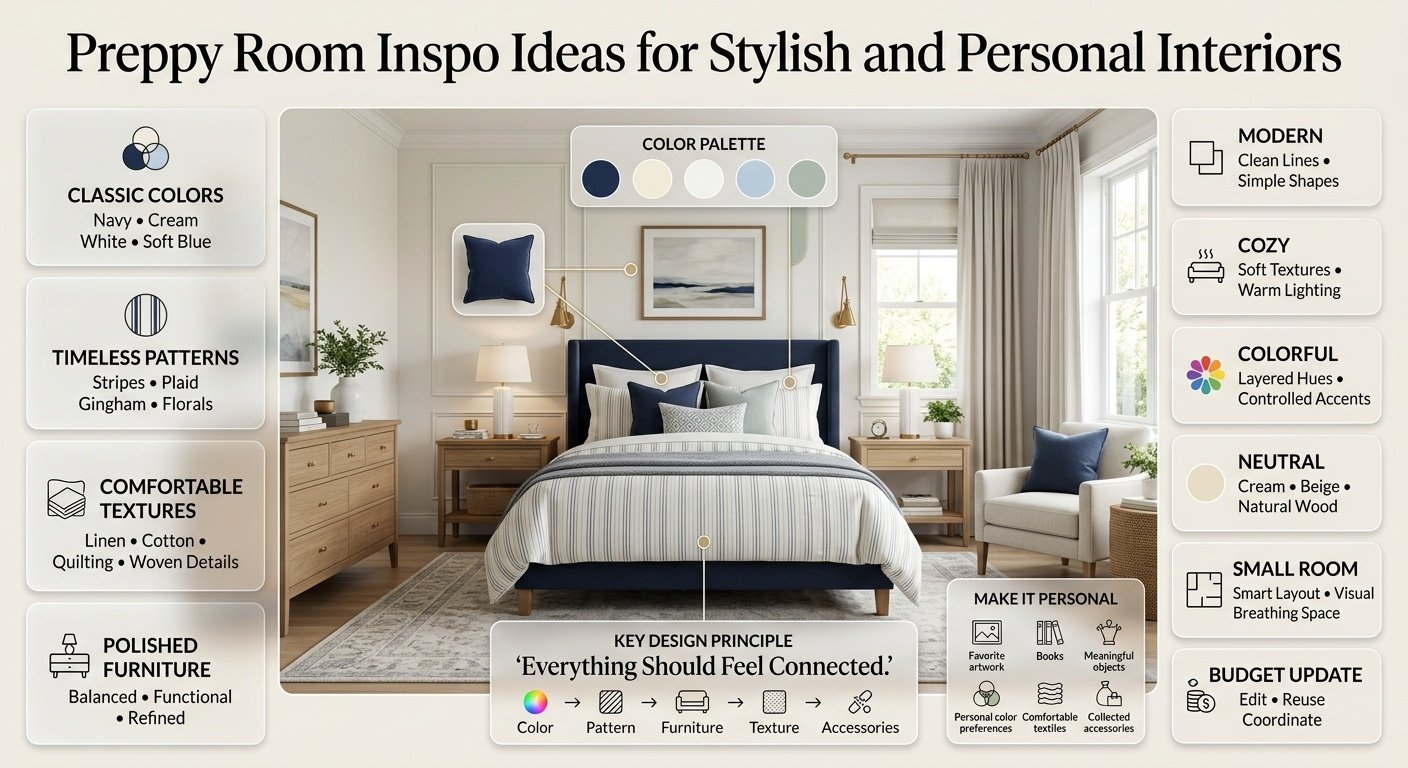
That’s exactly where Preppy Room Inspo becomes useful. Instead of copying one specific room, you can use preppy design principles to create a space with classic colors, timeless patterns, comfortable textures, polished furniture, and personal details.
If you’re starting from scratch or simply want to refresh the room you already have, Preppy Room can give you a broader starting point before you begin choosing individual colors, patterns, furniture, and accessories.
The best preppy rooms aren’t necessarily the ones with the most decorations. They are the rooms where everything feels connected. A navy cushion relates to the artwork. The artwork repeats a color from the rug. The rug works with the furniture. The bedding introduces a pattern without competing with everything else.
That sense of connection is what makes a room feel intentionally designed.
In this guide, you’ll find practical Preppy Room Inspo for bedrooms, small rooms, modern spaces, cozy rooms, colorful interiors, neutral palettes, and budget-friendly updates. You’ll also learn how to combine patterns, choose colors, style furniture, decorate walls, create a polished look, avoid common mistakes, and make your room feel personal rather than copied.
What Is Preppy Room Inspo?
Preppy Room Inspo is decorating inspiration based on classic colors, recognizable patterns, polished furniture, layered textiles, and personal decorative details. Popular elements include navy, white, cream, blue, green, pink, stripes, checks, florals, plaid, traditional furniture, framed artwork, natural materials, and carefully chosen accessories.
The word “preppy” doesn’t mean that every room has to look formal or traditional.
A preppy room can be:
- Classic
- Modern
- Cute
- Cozy
- Minimal
- Colorful
- Neutral
- Coastal-inspired
- Traditional
- Playful
The important thing is how the elements work together.
For example, navy and white can create a classic preppy room, while navy, cream, light wood, and simple furniture can create a softer modern version. Pink, green, and floral patterns can make the same style feel cheerful and playful.
So rather than asking, “What objects do I need to make my room preppy?” ask:
“What combination of color, pattern, texture, furniture, and personality creates the atmosphere I want?”
That question will lead to much better decorating decisions.
What Makes a Room Look Preppy?
A preppy room usually combines several visual characteristics rather than relying on one particular decoration.
The strongest foundation normally comes from five areas:
- A coordinated color palette
- Classic or clean furniture
- Structured patterns
- Layered textiles
- Personal decorative details
1. Coordinated Colors
Preppy interiors often use recognizable color combinations such as:
- Navy and white
- Blue and cream
- Pink and white
- Green and cream
- Green and navy
- Red and navy
- Light blue and white
- Soft pastel combinations
- Neutral and classic tones
The colors don’t have to be bright.
A soft blue and cream room can feel just as preppy as a bold navy and white room.
2. Classic Furniture
Furniture with simple traditional shapes can instantly support the style.
Think about:
- Wooden desks
- Upholstered beds
- Classic nightstands
- Simple dressers
- Bookcases
- Comfortable chairs
- Traditional benches
However, modern furniture can also work.
The important thing is that the furniture feels intentional and works with the room’s colors.
3. Patterns
Patterns are one of the easiest ways to introduce preppy character.
Popular choices include:
- Stripes
- Gingham
- Plaid
- Checks
- Florals
- Geometric prints
- Small repeating patterns
The mistake is assuming that more patterns automatically create a stronger preppy room.
Usually, the opposite happens.
A few coordinated patterns can look sophisticated. Too many unrelated patterns can make the room feel chaotic.
4. Layered Textiles
Textiles soften the room and give the design depth.
You can layer:
- Bedding
- Cushions
- Throws
- Rugs
- Curtains
- Upholstery
- Decorative fabrics
This is especially useful when your room has a simple color palette.
5. Personal Details
A preppy room should still feel like someone’s real room.
Add:
- Favorite books
- Personal photographs
- Meaningful artwork
- Collections
- Travel memories
- Favorite colors
- Decorative objects
The room shouldn’t look like a showroom.
How Do You Start Decorating a Preppy Room?
The easiest way to avoid expensive mistakes is to create the room’s visual direction before buying anything.
You don’t need a professional interior designer or complicated software.
Start with the room you already have.
Step 1: Look at What You Already Own
Before shopping, identify the pieces that you want to keep.
Ask:
- What furniture do I already like?
- What colors are already present?
- Which items are practical?
- Which items look out of place?
- What needs replacing?
- What can simply be rearranged?
You may discover that the room doesn’t need a complete makeover.
It may only need better coordination.
Step 2: Choose an Anchor Color
Pick one color that will visually lead the room.
Good options include:
- Navy
- Soft blue
- Sage
- Forest green
- Pink
- Cream
- Beige
Navy is particularly flexible because it works with many supporting shades.
But don’t automatically choose navy simply because it’s associated with preppy style.
If you love green, build around green.
If you prefer soft pink, use pink.
If you want a calmer room, start with cream and introduce color gradually.
Step 3: Choose a Supporting Color
Your second color should complement the first.
For example:
Navy + White
Green + Cream
Pink + White
Blue + Cream
Navy + Green
The supporting color doesn’t have to occupy the same amount of space.
It simply needs to appear enough times to connect the room.
Step 4: Choose One Main Pattern
This is an important step.
Don’t start with five patterns.
Choose one pattern that will become the visual feature.
For example:
- Navy stripe bedding
- Green floral curtains
- Pink gingham cushions
- Plaid throw
- Checked rug
Once the main pattern is selected, use simpler textures and solid colors around it.
Step 5: Add Supporting Details
Now introduce smaller elements.
These might include:
- Artwork
- Lamps
- Books
- Cushions
- Plants
- Decorative trays
- Mirrors
- Small objects
At this stage, the room should begin to feel complete without looking crowded.
How Do You Choose a Preppy Room Color Palette?
Color is probably the biggest factor in how your room feels.
The same furniture can look completely different depending on the palette around it.
A navy room with white and brass feels different from a navy room with red and cream.
That’s why color planning should happen before accessory shopping.
Navy and White Preppy Room
Navy and white is one of the easiest combinations to work with.
White creates openness.
Navy adds depth.
Together, they create strong contrast without requiring lots of decoration.
You can use:
- White walls
- Navy bedding
- White curtains
- Navy cushions
- Natural wood furniture
- Small brass details
For more specific ideas, explore Navy and White Preppy Room Ideas.
Why This Palette Works
The biggest advantage is flexibility.
You can add another accent color later without changing the entire room.
Try:
Navy + White + Green
or:
Navy + White + Soft Pink
or:
Navy + White + Natural Wood
This makes the room easier to update over time.
Blue and Cream Preppy Room
Blue and cream is softer than a strong navy-and-white combination.
It works particularly well if you want the room to feel:
- Warm
- Comfortable
- Traditional
- Relaxed
- Elegant
Cream also works nicely with wood because both have warm visual qualities.
You can introduce blue through:
- Bedding
- Curtains
- Artwork
- Cushions
- Accent furniture
Then use cream for:
- Walls
- Rugs
- Upholstery
- Bedding layers
For more inspiration, see Blue and Cream Preppy Room.
Pink and White Preppy Room
Pink and white can create a cheerful room while still looking polished.
The key is choosing the right pink.
Soft blush can create a subtle atmosphere.
Stronger pink can create a more energetic room.
If you want the room to feel sophisticated, combine pink with:
- White
- Cream
- Light wood
- Navy
- Brass
- Soft green
You don’t need pink everywhere.
A pink headboard or bedding can be enough to establish the palette.
For additional inspiration, see Pink and White Preppy Room Ideas.
Green and Cream Preppy Room
Green and cream is a particularly versatile combination.
Soft sage can create a relaxed atmosphere.
Deeper green can make the room feel richer and more traditional.
Cream prevents darker green from becoming visually heavy.
Try:
Cream walls + green bedding + wood furniture + botanical artwork
or:
Green accent wall + cream bedding + natural textures
For more ideas, explore Green and Cream Preppy Room Ideas.
Red and Navy Preppy Room
Red and navy create a more energetic traditional palette.
Because both shades can be visually strong, balance them with:
- White
- Cream
- Natural wood
- Beige
A simple formula is:
Cream foundation + navy main color + small red accents
Instead of making red a major color, use it in:
- A cushion
- Artwork
- A throw
- Books
- Small accessories
See Red and Blue Preppy Room Ideas for more inspiration.
Green and Navy Preppy Room
Green and navy can create a deeper, sophisticated atmosphere.
This combination works particularly well with:
- White
- Cream
- Natural wood
- Brass
- Botanical patterns
For example:
Navy bed + cream bedding + green cushions + wooden nightstands
The colors are strong, but the neutral surfaces stop them from becoming overwhelming.
Explore Green and Navy Preppy Room Ideas for more ideas.
Light Blue and White Preppy Room
If navy feels too dark, light blue is a useful alternative.
Light blue and white can make a room feel:
- Airy
- Fresh
- Bright
- Relaxed
- Youthful
The palette also works well in smaller rooms.
You can add:
- Pale blue bedding
- White furniture
- Blue artwork
- Soft blue curtains
- Light wood
See Light Blue and White for additional color inspiration.
Neutral and Classic Preppy Room Colors
Not every preppy room needs strong colors.
Neutral rooms can use:
- Cream
- Beige
- White
- Taupe
- Light brown
- Soft gray
- Natural wood
Then introduce preppy character through:
- Stripes
- Traditional furniture
- Brass details
- Framed artwork
- Layered textiles
This approach is especially useful if you want a room that can easily change later.
For more inspiration, explore Neutral and Classic Tones.
Can You Use Multiple Colors in a Preppy Room?
Yes, but multiple colors need structure.
A multicolor room should not look as though every attractive object was placed together.
Instead, establish relationships between colors.
For example:
Navy + Green + Pink + Cream
The cream acts as the calming foundation.
Navy becomes the anchor.
Green and pink provide accents.
This creates variety while maintaining control.
If you love several colors, Multicolor Preppy Palettes can provide additional direction.
How Do Patterns Work in Preppy Room Inspo?
Patterns are one of the strongest visual tools in preppy interiors.
But patterns need hierarchy.
Think of patterns in three levels:
Dominant Pattern
This is the pattern people notice first.
Examples:
- Large floral
- Bold plaid
- Strong stripe
- Large gingham
Supporting Pattern
This pattern is quieter.
Examples:
- Small check
- Thin stripe
- Small geometric design
Solid Elements
These give the eye a resting place.
For example:
Large floral bedding + small striped cushion + solid cream curtains
This works because each element has a different role.
How Many Patterns Should You Use?
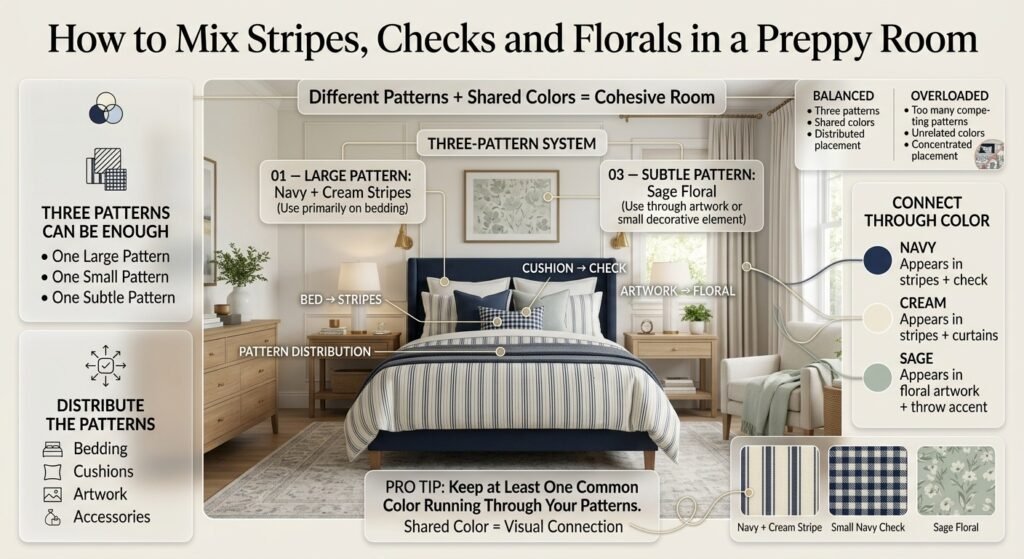
There isn’t a strict number, but three patterns can often be enough for a bedroom.
For example:
- One large pattern
- One small pattern
- One subtle pattern
You don’t need every pattern in the same area.
A floral curtain, striped cushion, and small checked throw can be distributed across the room.
This creates visual movement without making the bed, walls, and floor compete simultaneously.
How Do You Mix Stripes, Checks and Florals?
The easiest way is to connect them through color.
Imagine your main colors are:
Navy + Cream + Sage
Your room might contain:
- Navy-and-cream striped bedding
- Sage floral artwork
- Small navy check cushion
- Cream curtains
The patterns are different, but the colors connect them.
That’s much easier to control than choosing unrelated patterns based only on whether you like each one individually.
💡 Pro Tip: If you’re mixing several patterns, keep at least one common color running through them. The shared color acts like a visual thread connecting the room.
How Can Bedding Create a Preppy Room?
Bedding is often the easiest place to establish the entire style.
Because the bed usually occupies a large visual area, changing the bedding can dramatically change the room without replacing furniture.
Start with a foundation.
Layer 1: Sheets
White or cream sheets are versatile.
Layer 2: Main Quilt or Duvet
This is where you can introduce your main color.
Layer 3: Decorative Pillows
Add one or two patterns.
Layer 4: Throw
A folded throw at the bottom of the bed adds texture.
You don’t need dozens of pillows.
The goal is layering, not excess.
What Furniture Works Best in a Preppy Room?
Furniture should support your chosen direction.
For a classic room, consider:
- Wood furniture
- Upholstered headboards
- Traditional desks
- Classic bedside tables
- Bookcases
- Comfortable armchairs
For a modern room, consider:
- Simple silhouettes
- Clean edges
- Minimal hardware
- Light wood
- Neutral upholstery
You can also combine both.
A traditional desk with modern bedding can create an interesting balance.
Should All Preppy Furniture Match?
No.
In fact, perfectly matching furniture can sometimes make a room feel less personal.
Instead of buying everything from one collection, look for pieces that share something.
For example:
- Similar wood tones
- Similar hardware
- Similar proportions
- Related colors
A white dresser, natural wood desk, and navy upholstered chair can work together without matching exactly.
The room will feel collected rather than manufactured.
How Can You Use Wood in a Preppy Room?
Wood adds warmth to palettes dominated by white, blue, green, or cream.
Light wood can create a relaxed atmosphere.
Medium wood feels traditional.
Dark wood can add richness.
Use wood through:
- Desks
- Bed frames
- Nightstands
- Shelves
- Picture frames
- Stools
- Decorative boxes
Wood is especially useful when a room starts feeling too cold or overly polished.
How Do You Decorate the Walls?
Wall decoration should have a purpose.
Instead of filling every blank wall, identify one or two areas that deserve attention.
Good locations include:
- Above the bed
- Above a desk
- Above a dresser
- Beside a reading chair
Possible decorations include:
- Framed botanical prints
- Classic artwork
- Personal photographs
- Mirrors
- Gallery walls
- Decorative plates
- Simple illustrations
The artwork should relate to your room’s color palette.
If your bedding is navy and cream, artwork containing those colors can make the room feel more connected.
How Do You Create a Preppy Gallery Wall?
A gallery wall can become the room’s focal point.
Start by selecting artwork with a shared connection.
That connection could be:
- Color
- Frame style
- Subject
- Size
- Mood
You don’t need every frame to be identical.
A mixture of frame styles can actually feel more collected.
However, keep the overall arrangement balanced.
Simple Gallery Wall Formula
Try:
Large central piece + two medium pieces + smaller supporting frames
Then leave enough space around the arrangement.
What Lighting Works Best?
Lighting is often overlooked, but it can change the entire mood of a room.
Use more than one light source whenever possible.
For example:
- Ceiling light
- Bedside lamp
- Desk lamp
- Floor lamp
- Accent lighting
Warm lighting generally makes cream, wood, navy, and soft colors feel more comfortable.
A beautiful room can still feel disappointing if the lighting is harsh.
How Do You Use Brass in a Preppy Room?
Small brass details can add polish.
You can introduce brass through:
- Lamp bases
- Drawer handles
- Picture frames
- Mirrors
- Small decorative objects
You don’t need brass everywhere.
A few repeated details are usually enough.
For example:
Brass lamp + brass frame + brass drawer pulls
This creates repetition without making the entire room metallic.
How Do You Make a Preppy Room Cozy?
Preppy rooms can sometimes become too structured.
Texture helps soften the design.
Use:
- Quilted bedding
- Soft throws
- Rugs
- Upholstered chairs
- Curtains
- Cushions
- Woven baskets
- Natural wood
A room with only smooth surfaces can feel flat.
A combination of soft, woven, wooden, and textured materials creates depth.
How Can You Make a Small Room Preppy?
A small room doesn’t need to be boring.
The biggest priority is preventing visual clutter.
Use:
- Light colors
- Multi-purpose furniture
- Vertical storage
- One major pattern
- Compact lighting
- Limited accessories
Avoid placing too many small objects on every surface.
A small room often looks better when a few larger, useful pieces do most of the decorating work.
Small Room Formula
Light foundation + one accent color + one main pattern + useful storage + controlled accessories
This keeps the style visible without sacrificing space.
How Do You Make a Dorm Room Feel Preppy?
Dorm rooms have limitations, but the same design principles still work.
Focus on temporary changes such as:
- Bedding
- Throw pillows
- Removable wall decoration
- Rugs
- Desk accessories
- Lamps
- Storage baskets
- Curtains where permitted
Because dorm furniture is often basic, textiles can make a particularly large difference.
Choose one color palette and repeat it across your bedding, desk accessories, and wall decoration.
How Can You Create a Cute Preppy Room?
A cute preppy room can be playful without becoming visually overwhelming.
Use:
- Soft pink
- Light blue
- Sage
- Cream
- Small florals
- Gingham
- Rounded accessories
- Playful artwork
The trick is balance.
If your bedding is playful, keep the furniture simple.
If your wall art is colorful, use calmer textiles.
For more inspiration, see Cute Preppy Room.
How Can You Create a Modern Preppy Room?
Modern preppy style uses the same general vocabulary but with more restraint.
Instead of:
- Many accessories
- Heavy patterns
- Highly traditional furniture
Try:
- Clean furniture
- Neutral walls
- One strong pattern
- Two or three colors
- Simple artwork
- Natural materials
For example:
Cream walls + navy upholstered bed + light wood nightstands + simple striped bedding + one large artwork
This feels preppy without becoming overly traditional.
Explore Modern Preppy Room for more ideas.
How Can You Create a Minimal Preppy Room?
Minimal preppy design is about editing.
Start with:
- A restrained palette
- Simple furniture
- One or two patterns
- Limited accessories
- Clean surfaces
Instead of decorating every shelf, choose a few meaningful pieces.
The room should feel calm while still having recognizable character.
Minimal Preppy Room can help if you prefer this cleaner interpretation.
How Can You Create a Cozy Preppy Room?
A cozy preppy room should combine classic styling with softness.
Focus on:
- Layered bedding
- Warm lighting
- Soft rugs
- Cushions
- Throws
- Wood
- Comfortable seating
- Warm neutral shades
The room should invite you to spend time there.
For additional ideas, see Cozy Preppy Room.
How Do You Use Preppy Room Decor Without Creating Clutter?
Decoration works best when every item has a reason for being there.
Before adding an object, ask:
Does it add color, texture, function, personality, or visual balance?
If the answer is no, you probably don’t need it.
For example, a tray can organize small objects.
A lamp provides both function and style.
A framed photograph adds personality.
A plant adds natural texture.
These items contribute something.
Ten unrelated decorative objects may contribute very little beyond visual clutter.
For more focused decoration ideas, explore Preppy Room Decor.
30 Practical Preppy Room Inspo Ideas You Can Try
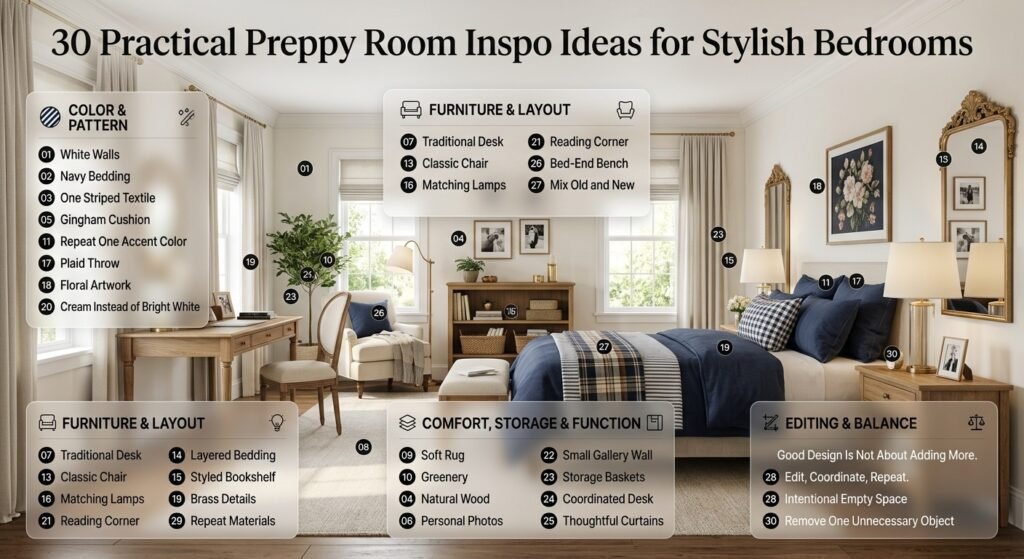
1. Start With White Walls
White gives colorful textiles room to stand out.
2. Add Navy Bedding
Navy immediately creates depth.
3. Use One Striped Textile
A stripe is an easy way to introduce classic character.
4. Add Natural Wood
Wood prevents a blue-and-white room from feeling cold.
5. Try a Gingham Cushion
A small check adds personality without dominating the room.
6. Frame Personal Photos
Personal details make the room feel lived-in.
7. Add a Traditional Desk
A desk can create a classic study-inspired element.
8. Use a Table Lamp
Lighting also becomes part of the decoration.
9. Add a Soft Rug
A rug connects the furniture and adds comfort.
10. Introduce Greenery
Plants soften structured designs.
11. Repeat One Accent Color
Use the same accent in at least two or three areas.
12. Add a Mirror
Mirrors can add light and visual depth.
13. Use a Classic Chair
A comfortable chair can create a useful focal point.
14. Layer Your Bedding
Layering gives the bed more dimension.
15. Style Your Bookshelf
Mix books, artwork, and a few decorative objects.
16. Use Matching Lamps
A pair of lamps can create symmetry.
17. Add a Plaid Throw
Plaid works especially well in classic palettes.
18. Try Floral Artwork
Botanical or floral imagery can soften navy and green palettes.
19. Introduce Brass
Small brass details add warmth.
20. Use Cream Instead of Bright White
Cream can create a softer, warmer atmosphere.
21. Create a Reading Corner
A chair, lamp, and small table can turn an unused area into a useful space.
22. Add a Small Gallery Wall
Keep the colors connected.
23. Use Storage Baskets
Practical storage can still look attractive.
24. Coordinate Your Desk
Keep notebooks, containers, and accessories within the room’s palette.
25. Choose Curtains Carefully
Curtains occupy a large visual area, so their color matters.
26. Add a Bench
A bench at the end of a bed can make the room feel more finished.
27. Mix Old and New
Traditional accessories can work with modern furniture.
28. Use Empty Space Intentionally
Not every surface needs decoration.
29. Repeat Materials
If you use wood in one area, consider repeating it elsewhere.
30. Remove One Unnecessary Object
Editing can improve a room more than adding something new.
30 More Preppy Room Inspo Ideas for a More Personal Space
31. Create a Desk Gallery
Place a small collection of framed artwork above your desk.
32. Use a Decorative Tray
A tray keeps small objects organized.
33. Add a Soft Throw
A throw adds both color and texture.
34. Use a Classic Alarm Clock
Small functional objects can become part of the aesthetic.
35. Display Favorite Books
Books add personality and visual interest.
36. Add a Woven Basket
Natural texture balances polished furniture.
37. Try a Navy Accent Chair
One strong furniture color can anchor a neutral room.
38. Use Greenery Near a Window
Natural light can highlight the plant and surrounding colors.
39. Add Decorative Boxes
Useful storage can also contribute to the style.
40. Use One Statement Artwork
A single large piece can be more effective than many tiny decorations.
41. Coordinate Hardware
Similar hardware finishes make the furniture feel more connected.
42. Add Texture to Neutral Rooms
Use linen-like fabrics, woven materials, wood, and soft textiles.
43. Create Symmetry
Matching lamps or nightstands can create a balanced appearance.
44. Use Asymmetry Carefully
Not every room needs perfect symmetry. One side can contain a chair while the other contains a plant.
45. Repeat a Pattern
If you use stripes, repeat them subtly elsewhere.
46. Keep Your Floor Visible
Too many objects can make the room feel crowded.
47. Choose Appropriate Furniture Size
Large furniture can overwhelm small rooms.
48. Avoid Tiny Accessories Everywhere
A few larger pieces can create a cleaner appearance.
49. Make the Bed the Focal Point
Use bedding, pillows, and artwork to create visual hierarchy.
50. Keep Everyday Items Accessible
A beautiful room still needs to be practical.
51. Use a Consistent Frame Finish
This can make a gallery wall feel more intentional.
52. Add a Small Personal Collection
Display a few objects that actually mean something to you.
53. Create a Color Repetition
Repeat your main blue or green in three different areas.
54. Use a Neutral Rug
A neutral rug can balance stronger colors.
55. Add a Decorative Mirror
Choose a frame that complements your furniture.
56. Layer Curtains
If practical, combine a simple base with a decorative outer layer.
57. Add a Small Ottoman
An ottoman can provide seating and texture.
58. Style the Nightstand
Keep it simple: lamp, book, and one decorative object.
59. Refresh the Room Seasonally
Change small textiles rather than redesigning the whole space.
60. Edit Before You Buy
Sometimes the room already has enough.
How Do You Make a Preppy Room Look Expensive?
A polished room isn’t necessarily an expensive room.
The biggest difference usually comes from how carefully the pieces are selected and arranged.
Focus on Proportion
Furniture and decoration should be appropriately sized for the room.
A tiny rug under a large bed can make the room feel disconnected.
A huge piece of artwork in a small room can overwhelm everything else.
Choose pieces that relate to the scale of the space.
Pay Attention to Curtains
Curtains can dramatically affect the room.
Avoid treating them as an afterthought.
Their color, length, and placement can make the room feel either unfinished or polished.
Keep Surfaces Clean
A clean dresser or nightstand automatically looks more intentional.
You don’t need empty surfaces everywhere.
Just avoid turning every surface into storage.
Repeat Finishes
If you use brass on the lamps, repeat it subtly in another location.
If you use wood furniture, repeat wood somewhere else.
Repetition creates consistency.
How Do You Make a Preppy Room Look Sophisticated?
Sophistication usually comes from restraint.
If the room currently feels too playful or overly decorated, try editing it.
Remove:
- Unnecessary accessories
- Repeated patterns
- Random colors
- Excessive small objects
Then strengthen:
- One main color
- One main pattern
- Better lighting
- Natural materials
- Quality-looking textiles
- Balanced furniture
The room doesn’t need to become boring.
It simply needs a clearer hierarchy.
How Do You Make a Preppy Room Look Less Childish?
This is especially useful when you love colorful preppy design but want the room to grow with you.
Use:
- More sophisticated textiles
- Cleaner furniture
- Neutral walls
- Fewer novelty objects
- Classic artwork
- Better lighting
- Natural materials
You can still use pink, blue, green, or other playful colors.
The difference is in how they’re presented.
For example:
Blush + cream + light wood + brass
can feel more mature than:
Bright pink + multiple novelty prints + many unrelated accessories
The color isn’t necessarily the problem.
The overall composition is.
How Do You Make a Preppy Room Feel More Modern?
Modernize the room through restraint.
Instead of removing every classic detail, simplify it.
Use:
- Clean-lined furniture
- Fewer accessories
- Larger artwork
- Simple bedding
- Controlled patterns
- Neutral backgrounds
- Natural materials
A modern preppy room can still have stripes and navy.
It simply uses them more intentionally.
How Do You Make a Preppy Room Feel More Traditional?
Move toward:
- Darker wood
- Traditional furniture
- Plaid
- Floral prints
- Brass
- Classic artwork
- Deeper colors
Navy, forest green, cream, and warm wood work particularly well for this direction.
Traditional doesn’t have to mean old-fashioned.
You can mix classic pieces with contemporary lighting or simpler textiles to keep the room fresh.
What Are the Most Common Preppy Room Mistakes?
A room can contain many “preppy” elements and still fail visually.
Here are the biggest problems to watch for.
Mistake 1: Using Too Many Patterns
The room becomes noisy because everything wants attention.
Better Approach
Choose one dominant pattern and let other patterns support it.
Mistake 2: Using Too Many Colors
A room with ten unrelated colors rarely feels coordinated.
Better Approach
Choose a main color, supporting color, and accent.
Mistake 3: Making Everything Match
Matching every piece can make the room feel artificial.
Better Approach
Coordinate instead.
Mistake 4: Buying Decoration Before Planning
This is one of the easiest ways to waste money.
Better Approach
Plan the palette and furniture first.
Mistake 5: Ignoring Scale
Tiny artwork over a large bed can look lost.
Huge furniture in a small room can make the space uncomfortable.
Better Approach
Consider the size of every major piece relative to the room.
Mistake 6: Filling Every Surface
Empty space is part of good design.
Better Approach
Leave breathing room around important objects.
Mistake 7: Ignoring Function
A beautiful room still needs to work for everyday life.
Better Approach
Make sure storage, lighting, seating, and surfaces serve real purposes.
Mistake 8: Copying Someone Else’s Room Exactly
An inspiration photograph shows someone else’s room, not yours.
Better Approach
Take the principle, not the entire design.
If you love the color combination but not the furniture, keep the colors.
If you love the bedding but not the wall color, adapt it.
How Do You Create a Preppy Room on a Budget?
You don’t need to replace everything.
Start with high-impact changes.
Budget Priority 1: Bedding
Because the bed is visually dominant, new bedding can change the room quickly.
Budget Priority 2: Lighting
A better lamp can improve both atmosphere and appearance.
Budget Priority 3: Artwork
Artwork can establish personality without requiring expensive furniture.
Budget Priority 4: Textiles
A rug, cushion, or throw can introduce your palette.
Budget Priority 5: Small Accessories
Only buy these after the larger visual elements are working.
What Should You Buy First?
If you’re decorating from an almost empty room, use this order:
- Main furniture
- Main color palette
- Bedding
- Rug
- Curtains
- Lighting
- Artwork
- Secondary textiles
- Accessories
- Personal details
This prevents you from buying accessories that later don’t fit the room.
What Should You Avoid Buying?
Avoid buying something simply because it is labeled “preppy.”
A room doesn’t become better because an object has a particular aesthetic label.
Instead, ask:
- Does it fit my palette?
- Does it fit the room?
- Does it add something useful?
- Does it work with what I already own?
- Will I still like it later?
If not, skip it.
How Do You Coordinate Colors Throughout the Room?
Color repetition is one of the simplest professional-looking tricks.
Imagine your palette is:
Navy + Cream + Sage
You might use:
- Navy bedding
- Cream curtains
- Sage cushion
- Navy artwork
- Cream rug
- Sage plant pot
The colors don’t need to appear equally.
They simply need to repeat.
This creates visual rhythm.
What Is the Best Preppy Room Palette for Beginners?
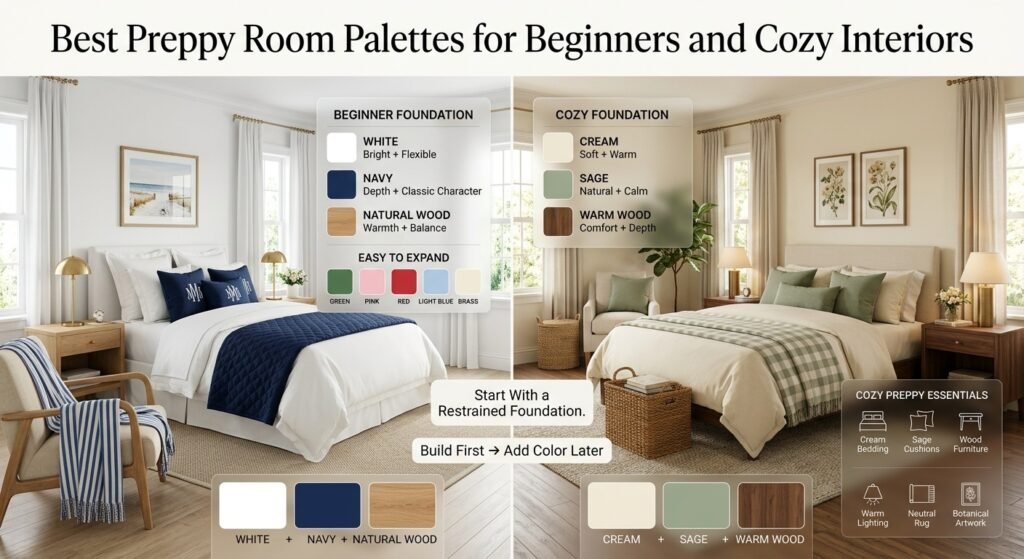
If you’re completely unsure, start with:
White + Navy + Natural Wood
It’s flexible, easy to expand, and works with many patterns.
Then decide whether you want to add:
- Green
- Pink
- Red
- Light blue
- Brass
- Cream
Starting with a restrained foundation makes future decisions easier.
What Is the Best Preppy Room Palette for a Cozy Look?
Try:
Cream + Sage + Warm Wood
This combination is softer and warmer.
Use:
- Cream bedding
- Sage cushions
- Wood furniture
- Warm lighting
- Neutral rug
- Botanical artwork
The result can feel preppy without relying heavily on navy.
What Is the Best Palette for a Bright Room?
Try:
White + Light Blue + Navy
White reflects light.
Light blue adds color.
Navy provides depth.
This is particularly effective when you want the room to feel fresh rather than dramatic.
What Is the Best Palette for a More Dramatic Room?
Try:
Navy + Forest Green + Cream
Use navy and green selectively and allow cream to balance them.
Dark colors can look beautiful when the room has enough light and visual breathing space.
How Can You Use Artwork in Preppy Room Inspo?
Artwork can establish the personality of the room.
You might choose:
- Botanical prints
- Coastal artwork
- Traditional illustrations
- Abstract art in your palette
- Personal photographs
- Vintage-inspired pieces
- Simple framed graphics
Don’t choose artwork based only on whether it looks “preppy.”
Choose something you actually like.
The room will feel much more personal.
How Can Books Become Part of the Decor?
Books are one of the easiest ways to make a room feel lived-in.
Place them:
- On a desk
- On a nightstand
- In a bookcase
- On a coffee table
- On a shelf
Mix horizontal and vertical arrangements.
Avoid arranging everything too perfectly.
A little variation makes the room feel natural.
How Can Plants Work With Preppy Style?
Plants add organic texture.
Use them in:
- Woven baskets
- Ceramic pots
- Simple planters
- Small tabletop containers
Greenery works especially well with:
- Navy
- Cream
- White
- Beige
- Natural wood
If the room already contains green, plants can strengthen that color relationship naturally.
How Do You Create a Focal Point?
Every room benefits from having something that visually leads the eye.
In a bedroom, it might be:
- The bed
- A headboard
- Artwork above the bed
- A feature wall
In a study, it might be:
- The desk
- A bookcase
- A large artwork
Once you’ve selected the focal point, keep surrounding elements supportive rather than competitive.
How Do You Know When the Room Is Finished?
This is harder than it sounds.
A room can always accommodate another cushion, picture, lamp, or accessory.
But more doesn’t always mean better.
Try this test:
Look From the Door
What do you notice first?
Look at the Color Balance
Is one color overwhelming everything else?
Look at the Patterns
Are several patterns competing?
Look at the Surfaces
Are they crowded?
Look at the Function
Can you comfortably use the room?
Look at the Personality
Does the room actually feel like yours?
If the answers are positive, you’re probably finished.
Expert Advice for Better Preppy Room Styling
Start With the Largest Visual Elements
Don’t begin with tiny accessories.
Start with:
- Walls
- Bed
- Rug
- Curtains
- Large furniture
These determine most of the room’s visual character.
Use Accessories as the Final Layer
Accessories should support the design.
They shouldn’t be responsible for creating the entire design.
Don’t Chase Every Trend
A room can be inspired by current design without being dependent on trends.
Classic colors, good proportions, natural materials, and useful furniture tend to remain flexible.
Let Your Room Evolve
You don’t need to finish everything in one weekend.
Build the room gradually.
This often produces a more personal result because you’re making decisions based on how the room actually feels.
⭐ Expert Tip: If you’re stuck between adding something and leaving the space alone, leave it alone for a few days. If you still feel the room needs something, you’ll have a clearer idea of what that something should actually be.
A Simple Preppy Room Planning Formula
If you want a straightforward formula, use this:
Foundation
Choose:
1 wall color + 1 main furniture finish + 1 primary color
Layer
Add:
1 main pattern + 1 secondary pattern + 2–3 textures
Personality
Finish with:
artwork + books + personal objects + greenery
Final Edit
Remove anything that:
- Doesn’t fit
- Doesn’t serve a purpose
- Creates unnecessary visual noise
- Competes with the focal point
This formula is flexible enough for almost any room.
Preppy Room Inspo Checklist
Before you consider your room complete, check:
Color
- Do I have a clear color palette?
- Is one color dominant?
- Are my accent colors repeated?
Patterns
- Do my patterns share colors?
- Is one pattern more noticeable than the others?
- Do I have enough solid surfaces?
Furniture
- Is the furniture correctly sized?
- Does it coordinate without being identical?
- Is the room still practical?
Textiles
- Is the bedding layered?
- Does the rug support the palette?
- Do curtains work with the rest of the room?
Accessories
- Are surfaces overcrowded?
- Do accessories add personality?
- Is there enough empty space?
Lighting
- Do I have more than one light source?
- Does the lighting create the mood I want?
Personality
- Does the room feel like me?
- Are there meaningful personal details?
What Makes a Room Look Preppy?
A preppy room usually looks polished because several classic elements work together instead of relying on one decoration. The strongest foundation is a coordinated color palette, timeless furniture, recognizable patterns, layered textiles, and a few personal accessories. Navy and white are classic choices, but blue and cream, green and cream, pink and white, and neutral combinations can create the same overall character.
The important part is balance. A room doesn’t become more preppy simply because you add more stripes, checks, pillows, or decorative objects. A well-planned room usually has a clear focal point, repeated colors, and enough neutral space to keep the design comfortable.
Practical elements to consider:
Choose one dominant color and one or two supporting shades.
Use stripes, gingham, plaid, or florals selectively.
Add classic or clean-lined furniture.
Layer bedding, rugs, curtains, and cushions for texture.
Keep accessories personal rather than filling every surface.
What Are the Best Colors for a Preppy Room?
The best preppy colors are the ones that create a clear relationship throughout the room. Navy, white, cream, light blue, green, pink, red, beige, and soft pastels are especially versatile because they can be combined in many different ways. Navy and white create a crisp traditional look, while blue and cream feel softer and warmer. Green and cream bring a more natural atmosphere, while pink and white can create a lighter and more playful room.
Instead of choosing several colors at random, decide which shade will dominate and which ones will act as accents. This makes even a colorful room feel organized.
Useful color combinations include:
Navy + white + natural wood
Blue + cream + brass
Sage green + cream + beige
Pink + white + light wood
Navy + green + cream
Red + navy + white
Light blue + white + soft beige
Professional tip: Repeat your accent color in at least two or three areas—such as bedding, artwork, and cushions—so the room feels coordinated rather than decorated piece by piece.
How Can I Make My Bedroom Look Preppy Without Buying Everything New?
You can create a noticeable preppy transformation without replacing all your furniture. Start with the pieces that have the greatest visual impact, particularly bedding, lighting, curtains, rugs, and wall artwork. Rearranging your existing furniture can also change the room’s appearance before you spend anything.
For example, an ordinary bedroom can become more preppy by using white or cream bedding, adding a navy or striped throw, introducing framed artwork, replacing harsh lighting with warmer lamps, and organizing accessories into small groups. Existing wooden furniture can often stay because natural wood works well with many preppy color palettes.
Start with these changes:
Replace or layer the bedding.
Introduce one recognizable pattern.
Rearrange furniture to improve balance.
Add coordinated artwork.
Upgrade bedside or desk lighting.
Remove accessories that don’t fit the palette.
Add one or two meaningful decorative pieces.
The professional approach is to edit before you shop. Removing visual clutter can sometimes improve the room more than buying another decoration.
How Do You Mix Patterns in a Preppy Room Without Making It Look Too Busy?
The key to mixing patterns is giving each pattern a different visual role. Instead of using several bold prints at the same intensity, choose one dominant pattern, one supporting pattern, and simpler solid-colored elements around them.
For example, you could use navy-and-white striped bedding as the dominant pattern, a small checked cushion as the supporting pattern, and cream curtains as a solid background. The room can also include floral artwork if the artwork repeats the same navy, cream, or blue shades.
Pattern coordination becomes much easier when the colors are connected.
A practical pattern formula is:
Large or bold pattern → main focal point
Smaller pattern → supporting detail
Solid fabrics → visual breathing space
Repeated colors → connection between patterns
Common mistake: Using stripes, gingham, plaid, florals, and geometric patterns all at once without a clear hierarchy. The problem isn’t that these patterns are incompatible; it’s that they can compete when they all demand equal attention.
How Can I Make a Preppy Room Look Expensive and Sophisticated?
A sophisticated preppy room is usually created through restraint, proportion, texture, and consistency, rather than expensive decorations. Furniture should be appropriately sized for the room, textiles should look well layered, and colors should repeat naturally throughout the space.
Pay particular attention to details that occupy large visual areas. Properly fitted curtains, a correctly sized rug, attractive bedding, balanced artwork, and good lighting can make a bigger difference than a collection of small decorative objects.
You can also create a more polished appearance by mixing materials such as wood, fabric, glass, and small amounts of brass. The combination gives the room depth while preventing it from looking flat.
For a more sophisticated result:
Keep the main color palette controlled.
Choose fewer but stronger accessories.
Use layered, coordinated textiles.
Pay attention to furniture scale.
Repeat finishes such as wood or brass.
Leave some surfaces intentionally uncluttered.
Use warm, layered lighting.
Include personal pieces instead of generic decorations.
Expert insight: If a preppy room starts feeling overly decorated, don’t immediately add another item to fix it. Remove a few unnecessary pieces first. Sophistication often comes from knowing what not to add.
Conclusion
Creating a beautiful preppy room is less about following one strict style and more about bringing classic details together in a way that feels personal, balanced, and comfortable. The best preppy spaces combine thoughtful colors, timeless patterns, quality-looking textures, practical furniture, and carefully chosen decorative details.
Whether you prefer a traditional navy-and-white room, a soft blue-and-cream palette, a playful pink-and-white combination, or a more modern neutral approach, the key is consistency. Choose a clear color foundation, introduce patterns gradually, repeat important colors throughout the room, and leave enough open space for everything to feel intentional.
You also do not need to completely redesign your room to achieve the look. Sometimes changing the bedding, adding a patterned rug, updating wall art, introducing better lighting, or adding a few classic accessories can make a noticeable difference.
Most importantly, use Preppy Room Inspo as a starting point rather than a set of rules. Mix classic elements with your own personality, choose pieces you genuinely enjoy, and focus on creating a room that feels both stylish and livable.
A well-designed preppy room should not simply look beautiful in photographs—it should feel like a space you enjoy coming home to every day.
Leave a Reply