Introduction
Green and Cream Preppy Room Ideas | A room can have beautiful furniture and still feel unfinished if the colors don’t work together. Maybe you’ve chosen a green duvet, cream curtains, or a patterned rug, but you’re not sure what should come next. That’s where a carefully planned green and cream preppy room can make decorating much easier. The combination gives you enough color to create personality while keeping the space calm, bright, and timeless.
Green brings a natural, refreshing feeling into the room, while cream provides the warm neutral background that keeps everything balanced. Add classic preppy patterns, layered textiles, traditional furniture, and a few personal details, and the result can feel polished without looking overly formal.
If you’re building your room around the broader preppy aesthetic, the Preppy Room homepage is a useful starting point for exploring different decorating directions. From there, you can decide whether you want your green and cream space to feel classic, modern, cute, cozy, or minimal.
This guide goes much further than simply choosing two colors. You’ll learn how to select the right green, build a complete color palette, coordinate walls and bedding, choose furniture, mix patterns, decorate small rooms, work with different lighting conditions, create a preppy look on a budget, and avoid the mistakes that can make a carefully planned room feel disconnected.
What Is a Green and Cream Preppy Room?
A green and cream preppy room combines green and warm cream tones with the traditional visual language of preppy interior design. That usually includes stripes, checks, plaid, gingham, botanical patterns, tailored fabrics, classic furniture, layered bedding, framed artwork, and carefully chosen decorative details.
The important thing is that “preppy” doesn’t mean every item needs to look traditional.
A room can have a simple modern bed, for example, and still feel preppy when it’s paired with a striped duvet, green cushions, framed botanical artwork, a classic lamp, and a cream rug.
The style is more about coordination and personality than following a strict furniture checklist.
Green and cream are especially useful because they’re flexible enough to support several versions of the preppy look.
You could create:
- A traditional green and cream bedroom
- A soft sage preppy room
- A sophisticated forest-green room
- A cute green and cream space
- A modern preppy bedroom
- A cozy cottage-inspired room
- A minimal preppy interior
- A green, cream, and navy combination
- A green, cream, and blush palette
This flexibility is one of the biggest advantages of the color combination.
Why Are Green and Cream So Good for Preppy Interiors?
Green and cream create contrast without the harshness that can sometimes happen with black and white or very bright color combinations.
Cream gives the room visual breathing space.
Green gives it identity.
That balance is particularly useful in bedrooms because you usually want the space to look interesting during the day while remaining comfortable and relaxing at night.
Another advantage is that green naturally connects with plants, botanical artwork, natural wood, woven textures, and outdoor-inspired patterns.
Cream then acts as the bridge between these different elements.
For example, imagine a bedroom with:
- Cream walls
- Sage bedding
- A natural wood nightstand
- A green botanical print
- A cream rug
- Brass lamp
- Green-and-cream striped pillow
Nothing is excessively complicated, but everything relates to the same visual story.
That is what makes the room feel intentional.
How Do You Choose the Right Shade of Green?
Not every green creates the same atmosphere.
The green you choose should depend on the room’s natural light, size, furniture, and the mood you’re trying to create.
Sage Green
Sage is one of the easiest greens to work with.
It’s muted, soft, and slightly gray, which makes it less visually aggressive than brighter greens.
Sage works particularly well when you want:
- A calm bedroom
- A light and airy appearance
- A modern preppy look
- A softer color palette
- A room that feels connected to nature
Pair sage with cream, light wood, white accents, or brushed brass for an understated result.
Olive Green
Olive green has a warmer, earthier personality.
It can make a cream room feel richer and more grounded.
Olive looks especially attractive with:
- Warm cream
- Tan
- Natural wood
- Brass
- Beige
- Muted blue
If your room has warm flooring or wooden furniture, olive can create a particularly cohesive appearance.
Forest Green
Forest green is much stronger.
It can look beautiful, but it should usually be treated as an accent rather than automatically covering every surface.
Good applications include:
- Accent walls
- Upholstered headboards
- Curtains
- A statement chair
- Decorative cushions
- A large artwork
- A rug with controlled green patterning
A deep green headboard against a warm cream wall can create a strong focal point without making the whole bedroom dark.
Mint Green
Mint creates a fresher and more playful appearance.
It can work especially well in youthful spaces with:
- Gingham
- Small floral prints
- Cream furniture
- White accents
- Rounded decorative objects
- Light-colored wood
The main challenge with mint is avoiding a palette that becomes too sugary or overly bright.
Cream helps soften it.
Eucalyptus and Muted Botanical Greens

Muted botanical greens sit somewhere between sage and medium green.
They can be particularly effective if you want the room to feel natural rather than obviously colorful.
This is an excellent direction for rooms featuring plants, botanical artwork, cane furniture, woven baskets, or natural wood.
Should Green or Cream Be the Main Color?
There isn’t one correct answer.
However, if you’re decorating for the first time, cream is usually the easier dominant color.
A cream foundation allows you to experiment with green without committing the entire room to one shade.
A useful starting point is:
Cream foundation → green secondary color → small accent color
For example:
| Element | Color |
|---|---|
| Walls | Warm cream |
| Bedding | Green + cream |
| Rug | Cream with subtle green |
| Curtains | Cream |
| Furniture | Natural wood or white |
| Artwork | Green botanical |
| Accessories | Brass + small accent color |
This creates enough contrast without overwhelming the room.
If you love strong color, reverse the relationship.
Use green walls or a green headboard and let cream become the balancing color.
What Is the 60-30-10 Rule?
The 60-30-10 rule is a simple way to distribute colors throughout an interior.
The dominant color covers roughly 60% of the visual space.
The secondary color covers around 30%.
The remaining 10% is reserved for an accent.
For a green and cream room, that might look like:
- 60% cream
- 30% green
- 10% navy or brass
You don’t have to measure the room mathematically.
It’s simply a visual guideline.
If the room feels too plain, increase the secondary color.
If it feels too intense, return more visual space to cream.
💡 Pro Tip: Look at the room from the doorway before buying another decorative item. If your eye immediately sees too many competing colors, adding another accessory probably won’t solve the problem. Simplifying the palette usually will.
How Do You Create a Green and Cream Preppy Room From Scratch?
The easiest approach is to decorate from large elements to small ones.
Don’t begin by buying ten pillows.
Begin with the foundation.
Step 1: Decide on the Mood
Ask yourself what you want the room to feel like.
Do you want it to be:
- Calm?
- Traditional?
- Fresh?
- Cozy?
- Sophisticated?
- Playful?
- Modern?
This determines the shade of green and the amount of pattern you should use.
A calm room might use sage and cream.
A dramatic room might use forest green and cream.
A playful room could use mint and cream.
Step 2: Choose the Dominant Color
Cream is an easy starting point.
It works on:
- Walls
- Curtains
- Bedding
- Rugs
- Upholstery
Green can then be introduced gradually.
Step 3: Select Your Main Green
Choose one main green before purchasing accessories.
This prevents you from accidentally collecting five unrelated green shades.
You can use supporting greens later, but there should be a clear visual relationship between them.
Step 4: Pick One Main Pattern
Choose a pattern that establishes the preppy character.
For example:
- Green gingham
- Green plaid
- Green-and-cream stripes
- Botanical print
Then build around it.
Step 5: Add Supporting Textures
Bring in:
- Quilted bedding
- Woven baskets
- Soft rugs
- Linen-look curtains
- Upholstered seating
- Wood
- Cane
- Rattan
Step 6: Finish With Accessories
Only after the foundation is established should you add smaller decorative details.
This order saves money because you can see what the room actually needs.
How Should You Decorate the Walls?

Walls provide one of the largest opportunities to establish the palette.
Cream Walls
Cream walls are versatile and forgiving.
They work with almost any green.
They also make it easier to change your bedding or accessories later.
If you’re renting or simply don’t want to repaint, cream walls can become the perfect neutral background.
Green Accent Wall
A green accent wall can give the bedroom a stronger identity.
Instead of painting all four walls, consider:
- Behind the bed
- A wall containing a desk
- A reading corner
- A wall behind open shelving
This keeps the green intentional.
Green Wainscoting
For a traditional preppy appearance, green wainscoting with cream above it can be extremely effective.
This creates architectural interest without needing wallpaper.
You can use the same idea with:
- Green lower wall + cream upper wall
- Cream wall + green trim
- Green paneling + cream bedding
The result can feel classic without becoming old-fashioned.
What Type of Bedding Works Best?
Bedding is usually the easiest way to introduce the green and cream palette.
A layered bed looks more sophisticated than a single solid-color comforter.
Try a combination such as:
Cream sheets + green quilt + striped pillow + botanical cushion + textured throw
Or:
Green duvet + cream shams + gingham accent pillow + cream throw
The key is variation.
If everything is solid green, the bed can look flat.
If everything is patterned, it can become visually noisy.
Green and Cream Quilts
Quilts work particularly well for preppy rooms because their stitching adds texture.
Choose a cream quilt and introduce green through pillows and throws if you want a lighter look.
Alternatively, choose a muted green quilt and keep the surrounding bedding cream.
Striped Bedding
Stripes instantly communicate a classic preppy feeling.
Green-and-cream stripes are especially useful because they combine both major colors in one piece.
This can make coordinating the rest of the room much easier.
Gingham Bedding
Gingham creates a cheerful, traditional appearance.
Use it as the main pattern only if the rest of the room is relatively calm.
Plaid Bedding
Plaid works particularly well with deeper greens.
It can make the room feel warmer and more sophisticated.
For additional style inspiration, you can compare this approach with the ideas in Classic Preppy Room, particularly if you want traditional details rather than a heavily modern aesthetic.
How Do You Mix Patterns Without Making the Room Busy?
Pattern mixing is one of the most important skills in preppy decorating.
The trick isn’t to avoid patterns.
It’s to control them.
A simple formula is:
One large pattern + one medium pattern + one small pattern
For example:
- Large green plaid blanket
- Medium green-and-cream stripe pillow
- Small botanical cushion
Each pattern has a different scale.
That creates visual hierarchy.
Don’t Match Everything
Your pillows don’t need to come from the same collection.
In fact, slightly different patterns often make the room look more naturally styled.
The colors should connect even when the patterns don’t.
⚠ Common Mistake: Using several large-scale patterns with equally strong contrast makes every item compete for attention. If the bedding is heavily patterned, choose quieter curtains and rugs.
How Do You Choose Curtains?
Cream curtains are the safest option.
They keep the room light and allow green to remain the accent.
Green curtains can also work, especially when the walls are cream.
For a traditional look, consider:
- Green-and-cream stripes
- Soft green solid curtains
- Cream curtains with subtle botanical patterns
Avoid choosing curtains solely because they match one pillow.
Curtains occupy a large visual area, so they should work with the room as a whole.
What Furniture Goes With Green and Cream?
Green and cream are surprisingly easy to pair with furniture.
White Furniture
White furniture creates a clean and youthful appearance.
It works especially well with sage and mint greens.
Natural Wood
Wood adds warmth.
This is one of the best choices if the room contains lots of cream because it prevents the palette from feeling too pale.
Medium Wood
Medium wood works particularly well with olive and forest green.
It creates a more traditional atmosphere.
Cane and Rattan
Cane and rattan add texture without introducing another strong color.
They can be especially useful in relaxed or cottage-inspired versions of the preppy style.
Upholstered Furniture
A cream upholstered chair or bench can add softness.
If you already have a green chair, use cream elsewhere to balance it.
Do All the Furniture Pieces Need to Match?
No.
A room often looks more sophisticated when furniture pieces are coordinated rather than identical.
For example:
- Cream upholstered bed
- Natural wood nightstand
- White dresser
- Wooden desk
- Brass lamp
The pieces don’t match exactly, but they share compatible materials and colors.
That’s enough to create cohesion.
How Can You Use Wood in a Green and Cream Room?
Wood is one of the easiest ways to make the palette feel warmer.
Green and cream can occasionally feel too cool or flat when there isn’t enough texture.
Wood solves that problem.
Use it through:
- Nightstands
- Bed frames
- Dressers
- Shelves
- Picture frames
- Small stools
- Desk surfaces
You don’t need every wood piece to have the same finish.
However, try to avoid combining too many dramatically different wood tones in a small room.
What Accent Colors Work With Green and Cream?
Green and cream form the foundation, but a third color can add personality.
Navy
Navy is one of the most natural additions to a preppy palette.
It makes green feel more traditional and sophisticated.
A palette such as:
Cream + sage + navy
is especially versatile.
If you want to explore this classic direction further, see Navy and White Preppy Room Ideas.
Blush Pink
Blush gives green and cream a softer, more playful feeling.
Use it in small doses:
- One cushion
- Artwork
- Small accessories
- Flowers
- A decorative throw
Light Blue
Light blue can create a fresh, coastal-inspired variation.
This is particularly effective with sage.
Brown
Brown adds warmth.
It works especially well when the room contains natural wood furniture.
Brass
Brass is technically a metallic accent rather than a conventional color, but it works beautifully with green and cream.
Try:
- Lamps
- Drawer handles
- Picture frames
- Mirrors
- Small decorative objects
How Do You Create a Modern Green and Cream Preppy Room?
Modern preppy rooms usually use fewer decorative elements and cleaner furniture.
Instead of relying on lots of patterns, focus on:
- Simple silhouettes
- Solid green textiles
- Cream walls
- Minimal artwork
- Clean lighting
- One or two traditional references
For example:
Cream wall + simple cream bed + sage duvet + green accent chair + brass lamp + botanical print
The preppy identity is still there, but it isn’t overwhelming.
If this sounds closer to your taste, the Modern Preppy Room style provides another useful direction.
How Do You Create a Cute Green and Cream Preppy Room?
A cute version can be playful without becoming cluttered.
Consider:
- Soft sage or mint
- Gingham
- Small floral prints
- Rounded accessories
- Decorative bows
- Soft cream bedding
- Small framed artwork
- Light wood
The most important thing is scale.
Use smaller patterns and smaller accessories so the room maintains a light appearance.
For additional ideas, explore Cute Preppy Room.
How Do You Make the Room Cozy?
A cozy room isn’t necessarily a dark room.
You can create coziness through texture.
Start with cream as your base.
Then add:
- A thick green throw
- Quilted bedding
- A soft rug
- Woven baskets
- Warm wood
- Cushioned seating
- Soft lighting
Layering these elements makes the room feel comfortable without requiring dramatic colors.
For more inspiration, Cozy Preppy Room can help you explore how texture and color work together.
How Do You Create a Minimal Green and Cream Room?
Minimal preppy design requires discipline.
You don’t need to remove all personality.
Instead, choose fewer items with stronger visual purpose.
For example:
- Cream walls
- Simple green bedding
- One patterned cushion
- One framed botanical print
- Natural wood nightstand
- One lamp
- One plant
The room remains recognizably preppy because of the colors and selected details.
But it doesn’t feel crowded.
The Minimal Preppy Room approach is useful if you prefer a clean space with less visual clutter.
How Can Botanical Details Strengthen the Design?
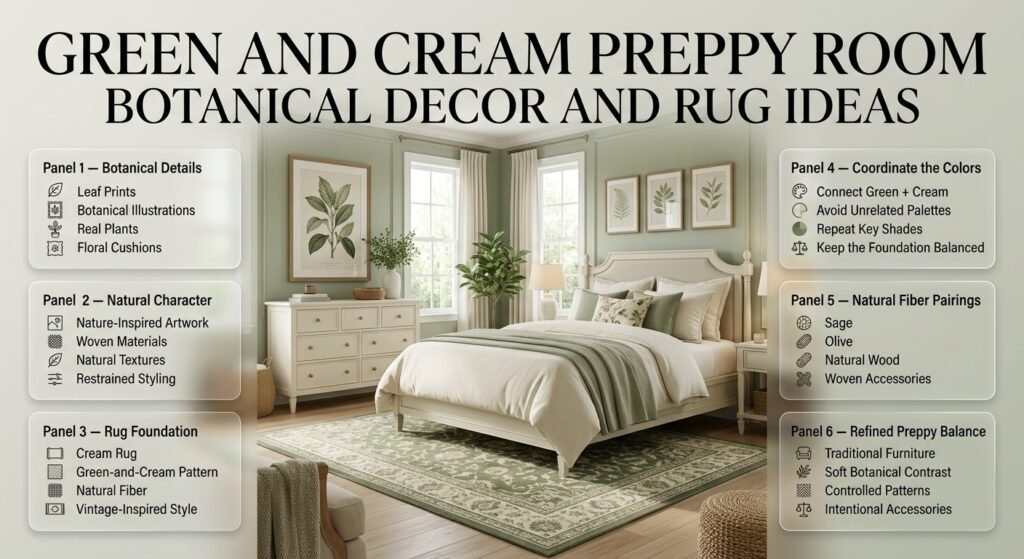
Green naturally connects to botanical themes.
You can reinforce that relationship through:
- Leaf prints
- Botanical illustrations
- Real plants
- Floral cushions
- Nature-inspired artwork
- Woven materials
The important point is not to turn the entire room into a jungle theme.
One or two botanical elements can be enough.
A framed botanical print above a cream dresser may have more impact than ten small plant decorations.
How Do You Choose Rugs?
The rug should connect the major colors rather than introduce an unrelated palette.
Good options include:
Cream Rug
Best for a bright, soft room.
Green-and-Cream Patterned Rug
Useful if the rest of the room is relatively simple.
Natural Fiber Rug
Excellent with:
- Sage
- Olive
- Natural wood
- Woven accessories
Vintage-Inspired Rug
Can work beautifully with traditional furniture, provided its colors aren’t competing with the green and cream foundation.
How Does Lighting Affect Green?
Lighting can significantly change how green appears.
A soft sage can look gray under one type of light and warmer under another.
Deep green can appear almost black in a poorly lit room.
Before committing to a wall color, observe a sample during:
- Morning
- Afternoon
- Evening
- Artificial lighting
This matters especially if you’re considering a darker green.
⭐ Expert Tip: Always judge a paint sample in the actual room rather than relying entirely on a small online color image. The room’s natural light, flooring, furniture, and surrounding colors all affect how the green will appear.
How Can You Make a Small Green and Cream Bedroom Look Bigger?
Small bedrooms benefit from visual simplicity.
Use cream on the largest surfaces and introduce green selectively.
A practical combination might be:
- Cream walls
- Cream bedding
- Sage cushions
- Small green rug
- Light wood furniture
- Cream curtains
- One large mirror
Avoid making every wall a dark green unless you specifically want a dramatic enclosed atmosphere.
Use Vertical Space
Tall curtains and vertically oriented artwork can help draw the eye upward.
Keep the Floor Visible
A room can feel smaller when too much furniture covers the floor.
Reduce Decorative Clutter
A small room doesn’t need twenty accessories.
Choose a few pieces that matter.
How Can You Decorate a Green and Cream Room on a Budget?
You don’t need to replace everything.
In fact, replacing every piece at once can make it harder to create a coherent design.
Start with what you already have.
Budget Priority 1: Bedding
A new duvet, quilt, or comforter can dramatically change the appearance of a bedroom.
Budget Priority 2: Pillows
Two or three well-selected pillows can introduce pattern.
Budget Priority 3: Artwork
A framed botanical print can strengthen the theme.
Budget Priority 4: Lighting
Changing a lamp can alter the mood of the entire nightstand area.
Budget Priority 5: Textiles
A throw or rug adds texture.
Budget Priority 6: Accessories
Only buy these after the larger elements are working together.
📌 Quick Tip: Before buying anything new, photograph your room and make a simple list of what it lacks. This is usually more useful than shopping without a plan.
Can You Transform an Existing Bedroom Without Replacing Furniture?
Absolutely.
Suppose your current bedroom has:
- A brown wooden bed
- White dresser
- Neutral curtains
- Beige carpet
You don’t need to start over.
Add:
- Green bedding
- Cream throw
- Green patterned cushions
- Botanical artwork
- Brass lamp
- Small plant
The existing furniture becomes part of the design.
This is often the most affordable approach.
What Wall Art Works Best?
Wall art should reinforce the room’s character.
Good options include:
- Botanical illustrations
- Traditional landscapes
- Framed maps
- Architectural drawings
- Simple line art
- Green abstract artwork
- Classic typography
- Small gallery walls
Try to repeat at least one room color in the artwork.
A botanical print containing green leaves and cream background naturally connects with the palette.
How Do You Style a Nightstand?
Nightstands should be functional first.
A practical arrangement might include:
- Lamp
- Small framed picture
- Decorative object or plant
That’s enough.
You don’t need a collection of objects covering the entire surface.
A tidy nightstand supports the clean, polished character of preppy design.
How Do You Style a Dresser?
A dresser provides more space, so you can create a larger arrangement.
Try:
Large mirror or artwork + lamp + small vase + one decorative object
Keep the heights different.
A tall lamp beside a lower object creates visual variation.
Don’t line up five objects at exactly the same height.
How Can Plants Fit Into the Palette?
Plants are an easy addition because their green leaves naturally reinforce the color scheme.
Good choices depend on the room’s available light and your ability to care for them.
If real plants aren’t practical, botanical artwork can provide a similar visual connection.
Use plants as accents rather than filling every corner.
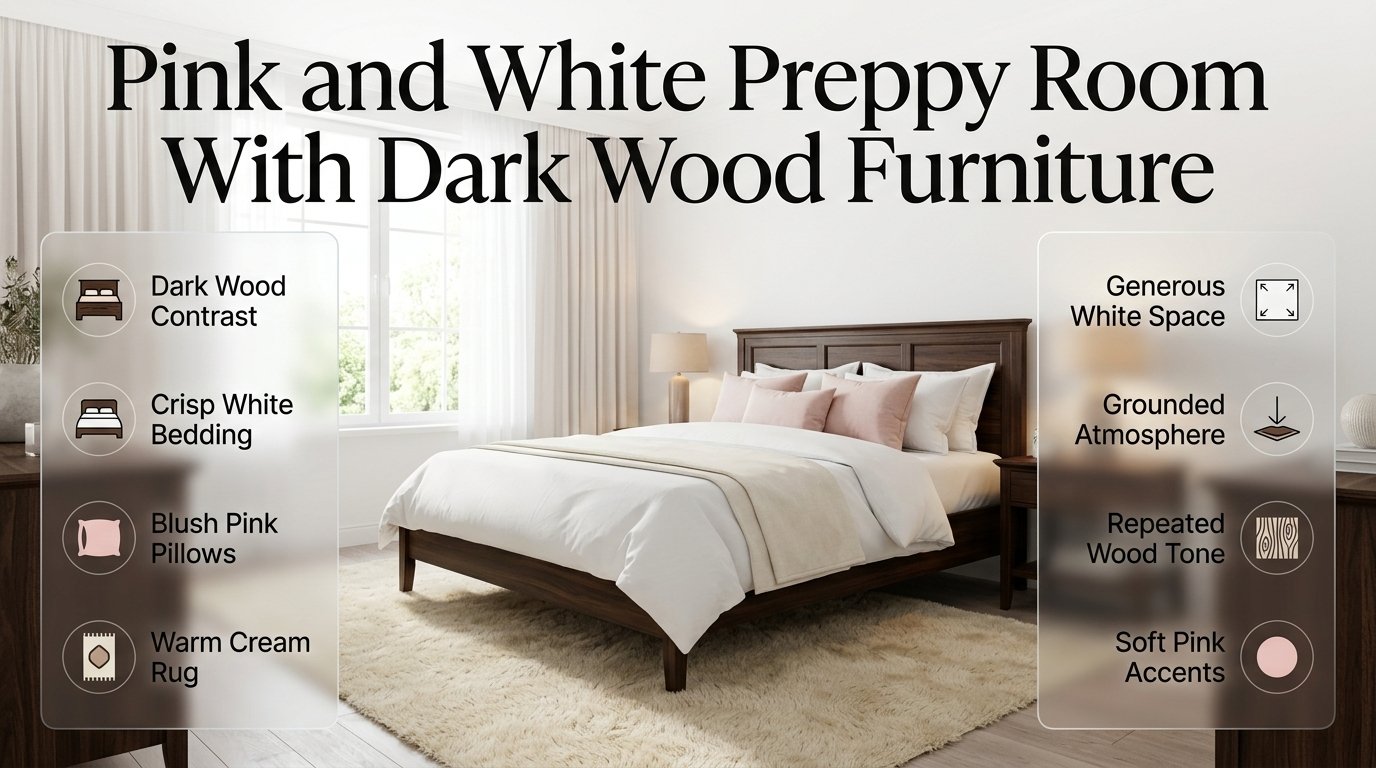
Pink and White Preppy Room Ideas
Pink and white preppy room ideas create a bright, stylish, and timeless space by combining soft pink tones with clean white details. This color combination works especially well with classic patterns, elegant furniture, layered bedding, decorative pillows, framed wall art, and subtle gold or natural-wood accents. Whether you prefer a soft blush aesthetic or a more playful preppy look, pink and white can make the room feel fresh, organized, and full of personality without becoming overwhelming. The key is to balance the colors thoughtfully—use white as the main foundation and introduce pink through bedding, curtains, rugs, artwork, cushions, or small decorative pieces for a polished and cohesive finish.
If you’re looking for more inspiration, explore our detailed Pink and White Preppy Room Ideas guide for practical tips on choosing colors, bedding, patterns, furniture, lighting, and stylish decor combinations.
How Do You Make Green and Cream Feel More Luxurious?
Luxury doesn’t necessarily require expensive furniture.
It often comes from:
- Consistent colors
- Good proportions
- Quality-looking textures
- Fewer but better accessories
- Layered bedding
- Proper lighting
- Framed artwork
- Coordinated hardware
For example, a simple cream bed can look much more polished when paired with a well-layered green duvet, tailored pillows, a textured throw, a balanced nightstand, and warm lighting.
The secret is editing.
Remove anything that doesn’t contribute to the overall design.
What Are the Most Common Green and Cream Decorating Mistakes?
Mistake 1: Choosing Green Before Considering the Light
A green shade can look completely different depending on the room.
How to avoid it: Test samples in the actual space.
Mistake 2: Using Too Many Green Shades
Five unrelated greens can make the room look accidental.
How to avoid it: Choose one main green and one supporting green.
Mistake 3: Making Everything Match
Perfect matching can make the room look like a showroom.
How to avoid it: Coordinate colors while varying textures and patterns.
Mistake 4: Using Too Many Patterns
Preppy design encourages patterns, but more isn’t always better.
How to avoid it: Vary pattern scale and keep some major pieces solid.
Mistake 5: Ignoring Texture
A room with only flat cotton and painted surfaces can feel visually empty.
How to avoid it: Add quilting, woven materials, wood, rugs, and upholstery.
Mistake 6: Adding Accessories Too Early
Small decorations can distract from larger design problems.
How to avoid it: Establish walls, furniture, bedding, and rug first.
Mistake 7: Making the Room Too Dark
Deep green everywhere can reduce the sense of space.
How to avoid it: Balance darker green with cream, light wood, and appropriate lighting.
Mistake 8: Forgetting Practicality
A beautiful room still needs to function.
How to avoid it: Keep storage accessible, leave walking space, and choose bedding that’s comfortable for everyday use.
How Many Patterns Should a Preppy Room Have?
There is no fixed number, but three coordinated patterns are often enough to create interest.
For example:
Pattern 1: Green plaid blanket
Pattern 2: Green-and-cream stripe pillow
Pattern 3: Small botanical cushion
Notice that the patterns don’t need to be identical.
They simply need to share colors and have different visual scales.
How Do You Coordinate Green and Cream Across the Whole Room?
The easiest method is repetition.
If green appears only on the bed, it can feel disconnected.
Repeat it in at least two or three additional places.
For example:
- Green bedding
- Green artwork
- Green chair
- Small green decorative object
The repetitions don’t have to be exact matches.
Their relationship is enough.
The same applies to cream.
If your cream bedding is warm and your curtains are a very cool white, the difference may become noticeable.
This is why warm cream tones usually work best when the palette is intended to feel cohesive.
What If the Room Already Has White Instead of Cream?
You don’t necessarily need to replace it.
White and cream can work together when used intentionally.
For example:
- White dresser
- Cream bedding
- Green cushions
- Natural wood
- Brass accents
The important thing is to avoid introducing too many slightly different neutrals without a purpose.
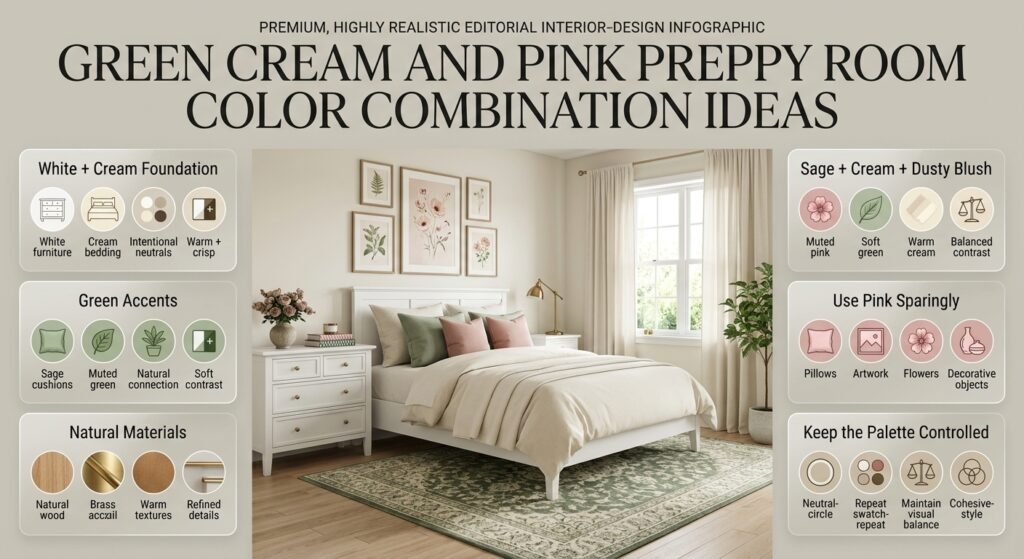
Can Green and Cream Work With Pink?
Yes.
Green and pink are complementary enough to create contrast while still feeling soft when the shades are muted.
Try:
Sage + cream + dusty blush
rather than very bright pink.
Use blush in small amounts through:
- Pillows
- Artwork
- Flowers
- Decorative objects
This creates a softer version of the preppy aesthetic.
Can Green and Cream Work With Blue?
Definitely.
Blue and green can create a fresh, traditional palette.
Navy is especially useful when you want a classic preppy appearance.
Lighter blues can make the room feel more relaxed and airy.
If you want to explore another cream-based combination, the Blue and Cream Preppy Room style provides a useful comparison.
Green and Cream Color Combinations to Try
Here are several complete palettes you can adapt.
Palette 1: Soft Sage
Cream + sage + natural wood + brass
Best for a calm, warm bedroom.
Palette 2: Classic Preppy
Cream + medium green + navy + brass
Best for a traditional, polished room.
Palette 3: Cozy Botanical
Warm cream + olive + brown + natural wood
Best for a relaxed, earthy atmosphere.
Palette 4: Fresh and Playful
Cream + mint + soft pink + light wood
Best for a cheerful room.
Palette 5: Dramatic
Cream + forest green + brass + dark wood
Best for a sophisticated statement room.
Palette 6: Minimal
Cream + muted sage + white + light wood
Best for a clean, uncluttered space.
Green and Cream Ideas for Different Room Sizes
Small Bedroom
Use cream as the dominant background.
Keep green concentrated around the bed and selected accessories.
Medium Bedroom
You can introduce larger green elements such as curtains, a chair, or an accent wall.
Large Bedroom
A large room can support deeper green furniture or a stronger patterned rug.
However, large rooms still need visual balance.
Size doesn’t eliminate the need for proportion.
How Do You Choose the Right Accent Chair?
An accent chair can become an important secondary focal point.
For a cream-heavy room, a green chair can add depth.
For a green-heavy room, choose cream or natural upholstery.
Consider:
- Chair scale
- Fabric texture
- Wood or metal legs
- Placement
- Relationship with the bed
A chair should have enough space around it to feel intentional.
Don’t squeeze one into a corner simply because there’s empty space.
How Do You Use Mirrors?
Mirrors can serve both decorative and practical purposes.
In a smaller room, a large mirror can reflect light and make the space feel more open.
Choose frames that fit the style:
- Brass for classic elegance
- Wood for warmth
- White for a lighter look
- Dark frame for contrast
A mirror above a dresser can become a strong focal point.
How Can You Use Shelves?
Open shelves are useful for displaying a controlled collection of preppy accessories.
Try:
- A small plant
- Framed artwork
- A decorative box
- One or two books
- A ceramic object
Don’t fill every shelf completely.
Empty space makes the displayed objects more noticeable.
How Do You Make the Room Look Professionally Designed?
Professional-looking rooms usually have one thing in common:
They feel edited.
Instead of asking, “What else can I add?”
Ask:
“What can I remove?”
Check the room for:
- Repeated colors
- Balanced proportions
- Consistent materials
- Appropriate pattern scale
- Functional furniture placement
- Clear focal points
- Adequate empty space
If everything is competing for attention, the room needs editing.
If everything is beige and nothing catches your eye, it needs a focal point.
Good design sits between those extremes.
Expert Advice for Decorating With Green and Cream
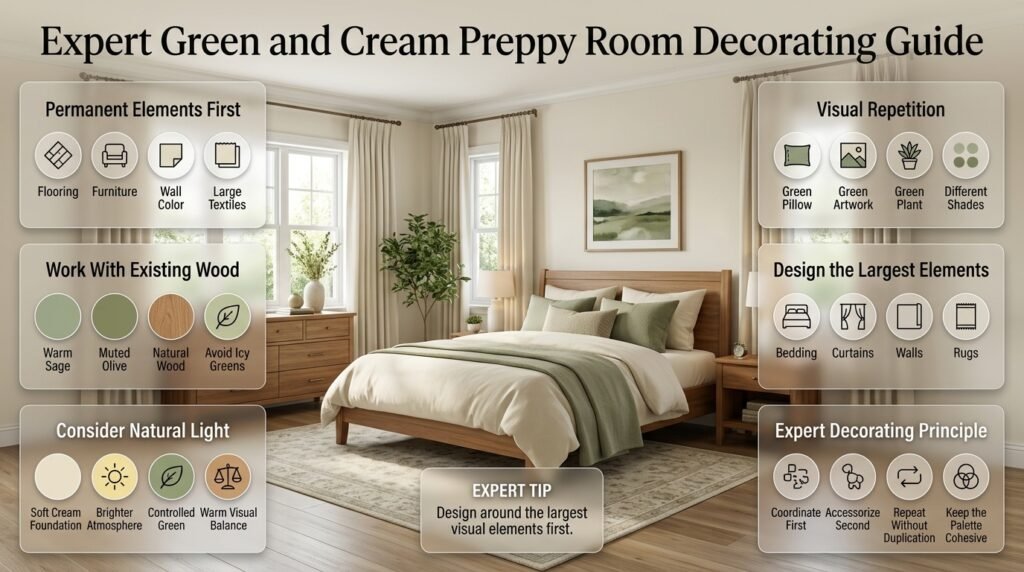
Experienced decorators often start with the room’s permanent elements.
If the floor, furniture, or wall color is staying for several years, those choices should guide the rest of the palette.
Decorative pieces are easier to replace.
For example, if you already have warm medium wood furniture, don’t fight it by choosing icy greens and cool grays.
Instead, choose a warm sage or olive that works with the wood.
Likewise, if your room receives limited natural light, a soft cream foundation may be more practical than covering every surface with a deep green.
Another useful principle is to create visual repetition without exact duplication.
A green pillow, green artwork, and green plant don’t need to be the same shade.
They simply remind the eye that green is part of the room’s overall story.
⭐ Expert Tip: Design around the largest visual elements first. A beautiful collection of small accessories cannot compensate for bedding, curtains, walls, and rugs that fight each other.
A Practical Green and Cream Shopping Checklist
Before buying anything, identify which category needs attention.
Foundation
- Wall color
- Flooring
- Main furniture
Bed
- Sheets
- Quilt or duvet
- Pillows
- Throw
Windows
- Curtains
- Curtain hardware
Lighting
- Main light
- Bedside lamp
- Accent lighting
Decoration
- Artwork
- Mirror
- Plant
- Decorative objects
Texture
- Rug
- Woven basket
- Upholstery
- Textured blanket
This checklist prevents random shopping.
A Green and Cream Room Example
Imagine a medium-sized bedroom with warm cream walls and medium wood flooring.
The bed has a simple cream upholstered headboard.
The bedding consists of a muted sage quilt, cream sheets, and two green-and-cream striped pillows.
At the foot of the bed sits a soft cream throw with subtle texture.
A natural wood nightstand holds a brass lamp and a small botanical print.
Across the room is a white dresser with a larger framed botanical artwork above it.
A green upholstered chair sits near the window.
The curtains are cream.
A simple cream-and-green rug connects the bed and furniture.
Notice how the room doesn’t need dozens of decorations.
The green appears in several locations.
The cream remains dominant.
The wood adds warmth.
The brass adds a small amount of shine.
The patterns are controlled.
That’s enough to create a complete design.
A Budget Green and Cream Room Example
Now imagine you’re decorating without replacing furniture.
You already have:
- White bed
- Wooden dresser
- Neutral rug
- Cream walls
- Basic curtains
Instead of renovating, you buy:
- Green quilt
- Two patterned cushions
- Cream textured throw
- Botanical wall print
- Small brass-colored lamp
- Green plant
The furniture stays.
The room’s identity changes.
This illustrates an important decorating principle:
You don’t always need more furniture. Sometimes you need a better relationship between the pieces you already own.
Green and Cream Preppy Room Checklist
Before declaring the room finished, ask yourself:
- Is cream clearly part of the foundation?
- Is there one dominant green?
- Do the patterns have different scales?
- Does the bedding look layered?
- Is there enough texture?
- Does the furniture work with the palette?
- Is there a clear focal point?
- Are the accessories intentionally selected?
- Does the room still have enough open space?
- Does the lighting suit the green shade?
- Are the colors repeated throughout the room?
- Does the room feel comfortable as well as attractive?
If most answers are yes, your design is probably on the right track.
What colors go best with a green and cream preppy room?
Green and cream already create a strong foundation, so the best supporting colors are those that add contrast without competing with the main palette. Navy, natural wood, brass, soft pink, light blue, and warm brown are particularly useful depending on whether you want the room to feel traditional, cozy, playful, or modern.
For a classic preppy look, navy is probably the strongest third color. For a softer and more relaxed bedroom, natural wood and warm brown work beautifully with muted green. If you’re creating a more playful space, a small amount of blush pink can add personality without taking over the room.
Practical ways to use accent colors:
Navy: pillows, artwork, stripes, or a small throw
Natural wood: nightstands, shelves, bed frames, or picture frames
Brass: lamps, handles, mirrors, and decorative details
Blush pink: one or two cushions or small accessories
Light blue: artwork, bedding details, or decorative pieces
Warm brown: furniture, baskets, and natural materials
The important part is proportion. Don’t introduce all of these colors at once. Choose one main accent and let green and cream remain the stars of the room. A classic preppy approach similarly benefits from a controlled palette rather than trying to include every traditional preppy color.
Is sage green and cream a good combination for a preppy bedroom?
Sage green and cream are one of the easiest combinations to use when you want a preppy bedroom that feels calm, fresh, and timeless. Sage provides enough color to give the room character, while cream prevents the overall design from becoming too dark or visually heavy.
The combination is particularly flexible because you can push it toward different styles. Add gingham and traditional furniture for a classic preppy look, use natural wood and woven textures for a cozy interpretation, or simplify the patterns and furniture for a modern room.
A useful starting palette is:
Warm cream → sage green → natural wood → small brass accents
You can then introduce one preppy pattern, such as a stripe, gingham, plaid, or botanical print.
Best places to introduce sage green:
Bedding
Accent pillows
Curtains
Headboard
Accent chair
Rug
Wall paneling
Artwork
If you’re hesitant about painting the walls green, start with bedding or curtains. This gives you a chance to see how the shade behaves under your room’s natural and artificial lighting before making a permanent change.
Sage and cream have also remained popular in 2026 bedroom inspiration because they combine nature-inspired color with warm, livable neutrals.
How do you make a green and cream room look more preppy without making it too busy?
The easiest way to make the room feel genuinely preppy is to focus on pattern, structure, and classic details rather than simply adding more decorations. Stripes, gingham, plaid, tailored bedding, traditional artwork, brass accents, and well-proportioned furniture can establish the style much more effectively than filling the room with themed accessories.
Pattern mixing is where many rooms go wrong. If the bed already has a strong plaid or gingham pattern, the curtains and rug don’t also need to be bold. Instead, allow the main pattern to lead and use quieter textures around it.
A practical combination could be:
Green-and-cream plaid throw
Solid cream duvet
Thin green-and-cream striped pillow
Small botanical cushion
Cream curtains
Natural wood furniture
One framed botanical artwork
A simple pattern strategy:
Choose one dominant pattern
Add one medium-scale pattern
Use one small pattern if necessary
Keep some major surfaces solid
Repeat your main green in two or three areas
This creates the collected appearance associated with good preppy interiors without making the bedroom feel like every surface is competing for attention. Current preppy design coverage similarly emphasizes pattern scale, color anchoring, and controlled detail as the difference between curated and cluttered spaces.
How can you decorate a small bedroom with green and cream?
A small bedroom can look excellent with green and cream, but the key is controlling visual weight. Use cream for larger surfaces and reserve stronger green for selected areas. This keeps the room feeling open while still giving it the personality you’re looking for.
Cream walls are a particularly flexible starting point because they reflect more light visually and allow green bedding, artwork, or furniture to become focal points. If you prefer green walls, consider using a softer or muted shade rather than automatically choosing a very dark green.
For a small room, try:
Cream walls
Sage green bedding
Cream curtains
Light wood furniture
One green accent chair or cushion
Small patterned rug
One large mirror
Limited decorative objects
Furniture scale matters just as much as color. An oversized bed, tiny nightstand, and several large decorative pieces can make a small room feel awkward even when the color palette is perfect. Current bedroom design advice also emphasizes appropriate proportions and avoiding excessive matching or visual clutter.
Small-room checklist:
Keep the largest surfaces relatively light
Choose furniture that fits the room properly
Use green as an accent when the space feels tight
Don’t cover every wall with decoration
Keep pathways clear
Use vertical artwork or curtains to draw the eye upward
Let some surfaces remain empty
The goal isn’t to remove all personality. It’s to make every item earn its place.
How do you make a green and cream preppy bedroom look expensive?
A sophisticated green and cream bedroom isn’t created by simply buying expensive furniture. The biggest difference usually comes from coordination, proportion, texture, lighting, and restraint.
Start with a consistent palette. Choose a cream tone that works with your green rather than combining several unrelated whites and neutrals. Then introduce texture through quilted bedding, woven baskets, natural wood, upholstery, rugs, and curtains.
Lighting is another major factor. A beautiful green can look completely different depending on the light in the room, so use layered lighting rather than relying on one overhead fixture.
Details that can elevate the room:
Layered bedding rather than one flat comforter
Properly sized pillows
A quality-looking textured throw
Framed artwork instead of random wall decorations
Natural wood or well-finished furniture
Brass or other warm metal accents
Curtains that reach the appropriate height
A rug that is correctly scaled to the bed
Clear surfaces with intentional decoration
A consistent green-and-cream palette
One of the biggest mistakes is assuming that adding more expensive-looking accessories will automatically make the room feel luxurious. In practice, editing is often more effective than adding. Recent bedroom design guidance also points toward avoiding overly matched furniture, excessive feature-wall patterns, and poorly proportioned pieces in favor of more individual, balanced spaces.
⭐ Expert formula:
Warm cream foundation + one dominant green + controlled preppy pattern + natural texture + warm lighting + a few intentional accessories.
That formula gives you the polished character of a preppy room while keeping the space comfortable and believable.
Conclusion
A green and cream preppy room is a perfect example of how a simple color combination can create a space that feels stylish, comfortable, and timeless. Cream gives the room a warm and versatile foundation, while green adds personality, freshness, and a natural sense of depth.
The best results come from finding the right balance rather than trying to match everything perfectly. Choose one main shade of green, keep cream as a reliable neutral, and then introduce preppy character through stripes, gingham, plaid, botanical prints, layered bedding, classic furniture, and thoughtful accessories.
You also don’t need to completely redesign your room to achieve this look. Changing the bedding, adding a patterned cushion, introducing botanical artwork, updating lighting, or bringing in a few natural textures can make a noticeable difference while keeping your existing furniture.
Whether you prefer soft sage, earthy olive, or a deeper forest green, the same principle applies: build the room gradually, repeat colors naturally, mix patterns carefully, and leave enough space for the design to breathe.
Most importantly, decorate for how you actually want the room to feel and function. A successful preppy bedroom shouldn’t simply look good in photographs—it should feel welcoming, practical, and personal every day. With a thoughtful combination of green, cream, texture, pattern, and classic details, you can create a room that feels polished today while remaining easy to update in the future.
Leave a Reply