
Introduction
Preppy Room Design Ideas | Designing a room can seem easy until you actually start putting everything together. You may like navy stripes, soft pink, classic furniture, floral prints, colorful pillows, warm lighting, or beautiful wall art, but combining all of these ideas without making the room feel crowded can be surprisingly difficult.
That is where preppy room design ideas become useful. A well-designed preppy room isn’t simply a collection of stripes, plaid, pillows, and colorful accessories. The real goal is to create a space where colors, patterns, furniture, lighting, textiles, artwork, and personal details feel connected.
If you’re looking for a broader starting point, Preppy Room brings together classic style, fresh colors, balanced patterns, and practical decorating inspiration that can help you decide what direction suits your room.
In this guide, you’ll learn how to plan a preppy room from the beginning, choose the right colors, mix patterns without creating visual chaos, select furniture, style the bed, decorate walls, use lighting, work with small spaces, create cute or modern variations, and avoid the mistakes that often make preppy rooms look overdecorated.
The goal isn’t to copy one particular bedroom.
The goal is to understand why certain combinations work so you can create a room that looks polished while still feeling personal.
What Makes Preppy Room Design Look Good?
A successful preppy room combines classic visual elements with a fresh and comfortable atmosphere. The style often uses coordinated colors, recognizable patterns, structured furniture, layered textiles, framed artwork, and carefully selected accessories.
The important part is balance.
A room doesn’t become more preppy simply because you add more plaid, more pillows, or more decorative objects. In fact, adding too many recognizable elements can make the room feel busy.
A stronger design usually has a clear visual hierarchy.
For example:
Main color → furniture → bedding → pattern → artwork → accessories
This gives the eye somewhere to go.
A navy upholstered bed might become the main feature. Cream bedding can soften it. A striped pillow can introduce pattern. Framed artwork can repeat the navy and cream. A small brass lamp can add warmth.
None of those elements needs to dominate.
Together, they create a connected design.
What Are the Main Elements of a Preppy Room?
A preppy room can be built around several basic elements:
- Coordinated colors
- Classic patterns
- Comfortable furniture
- Layered bedding
- Curtains and rugs
- Framed artwork
- Decorative lighting
- Organized accessories
- Natural textures
- Personal objects
You don’t need all of them in equal amounts.
Think of them as ingredients rather than requirements.
A minimal room might use only a few. A colorful room might use more. A traditional bedroom might emphasize furniture and artwork, while a cute version might emphasize bedding and accessories.
Why Does Balance Matter More Than Decoration?
Imagine a room with navy bedding, red curtains, green pillows, yellow artwork, floral wallpaper, a patterned rug, and several colorful decorative objects.
Every individual item might look attractive.
But together, the room could feel exhausting.
Now imagine the same room with cream walls, navy bedding, one green accent, a small amount of red, simple artwork, and a neutral rug.
The second room may contain fewer decorative elements, but each one has more impact.
That’s an important principle for preppy design:
Don’t ask, “What else can I add?”
Ask:
“What does this room still need?”
That small change in thinking can dramatically improve the final result.
If you want to create a bedroom that feels polished, comfortable, and distinctly preppy, explore these preppy bedroom design ideas for practical inspiration on coordinating colors, patterns, furniture, bedding, and decorative accents.
How Do You Choose a Color Palette for a Preppy Room?
Color is one of the strongest tools for creating a preppy atmosphere.
Classic combinations often include navy and white, green and cream, pink and red, blue and cream, or combinations of soft pastels. However, modern preppy rooms can use a much wider range of colors.
Start with three basic roles:
- Dominant color
- Supporting color
- Neutral
For example:
Navy + soft blue + cream
or:
Pink + red + white
or:
Forest green + light blue + cream
or:
Lavender + powder blue + white
The neutral doesn’t have to dominate the room. Its job is to create breathing space.
Should You Use Navy in a Preppy Room?
Navy is one of the easiest colors to associate with classic preppy interiors, but it isn’t mandatory.
It works particularly well because it can be:
- Traditional
- Sophisticated
- Fresh
- Dramatic
- Easy to combine
Navy can appear on walls, bedding, curtains, artwork, furniture, or small accents.
If a full navy wall feels too dark, use navy through smaller elements instead.
For example:
- Navy quilt
- Navy striped pillows
- Navy desk accessories
- Navy artwork
- Navy curtain trim
This creates the same visual connection without making the room feel heavy.
What Other Colors Work Well?
Green can create a natural, classic atmosphere.
Pink can make the room softer and more playful.
Light blue can create a fresh and relaxed feeling.
Burgundy can add depth.
Red can create stronger contrast.
Cream can make a room feel warmer than bright white.
Lavender and pastel yellow can create a softer contemporary interpretation.
The important thing isn’t choosing the “correct” preppy color.
It’s choosing colors that work together.
How Do You Use Color Repetition?
Color repetition is one of the easiest ways to make a room feel professionally coordinated.
Suppose your bedding contains navy.
You might repeat navy in:
- A framed print
- A small cushion
- A lamp base
- A rug detail
- A curtain stripe
You don’t need the exact same shade everywhere.
Slight variation can actually make the room feel more natural.
The same principle works with pink, green, blue, burgundy, or any other accent.
Pro Tip: If a color appears only once in a room, it may look accidental. Repeating it two or three times in smaller amounts can make it feel intentional.
If you prefer a cleaner interpretation of the preppy aesthetic, explore these modern preppy room design ideas for practical ways to combine classic preppy details with streamlined furniture, refined colors, and contemporary styling.
If you want to make the most of your available space while keeping the room functional and visually balanced, explore these preppy room layout ideas for practical guidance on arranging furniture, defining zones, and improving the overall flow of the room.
How Should You Choose Preppy Bedroom Furniture?
Furniture creates the structural foundation of the room.
Before purchasing decorative accessories, decide what furniture the room actually needs.
Typical pieces include:
- Bed
- Nightstands
- Dresser
- Desk
- Desk chair
- Bookshelf
- Accent chair
- Storage bench
- Small side table
Traditional furniture often works naturally with classic preppy styling, but modern furniture can work just as well.
The key is coordination.
A traditional wooden desk can look excellent beside a simple modern bed.
A clean white dresser can work with classic plaid bedding.
A contemporary chair can make traditional furniture feel fresher.
Traditional vs. Modern Preppy Furniture
| Traditional Approach | Modern Approach |
|---|---|
| Wood furniture | Clean white furniture |
| Classic silhouettes | Simple lines |
| Brass details | Minimal hardware |
| Upholstered headboard | Streamlined headboard |
| Traditional desk | Contemporary desk |
| Decorative furniture | Functional storage |
You don’t have to choose one style for every piece.
Mixing them carefully can prevent the room from looking like a themed showroom.
How Can You Design the Bed as the Main Focal Point?
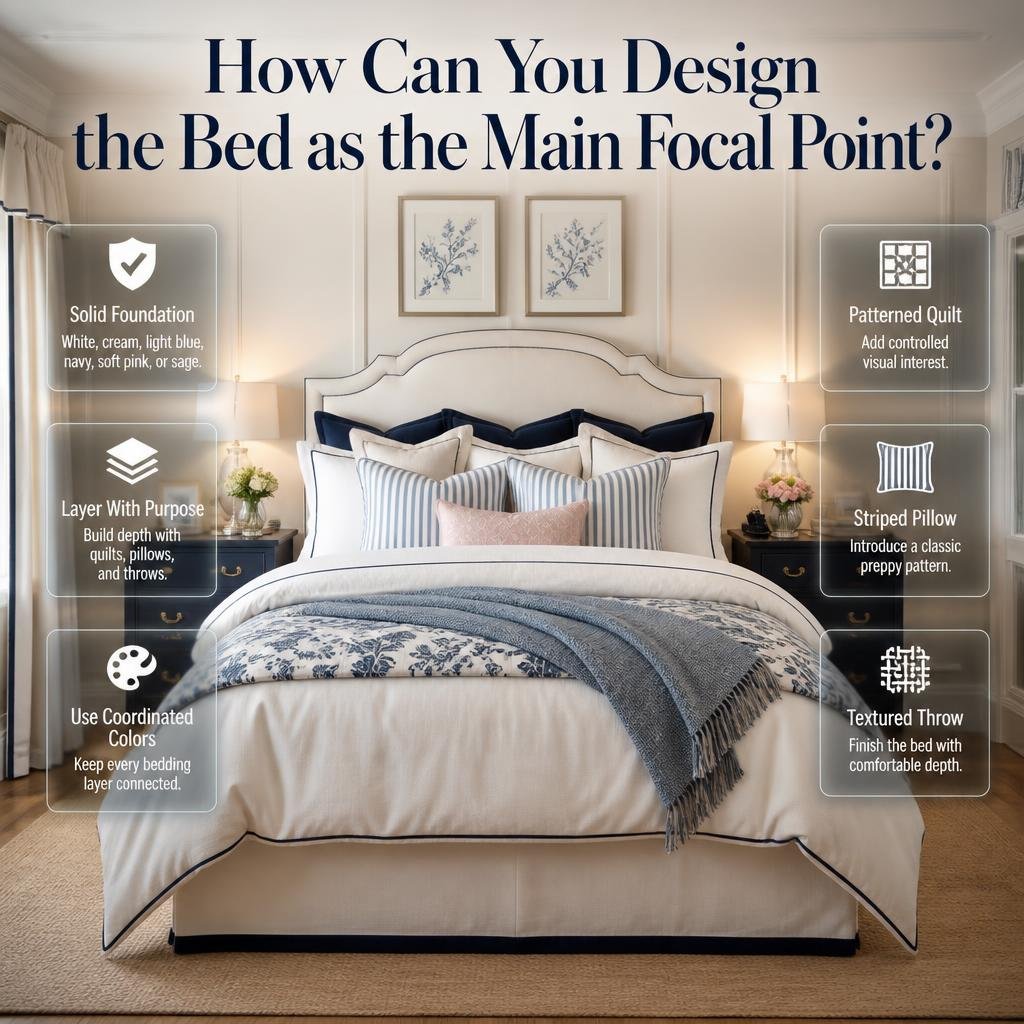
In a bedroom, the bed usually occupies one of the largest visual areas.
That makes bedding one of the most important parts of the design.
Start with a foundation.
This could be:
- White
- Cream
- Light blue
- Navy
- Soft pink
- Sage
Then add layers.
A simple combination might be:
Solid duvet + patterned quilt + striped pillow + textured throw
Another might be:
White bedding + navy piping + plaid cushion + soft blue blanket
Layering adds depth without requiring lots of separate decorations.
How Many Pillows Should You Use?
There isn’t a magic number.
The important question is whether the pillows improve the composition.
Use different:
- Sizes
- Shapes
- Textures
- Pattern scales
But keep the colors connected.
Three well-chosen pillows can often look better than eight unrelated ones.
Common Mistake: Don’t make every pillow a different bold pattern. If the bed already has patterned bedding, use one or two simpler pillows to create visual breathing room.
Which Patterns Work Best for Preppy Rooms?
Patterns are one of the defining characteristics of preppy interiors.
Common options include:
- Stripes
- Plaid
- Gingham
- Checks
- Florals
- Botanical prints
- Geometric patterns
- Argyle-inspired designs
The secret is not simply choosing good patterns.
It’s choosing patterns that have a relationship with one another.
How Do You Mix Patterns Without Making the Room Busy?
Use different pattern scales.
For example:
Large plaid → medium stripe → small check
This creates visual hierarchy.
You can also vary the type of pattern.
For example:
Floral + stripe + small geometric
The colors should provide the connection.
If the floral contains navy and cream, your stripe can repeat navy and cream.
That makes different patterns feel like part of the same story.
How Many Patterns Are Enough?
There is no universal number, but a useful starting point is:
- One dominant pattern
- One supporting pattern
- One subtle pattern
If your bedding has large plaid, the curtains might be solid.
If your curtains have a strong stripe, the bedding could be mostly solid.
The goal is not to eliminate pattern.
It’s to control where pattern gets attention.
How Can You Decorate the Walls?
Walls provide a large opportunity to add personality.
Good options include:
- Framed artwork
- Botanical prints
- Family photographs
- Mirrors
- Gallery walls
- Small shelves
- Decorative plates
- Classic prints
- Personal collections
The best wall decor supports the room’s existing colors.
If the room is navy and cream, artwork containing those shades can strengthen the palette.
If the room is pink and white, small amounts of pink in framed artwork can connect the walls with the bed.
For a more complete decorating approach, Preppy Room Decor explores how furniture, patterns, lighting, accessories, and decorative details can work together.
Should You Create a Gallery Wall?
A gallery wall can be an excellent choice when you have a large empty wall.
However, don’t fill the wall simply because it is empty.
Choose artwork with a connection.
That connection might be:
- Similar frame colors
- Repeated colors
- Similar subject matter
- Similar artistic style
- Consistent spacing
A gallery wall with completely unrelated images can look random.
A coordinated collection looks intentional.
What About Mirrors?
Mirrors can add function and visual space.
In smaller rooms, a strategically positioned mirror can help reflect natural light.
Choose the frame based on the overall design.
Wood can reinforce a natural or traditional atmosphere.
White can create a lighter appearance.
Brass can add warmth.
A darker frame can create stronger contrast.
How Should You Choose Curtains?
Curtains occupy a significant amount of wall space, so they can strongly influence the room.
If the bedding is already patterned, simple curtains may work better.
If the bedding is mostly solid, patterned curtains can add interest.
Possible choices include:
- Cream curtains
- White curtains
- Navy-and-white stripes
- Soft blue curtains
- Gingham
- Subtle floral patterns
Don’t automatically match curtains to bedding.
Instead, look for shared colors.
For example:
Navy bedding + cream curtains + navy artwork
This is coordinated without becoming repetitive.
How Do Rugs Fit Into Preppy Room Design?
A rug can connect furniture and textiles while adding softness.
Think about:
- Size
- Color
- Pattern
- Texture
- Placement
A rug that’s too small can make the furniture look disconnected.
A large rug can help visually unite the bed, nightstands, and surrounding space.
If your room already contains several strong patterns, choose a quieter rug.
If the rest of the room is simple, a patterned rug can become an interesting accent.
How Can Lighting Improve a Preppy Room?
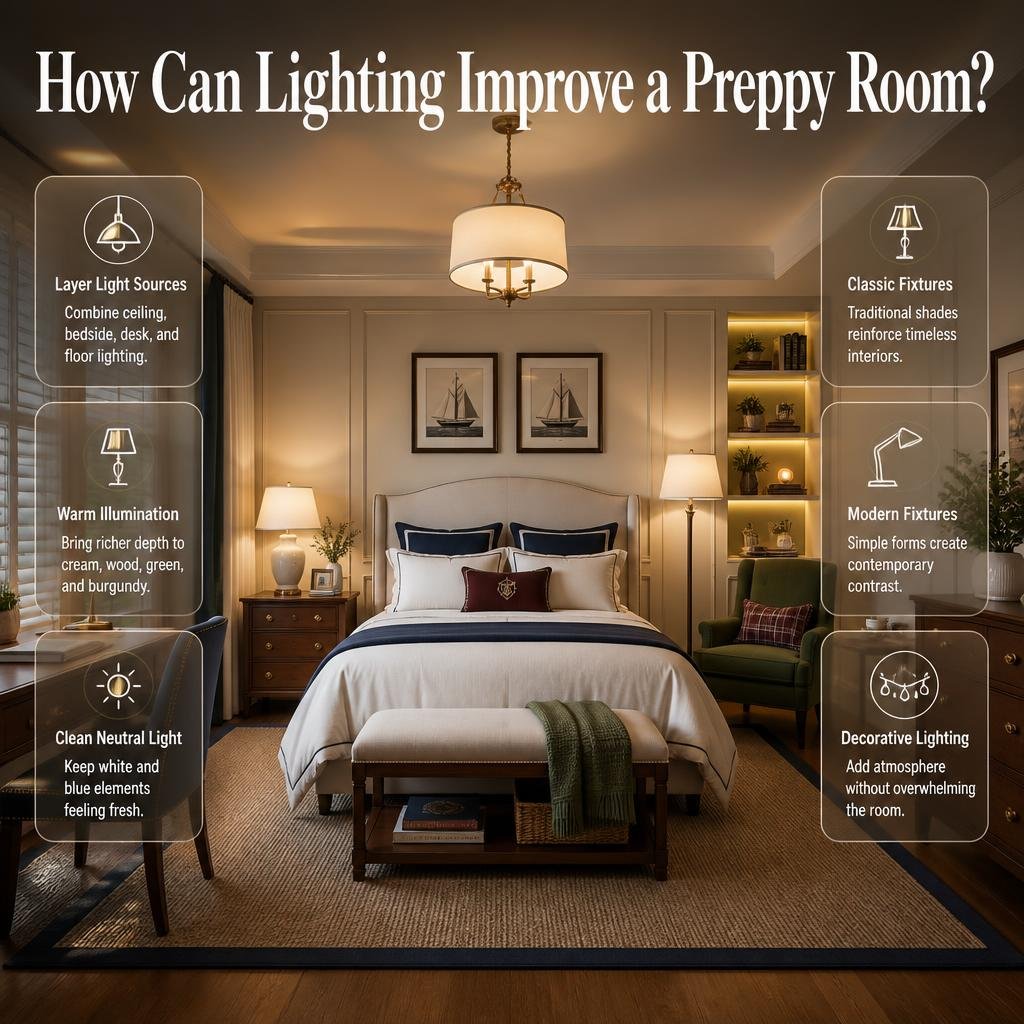
Lighting is often overlooked during decorating.
Yet even a beautiful room can feel flat under harsh lighting.
Try layering different sources:
- Ceiling fixture
- Bedside lamp
- Desk lamp
- Floor lamp
- Decorative lighting
A warm lamp can make cream, wood, green, and burgundy feel richer.
A brighter neutral light can make white and blue feel cleaner.
The fixture itself can also contribute to the style.
A traditional lamp with a classic shade can reinforce a timeless room.
A simple modern lamp can make traditional furniture feel more contemporary.
For readers who want to combine classic decorating with modern lighting, Preppy Room With LED Lights offers another direction.
How Can You Create a Cute Preppy Room?
Cute preppy design usually uses softer colors, playful details, charming patterns, and cheerful accessories.
Popular color combinations include:
- Pink and white
- Pink and red
- Lavender and cream
- Mint and blush
- Powder blue and white
- Pale yellow and blue
But cute doesn’t have to mean childish.
A sophisticated cute room might combine:
Cream walls + pink bedding + light wood furniture + gingham cushion + framed artwork
The furniture provides structure while the colors add personality.
For more playful room concepts, explore Cute Preppy Room Ideas.
You can also explore Cute Preppy Room for another interpretation of the same overall style.
For a timeless interpretation of the preppy aesthetic, explore these classic preppy room design ideas for practical ways to combine traditional furniture, refined patterns, classic colors, and balanced decorative details.
How Can You Create a Pink Preppy Room?
Pink is particularly effective when used thoughtfully.
Instead of making every item pink, create contrast.
For example:
- Cream walls
- White bed
- Pink quilt
- Navy accent
- Light wood furniture
- Brass-toned lamp
- Small floral artwork
This creates a more mature and balanced result.
If you want to build the room around pink specifically, Pink Preppy Room can help you explore the broader style.
For more targeted ideas, Pink Preppy Room Ideas can be used when you’re deciding how much pink to introduce.
A softer, more decorative direction can also be explored through Aesthetic Pink Preppy Room.
The important lesson is that pink doesn’t need to cover the whole room to become a strong part of the design.
How Can You Create an Aesthetic Preppy Room?
An aesthetic preppy room usually depends heavily on visual consistency.
Think about the entire room as one composition rather than a collection of objects.
Start with:
Color → furniture → textiles → lighting → artwork → accessories
This order matters.
If you start with accessories, you may find yourself trying to build the rest of the room around small objects.
Instead, let the large elements establish the direction.
For additional inspiration, Preppy Room Aesthetic explores how colors, patterns, furniture, textiles, and decorative details can create a cohesive aesthetic.
You can also use Aesthetic Preppy Room Decor when you want the room to feel more visually curated and decorative.
How Can You Design a Modern Preppy Room?
Modern preppy design combines traditional preppy colors and patterns with simpler furniture and cleaner spaces.
Try:
- White furniture
- Simple bed frame
- Navy accents
- Minimal artwork
- One classic pattern
- Clean-lined lighting
- Natural wood
- Limited accessories
For example:
White bed + navy striped blanket + light wood nightstand + modern lamp + framed botanical print
The room still feels preppy, but it doesn’t look overly traditional.
The same principle works in reverse.
You can take traditional furniture and pair it with modern artwork and simple lighting.
How Can You Make a Small Room Look Preppy?
Small rooms need careful editing.
You don’t necessarily need fewer colors.
You need better control of visual weight.
Use lighter foundations when possible.
Good choices include:
- White walls
- Cream bedding
- Light wood
- Soft blue
- Small-scale patterns
- Mirrors
- Vertical storage
Storage is particularly important.
If books, clothing, accessories, and school materials remain scattered around the room, even beautiful decor will struggle to look polished.
Consider:
- Under-bed storage
- Wall shelves
- Storage baskets
- Bedside drawers
- Desk organizers
- Tall shelving
A small room can still have personality.
The trick is making every major piece earn its place.
How Can You Create a Cozy Preppy Room?
Cozy preppy design focuses on softness and comfort.
Use layers rather than simply adding more objects.
Consider:
- Quilts
- Throws
- Cushions
- Soft rugs
- Curtains
- Upholstered furniture
- Warm lighting
- Natural wood
Texture becomes especially important.
A room with several solid colors can still feel rich when cotton, linen-like textiles, wood, woven materials, and soft fabrics are layered together.
The goal is to make the room comfortable without turning every surface into storage for decorative items.
How Can You Create a Minimal Preppy Room?
Minimal preppy design is about reducing the number of visual elements while keeping recognizable preppy characteristics.
Try:
- One dominant color
- One main pattern
- Simple furniture
- Limited accessories
- Clean surfaces
- Coordinated bedding
- One strong artwork piece
For example:
White walls + navy bedding + striped cushion + wooden nightstand + framed artwork
That’s enough.
Minimal doesn’t mean boring.
It means every visible element has a purpose.
How Do You Use Accessories Without Creating Clutter?
Accessories should finish the room rather than compete with it.
Useful choices include:
- Books
- Small plants
- Decorative boxes
- Trays
- Framed photos
- Ceramic objects
- Small lamps
- Baskets
- Collectibles
Group smaller objects.
Instead of placing six items separately across a dresser, arrange three or four together on a tray.
This creates a visual unit.
The same approach works on bookshelves.
Mix:
Books + framed photo + small decorative object
rather than covering every shelf with unrelated objects.
Quick Tip: After decorating, remove one or two accessories from every crowded surface. If the room immediately looks cleaner without losing personality, those items probably weren’t necessary.
How Can You Make a Preppy Room Feel Personal?
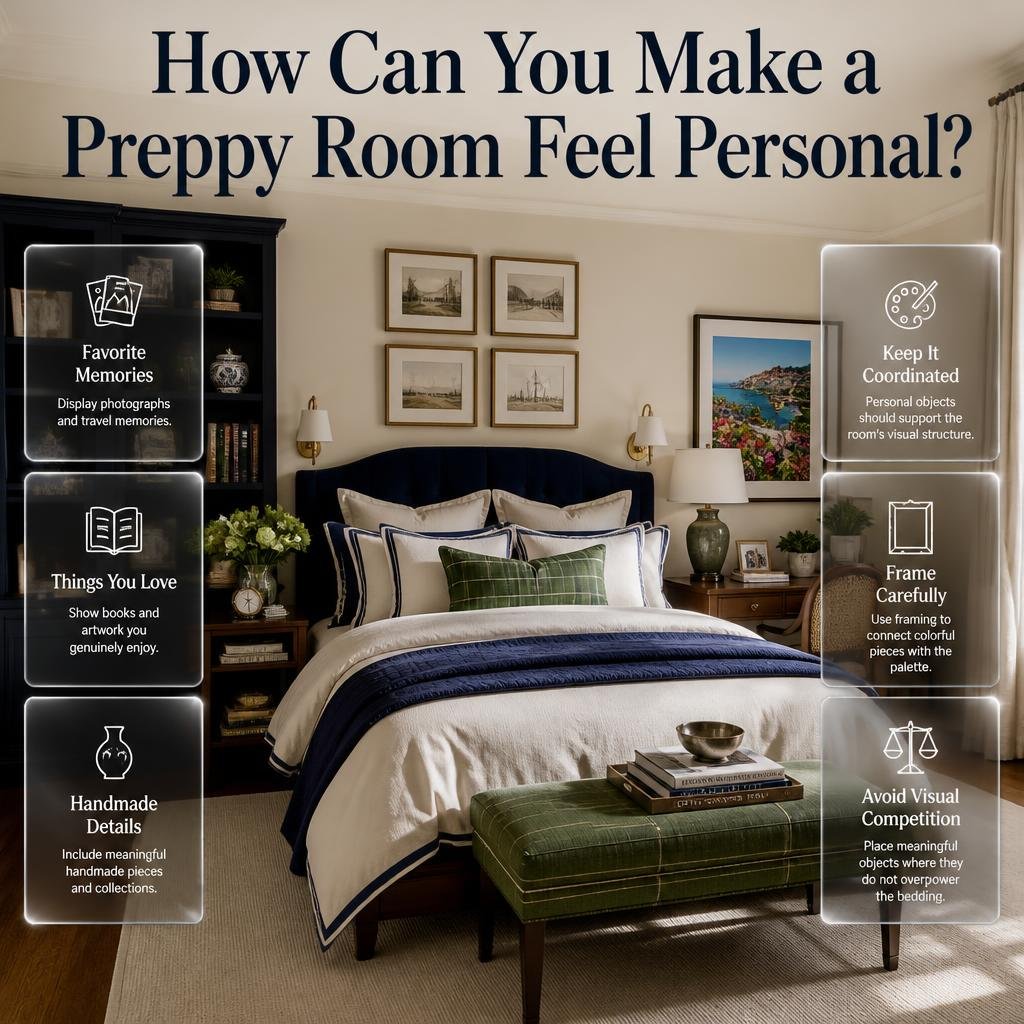
A polished room shouldn’t look like a furniture showroom.
Personal details are what make it yours.
Consider displaying:
- Favorite photographs
- Books you actually read
- Artwork you genuinely like
- Travel memories
- Handmade pieces
- Small collections
- Meaningful objects
The important thing is presentation.
Personal objects should still fit the room’s visual structure.
For example, if your room uses navy, cream, and green, a colorful photograph can still work if it’s framed carefully and positioned where it doesn’t compete with the bedding.
How Can DIY Projects Improve Preppy Room Design?
You don’t need to replace the entire room to change its style.
Small DIY updates can have a surprisingly large effect.
You could:
- Repaint an old frame
- Add fabric to a plain cushion
- Reorganize a bookshelf
- Create simple artwork
- Update drawer hardware
- Decorate a storage box
- Make a photo display
- Refresh an old tray
DIY works best when you already know your color palette.
Otherwise, you may create attractive individual projects that don’t work together.
If you’re interested in budget-friendly updates, DIY Preppy Room Decor provides ideas for customizing existing pieces and creating decorative details without treating a full renovation as necessary.
How Do You Plan a Preppy Room Before Buying Anything?
Good planning can save money and prevent design mistakes.
Start by measuring the room.
Record:
- Wall lengths
- Window positions
- Door positions
- Ceiling height if relevant
- Existing furniture dimensions
- Available walking space
Then make a simple furniture plan.
Think about movement first.
A beautiful bed isn’t useful if it blocks a doorway.
A large desk isn’t helpful if it leaves no comfortable walkway.
A decorative chair isn’t worth keeping if it becomes a place to pile clothes.
Function comes before styling.
A Simple Planning Formula
Use this order:
1. Measure
2. Plan furniture
3. Choose color palette
4. Select bedding
5. Choose curtains and rug
6. Add lighting
7. Add wall decor
8. Add accessories
9. Edit
This sequence reduces unnecessary purchases.
What Are the Most Common Preppy Room Design Mistakes?
Using Too Many Colors
Why It Happens
Preppy rooms can be colorful, so beginners often assume more colors automatically create a better result.
Why It Doesn’t Work
Every strong color competes for attention.
Better Approach
Choose two or three main colors and use different shades of them.
Using Too Many Patterns
Why It Happens
Stripes, plaid, gingham, floral, and checks all look attractive individually.
Why It Doesn’t Work
Several high-contrast patterns can compete for attention.
Better Approach
Use one dominant pattern and smaller supporting patterns.
Matching Everything Exactly
Why It Happens
Matching feels safe.
Why It Doesn’t Work
When every item has the same color, pattern, or finish, the room can feel artificial.
Better Approach
Coordinate instead of matching.
Buying Decor Before Furniture
Why It Happens
Small decorative items are easier and more exciting to buy.
Why It Doesn’t Work
You may end up choosing furniture around accessories.
Better Approach
Start with large pieces.
Filling Every Empty Wall
Why It Happens
Empty space can feel unfinished.
Why It Doesn’t Work
Not every wall needs decoration.
Better Approach
Allow some visual breathing room.
Making Everything a Statement
Why It Happens
You may want every item to feel special.
Why It Doesn’t Work
A room needs hierarchy.
Better Approach
Choose one or two focal points.
Ignoring Function
Why It Happens
Decorating focuses attention on appearance.
Why It Doesn’t Work
A beautiful room can still be uncomfortable or difficult to use.
Better Approach
Check storage, walking space, lighting, desk height, seating, and everyday convenience.
How Do You Create a Professional-Looking Preppy Room?
Professional-looking rooms aren’t necessarily expensive.
They usually have strong relationships between:
- Scale
- Color
- Pattern
- Texture
- Lighting
- Furniture
- Negative space
Pay Attention to Scale
A small artwork above a large bed can disappear.
A huge decorative object on a small desk can overwhelm it.
Choose objects according to the furniture and room size.
Repeat Materials
If you have wooden furniture, repeating wood somewhere else can help.
If you use brass-toned details, repeat them subtly.
If your bedding has blue, repeat blue elsewhere.
Repetition creates cohesion.
Control Contrast
Dark colors create visual weight.
Bright colors attract attention.
Large patterns are more noticeable than small patterns.
Use these qualities deliberately.
Expert Tip: Photograph the room from the doorway after you’ve finished decorating. The photo often makes it easier to identify clutter, awkward furniture placement, or a color that has become too dominant.
How Can You Refresh an Existing Room Without Starting Over?
You don’t always need a complete makeover.
Start by removing things.
Then rearrange the furniture.
After that, identify the largest visual areas.
Usually these include:
- Bed
- Curtains
- Rug
- Walls
- Dresser
- Desk
Change one or two of these rather than replacing everything.
For example:
Old room: plain bedding + random accessories
Refresh: coordinated bedding + framed artwork + organized dresser
That’s enough to create a noticeable difference.
For larger transformations, Preppy Room Makeover can help you think about the room as a complete project rather than a collection of small changes.
How Do You Choose Between Classic, Cute, Cozy, Modern, and Minimal?
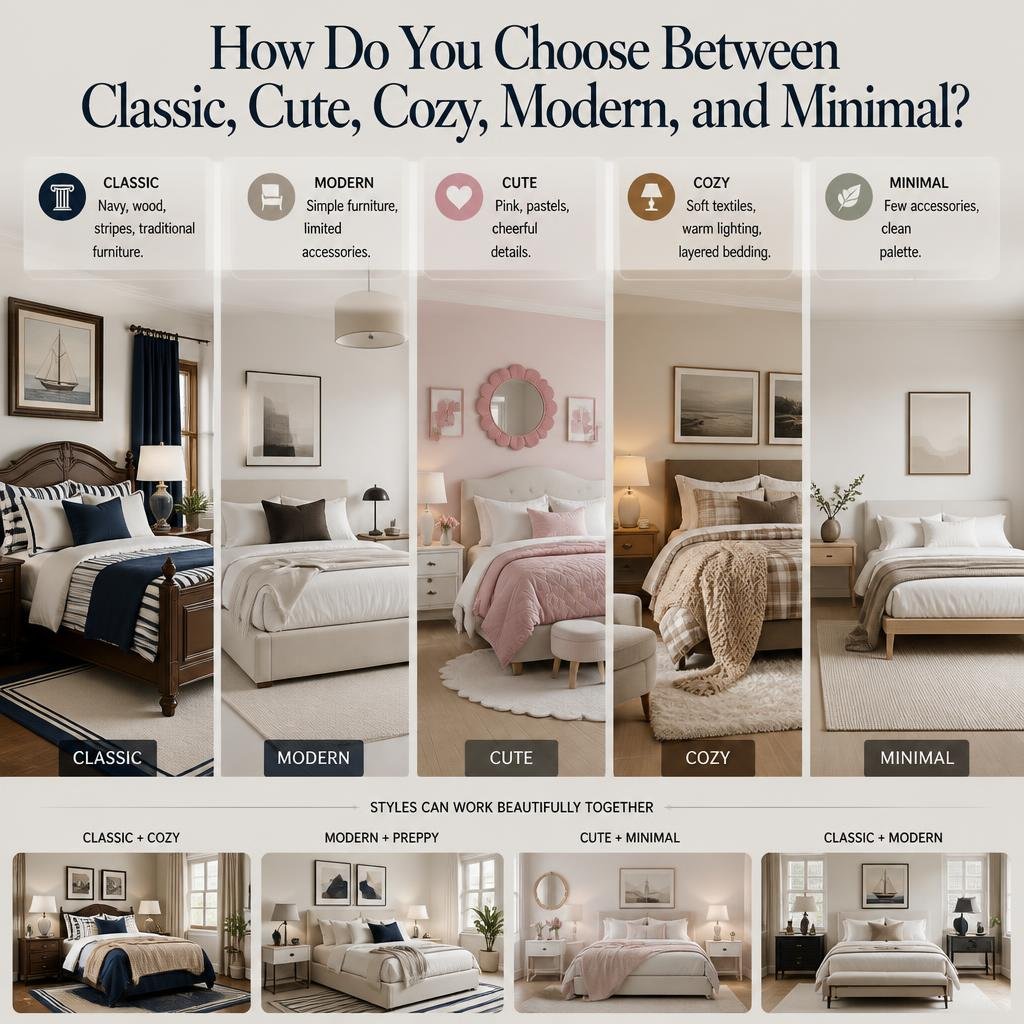
Use your existing room and personality as the starting point.
| Style | Best For | Main Characteristics |
|---|---|---|
| Classic | Timeless rooms | Navy, wood, stripes, traditional furniture |
| Modern | Clean spaces | Simple furniture, limited accessories |
| Cute | Playful rooms | Pink, pastel colors, cheerful details |
| Cozy | Comfortable rooms | Soft textiles, warm lighting, layered bedding |
| Minimal | Uncluttered rooms | Few accessories, clean palette |
You can also combine them.
For example:
Classic + Cozy
or:
Modern + Preppy
or:
Cute + Minimal
or:
Classic + Modern
This flexibility is one of the strengths of the style.
How Can You Use Preppy Room Design Ideas on a Budget?
A limited budget doesn’t mean you have to abandon the style.
Prioritize high-impact elements.
Start With What You Already Have
Before shopping, look at:
- Existing bedding
- Lamps
- Frames
- Books
- Furniture
- Cushions
- Baskets
- Artwork
Some items may already fit your desired palette.
Change Textiles First
Bedding, cushions, throws, and curtains can change the visual identity of a room without replacing major furniture.
Use Frames Strategically
A few coordinated frames can make inexpensive prints look more polished.
Organize Instead of Buying
Sometimes the biggest improvement is simply removing clutter.
A clean surface can make existing furniture look more expensive.
What Are Some Preppy Room Design Ideas for Different Color Palettes?
Navy, White, and Cream
This is a classic foundation.
Use navy for:
- Bedding
- Accent chair
- Artwork
- Curtains
Use white and cream for larger areas.
Add wood or brass-toned details for warmth.
Pink, White, and Navy
This combination creates contrast while remaining playful.
Use pink as the softer color and navy as the grounding shade.
Green, Cream, and Blue
This combination can feel natural and sophisticated.
Use green through:
- Bedding
- Plants
- Artwork
- Curtains
Then use blue as a smaller supporting color.
Lavender, Cream, and Powder Blue
This creates a softer pastel room.
Keep furniture relatively simple so the colors remain the main personality.
Burgundy, Navy, and Cream
This is stronger and more dramatic.
Use burgundy carefully.
A burgundy pillow or throw can have more impact than burgundy on every major surface.
How Do You Create a Preppy Room That Doesn’t Look Dated?
Use classic foundations but keep some elements contemporary.
For example:
Traditional wood furniture + simple modern artwork
or:
Classic striped bedding + streamlined lighting
or:
Traditional framed art + clean white furniture
Avoid making every element belong to the same historical style.
Mixing old-looking and modern-looking pieces can create a more natural room.
The goal isn’t to recreate a particular era.
It’s to create a room with timeless visual relationships.
How Can You Make the Room Feel More Expensive Without Spending More?
Focus on presentation.
A few practical improvements can make a major difference:
- Steam or straighten bedding
- Keep surfaces organized
- Hide unnecessary cables
- Use matching or coordinated hangers
- Frame artwork
- Arrange books intentionally
- Keep curtains properly positioned
- Use layered lighting
- Repeat colors
- Avoid overcrowding
Good organization is often more valuable than another decorative purchase.
How Can You Create a Strong Focal Point?
Every room benefits from having something that attracts attention first.
In a bedroom, this is often the bed.
You can strengthen it through:
- Headboard
- Bedding
- Wall artwork
- Accent wall
- Lighting
- Pattern
Don’t create five focal points.
If the bed is the main feature, keep the surrounding areas quieter.
If the wall art is the statement, use simpler bedding.
This makes the room easier to read visually.
How Do You Know When the Room Is Finished?
This is one of the hardest parts of decorating.
A room is not finished simply because you’ve run out of things to buy.
It’s finished when the important elements feel connected and the space works comfortably.
Stand at the entrance and ask:
What do I notice first?
If the answer is something unimportant, strengthen your focal point.
Is one color taking over?
If yes, reduce it or balance it with lighter tones.
Are patterns competing?
If yes, simplify one of them.
Is there enough empty space?
If no, remove a few objects.
Can I comfortably use the room?
If no, change the furniture arrangement.
Does the room feel like me?
If no, add one or two personal elements.
How Do You Design a Preppy Room Without Making It Look Too Busy?
A successful preppy room is about controlled layering, not filling the space with as many colors and patterns as possible. Start with a simple base such as cream, white, or light wood, then introduce one dominant preppy color and one or two supporting shades. After that, add classic patterns such as stripes, plaid, gingham, or checks in different sizes. This creates visual interest while keeping the room organized.
The biggest difference between a polished preppy room and an overcrowded one is usually visual hierarchy. Your bed, a feature wall, or a particular piece of artwork can be the main focal point, while the remaining elements should support it rather than compete with it.
Choose 2–3 main colors before buying accessories.
Let one pattern become the primary statement.
Use smaller patterns on pillows, throws, or accessories.
Keep some walls and surfaces visually quiet.
Repeat important colors in at least two or three areas.
Remove accessories that don’t contribute to the overall design.
Use solid-colored furniture when bedding or curtains are already patterned.
Professional tip: Before adding another decorative item, look at the room from the doorway. If your eye already has several places to land, the room probably needs editing rather than more decoration.
What Colors Work Best for a Preppy Room?
The best preppy color palette depends on the mood you want, but classic combinations such as navy and cream, blue and white, green and cream, pink and white, or burgundy and navy provide a strong starting point. Softer palettes using lavender, powder blue, blush, mint, or pale yellow can create a lighter and more contemporary interpretation of preppy style.
Rather than choosing colors individually, build a complete palette with a dominant color, supporting color, and neutral foundation. For example, navy can act as the dominant shade, powder blue can provide a softer supporting color, and cream can balance the overall room. This approach makes it easier to coordinate bedding, curtains, artwork, rugs, and accessories.
Navy + cream: Classic and timeless.
Pink + white + navy: Playful but structured.
Forest green + cream: Rich and traditional.
Powder blue + white: Fresh and relaxed.
Burgundy + navy + cream: Deeper and more dramatic.
Lavender + powder blue + cream: Soft and youthful.
Use different shades of the same color for additional depth.
Repeat accent colors instead of introducing a new color for every item.
Professional tip: Don’t automatically match every item to the exact same shade. Slight variations in color often make a room feel more natural and sophisticated while still maintaining a cohesive palette.
How Do You Mix Patterns in a Preppy Room Without Creating Visual Clutter?
Pattern mixing is one of the most effective ways to give a preppy room personality, but the patterns need a clear relationship. Instead of combining several bold designs at the same visual strength, create a hierarchy using different scales. A large plaid can work with a medium stripe and a small check because the eye can distinguish between them.
Color is another important connection. Different patterns don’t have to look identical, but they should share at least one or two colors. For example, navy-and-cream plaid bedding can work with a smaller blue stripe and a subtle cream geometric cushion. The patterns are different, but the shared palette makes them feel intentional.
Start with one dominant pattern.
Add one medium-scale supporting pattern.
Use a small or subtle pattern as the final layer.
Keep the colors related across different patterns.
Avoid placing several high-contrast patterns beside each other.
Balance patterned textiles with solid furniture.
Use texture as an alternative when the room already has enough patterns.
Professional tip: If your bedding is already strongly patterned, let your curtains or rug be quieter. If the bedding is mostly solid, you have more freedom to introduce pattern through curtains, cushions, artwork, or a rug.
How Can You Make a Small Bedroom Look Preppy and Still Feel Spacious?
A small bedroom can have plenty of preppy character, but the design needs to prioritize scale, storage, and visual breathing room. Start with furniture that fits the room rather than choosing oversized pieces simply because they look attractive. A compact desk, narrow nightstand, vertical shelving, or under-bed storage can provide functionality without consuming valuable floor space.
For the color palette, lighter foundations such as white, cream, pale blue, or soft neutral tones can help maintain an open appearance. You can then introduce stronger preppy colors through bedding, artwork, cushions, or smaller furniture pieces. Mirrors can also be useful when positioned where they reflect natural or artificial light.
Measure the room before purchasing furniture.
Choose furniture with built-in or hidden storage where possible.
Use vertical space for shelves and organization.
Keep large patterns limited in very small rooms.
Use bedding as the main colorful feature.
Avoid placing too many small decorative objects around the room.
Keep walkways clear.
Use mirrors strategically rather than covering every wall.
Choose furniture that serves more than one purpose when possible.
Professional tip: In a small room, don’t try to make every wall interesting. One well-designed focal area can look much more polished than several crowded walls competing for attention.
How Can You Make a Preppy Room Look Sophisticated Instead of Overdecorated?
Sophisticated preppy design comes from proportion, repetition, quality-looking materials, and thoughtful editing rather than simply adding expensive furniture or more accessories. Start with a restrained color palette, then combine classic elements such as wood furniture, framed artwork, stripes, plaid, tailored bedding, and warm lighting. The room should feel collected rather than themed.
One of the most effective techniques is to repeat colors and materials subtly throughout the space. For example, navy might appear in the bedding, artwork, and a small decorative object, while natural wood appears in the desk and picture frames. These repetitions create a visual connection without making everything look like a matching set.
Choose furniture with simple, well-proportioned shapes.
Use framed artwork instead of covering walls with random decorations.
Keep decorative surfaces organized.
Repeat important colors across different parts of the room.
Mix textures such as cotton, wood, woven materials, and soft upholstery.
Use warm layered lighting to add depth.
Leave some negative space around statement pieces.
Avoid buying accessories simply because an empty surface exists.
Combine classic elements with one or two modern details for freshness.
Professional tip: A room often looks more expensive after removing unnecessary items. Step back, photograph the room from the doorway, and look at the overall composition instead of judging each decoration individually.
Conclusion
Creating a beautiful preppy room is less about filling the space with patterns, colors, and decorations and more about creating a clear visual balance. A successful design usually starts with a strong color palette, practical furniture, comfortable textiles, and a few carefully selected details that give the room personality.
The best preppy room design ideas feel intentional without looking overly planned. Use classic combinations such as navy and cream, introduce patterns at different scales, repeat important colors throughout the room, and leave enough visual space for the design to breathe. If you prefer a softer look, pastel colors and lighter fabrics can create a fresh and relaxed atmosphere, while darker accents can add depth and traditional character.
Before adding another accessory, step back and look at the room as a whole. Ask whether the colors connect, whether the patterns feel balanced, and whether each decorative piece has a purpose. Small adjustments to bedding, curtains, artwork, lighting, or wall decor can often make a bigger difference than completely redecorating the room.
Most importantly, your preppy room should reflect your personality and work for your everyday life. Start with the elements you already love, build a consistent color story, and add details gradually. With thoughtful planning and a balance between classic style and personal touches, you can create a room that feels polished, comfortable, and timeless rather than simply following a trend.