Introduction
Preppy Study Room Ideas | A study room should make it easier to concentrate, stay organized, and actually enjoy spending time at your desk. But creating that balance isn’t always easy. A room can have attractive furniture and pretty decorations and still feel distracting, cramped, or unfinished. The goal is to create a workspace that looks polished while remaining genuinely useful for studying, reading, writing, and everyday work.
That’s where preppy study room ideas can be especially useful.
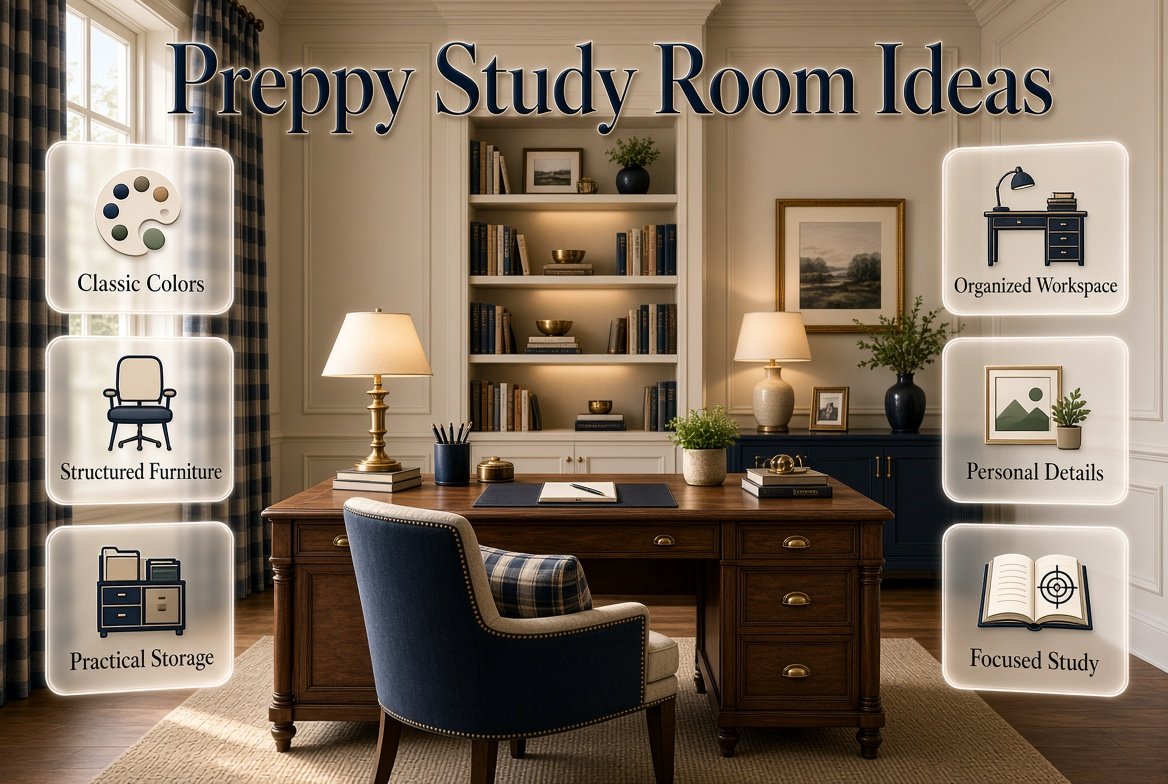
Preppy style naturally combines classic colors, timeless patterns, structured furniture, organized storage, comfortable textures, and personal details. That makes it a strong choice for a study space because the style can look sophisticated without becoming overly formal and decorative without sacrificing functionality.
If you’re still deciding what direction to take with your room, the Preppy Room homepage is a useful starting point for exploring different interpretations of the style, from classic and modern spaces to cute, cozy, and minimal designs.
In this guide, you’ll learn how to design a preppy study room from the ground up, choose the right colors and furniture, organize your desk, use patterns without creating visual clutter, make a small study area work, decorate on a budget, and create a space that feels personal rather than copied from a photograph.
What Is a Preppy Study Room?
A preppy study room is a workspace that combines classic interior design elements with practical organization and personal character. Common features include navy, cream, white, green, blue, or soft pink; stripes, plaid, gingham, checks, or subtle florals; traditional or transitional furniture; framed artwork; books; organized stationery; natural wood; and small polished accents.
However, a preppy study room isn’t simply a room filled with navy accessories and plaid patterns.
The strongest designs depend on relationships between elements.
The desk should work with the chair. The chair should connect with the room’s colors. Artwork should repeat some of the palette. Storage should support the way you actually study. Patterns should complement one another instead of competing.
A practical preppy study room usually includes:
- A comfortable desk
- A supportive chair
- Good task lighting
- Useful storage
- Organized stationery
- Books or reference materials
- A controlled color palette
- One or two recognizable patterns
- Wall decoration
- A few personal accessories
- Enough open space to work comfortably
The result should feel organized, classic, comfortable, and personal.
How Do You Create a Preppy Study Room?
The easiest way to create a preppy study room is to build the space in layers. Start with the functional essentials, establish a color palette, introduce one main pattern, and then add lighting, artwork, storage, and personal accessories.
A simple design formula is:
Functional foundation + controlled color palette + classic pattern + useful storage + personal details
For example:
Cream walls + navy desk + natural wood + blue plaid + brass lamp + framed photographs
This combination creates a recognizable preppy atmosphere without requiring every item in the room to look traditionally preppy.
The biggest mistake is decorating before deciding how the room needs to function.
If you study on a laptop, you need comfortable screen placement and cable organization. If you write frequently, you need clear desk space. If you use textbooks, you’ll need nearby storage. If the room is shared, you’ll need a layout that doesn’t interfere with other activities.
Start with those needs.
Then make the room beautiful.
Pro Tip: Ask yourself how you use the room on an ordinary day. Your real routine should determine the layout before decorative decisions are made.
What Colors Work Best in a Preppy Study Room?
Classic preppy colors work particularly well in study spaces because they can create a calm but structured visual environment.
Popular combinations include:
| Color Palette | Character | Best Use |
|---|---|---|
| Navy + Cream | Traditional and polished | Classic study |
| Blue + White | Fresh and clean | Bright workspace |
| Sage + Cream | Soft and calm | Relaxed study area |
| Green + Navy | Rich and academic | Library-inspired room |
| Pink + Navy | Playful and balanced | Youthful study space |
| Beige + Blue | Warm and timeless | Neutral study |
| Cream + Natural Wood | Soft and sophisticated | Minimal preppy room |
You don’t need to use all of these colors.
Choose a foundation first.
Cream, white, or light beige can create the background. Then introduce one stronger color such as navy, green, blue, or muted pink.
Finally, add a small accent such as brass, darker wood, or another supporting shade.
Try a 60-30-10 Approach
A simple color distribution can help keep the room balanced:
- 60% dominant color: walls, large furniture, or major background surfaces
- 30% supporting color: curtains, rug, chair, bedding, or larger accessories
- 10% accent color: artwork, stationery, lamp details, or decorative objects
You don’t have to measure this literally.
Think of it as a visual guideline.
For example:
60% cream + 30% navy and natural wood + 10% brass and sage
The room will usually feel more connected than one containing ten unrelated accent colors.
For broader decorating inspiration before choosing your study palette, explore Preppy Room Ideas, especially if you want to see how classic colors and patterns can work together across different spaces.
How Should You Choose a Study Desk?
The desk is the most important piece of furniture in a study room because it determines how comfortably the room functions.
A beautiful desk isn’t enough.
You need to consider:
- Available wall width
- Desk depth
- Legroom
- Chair clearance
- Drawer storage
- Laptop or monitor space
- Writing space
- Cable management
- Distance from windows
- Walking space around the desk
A traditional wooden writing desk can create a classic preppy appearance.
A white desk can make a smaller room feel lighter.
A navy or darker desk can become a strong focal point.
A floating desk can be useful when floor space is limited.
A desk with drawers is helpful when stationery and paperwork need to stay hidden.
What Desk Style Fits a Preppy Room?
There isn’t one required desk style.
Instead, choose furniture that matches the room’s overall direction.
Classic preppy:
Traditional wood desk, brass lamp, framed artwork, structured chair.
Modern preppy:
Clean-lined desk, simple lamp, limited accessories, natural wood.
Cute preppy:
White desk, soft-colored accessories, playful artwork, smaller decorative details.
Minimal preppy:
Simple desk, neutral colors, one pattern, very limited accessories.
The style can change while the functional requirements remain the same.
Expert Tip: Measure the desk and the chair together, not separately. A desk may fit perfectly against the wall but leave insufficient space for the chair to move comfortably.
How Do You Choose the Right Study Chair?
Your chair needs to support the amount of time you spend studying.
Look for:
- Comfortable seat height
- Adequate back support
- Appropriate seat depth
- Stable construction
- Easy movement
- A size that works with the desk
For the visual side, cream, beige, navy, brown, muted green, or patterned upholstery can work beautifully in a preppy room.
A plaid cushion can also introduce pattern without requiring an entirely patterned chair.
Don’t choose a chair only because it looks attractive in an inspiration photograph.
A study room is a working environment.
Comfort comes first.
How Do You Use Preppy Patterns Without Overdoing Them?
Patterns are one of the defining characteristics of preppy interiors, but they should be introduced with some control.
Good choices include:
- Stripes
- Plaid
- Gingham
- Checks
- Houndstooth
- Traditional florals
- Botanical patterns
- Small geometric prints
The problem isn’t having patterns.
The problem is having too many competing patterns.
Imagine a room with:
- Plaid curtains
- Striped rug
- Floral chair
- Checked cushions
- Patterned artwork
- Geometric storage boxes
Every item might look attractive individually, but together they can create visual noise.
Instead, choose a hierarchy.
A Simple Pattern Formula
One dominant pattern
Use it on a major item such as:
- Chair
- Rug
- Curtains
- Accent textile
One supporting pattern
Use it on:
- Cushion
- Throw
- Small textile
Small pattern details
Use them sparingly through:
- Artwork
- Stationery
- Decorative objects
This creates visual variety without allowing every element to compete for attention.
Common Mistake: Adding another pattern simply because the room has an empty surface. Empty space isn’t a design problem that always needs to be filled.
How Do You Organize a Preppy Study Desk?
A stylish study desk should still function as a study desk.
Keep the things you use every day within easy reach.
A practical setup might include:
- Laptop
- Notebook
- Pen holder
- Desk lamp
- Small tray
- Calendar
- One framed photo
- One decorative object
Less frequently used supplies should go into drawers, boxes, or nearby storage.
Try to keep a portion of the desktop completely clear.
This gives you somewhere to place a textbook, notebook, worksheet, or laptop without moving half the decoration first.
Create Three Desk Zones
Working zone:
The central area where you write, type, or read.
Storage zone:
A drawer, tray, organizer, or container for frequently used supplies.
Decorative zone:
A small section for a lamp, framed photo, plant, or other visual detail.
This approach prevents decorative objects from taking over the entire surface.
What Lighting Is Best for a Preppy Study Room?

Lighting should support both comfort and atmosphere.
Natural light is useful during the day, but your study room also needs reliable lighting for cloudy days and evening work.
A layered lighting setup can include:
Ambient Lighting
This provides general room illumination.
Examples include:
- Ceiling fixture
- Main room lamp
- Soft overhead lighting
Task Lighting
This focuses light on the desk.
A good desk lamp can make reading and writing more comfortable.
Accent Lighting
This adds atmosphere.
Examples include:
- Small table lamps
- Decorative wall lights
- Soft lighting near shelving
A brass or traditional-style desk lamp can work especially well in a classic preppy study room.
A simple contemporary lamp can be better suited to modern preppy design.
Where Should a Desk Lamp Go?
The ideal position depends on your dominant hand, desk arrangement, and screen placement.
The basic goal is to reduce unnecessary shadows and screen glare.
If you write with your right hand, placing the lamp toward the left side can help reduce shadows from your writing hand. If you’re left-handed, the opposite arrangement may work better.
The important thing is to test the position rather than following a rule blindly.
How Can Books Become Part of the Decor?
Books are one of the easiest ways to give a study room authentic character.
They are useful, personal, and naturally connected with the purpose of the space.
You can organize them by:
- Subject
- Size
- Frequency of use
- Color
- Category
There is no need to arrange every book by color.
Function should come first.
For decorative shelves, you can combine books with:
- Small plants
- Framed photographs
- Bookends
- Decorative boxes
- Small clocks
- Ceramic objects
Leave some open space between groups.
A shelf that’s completely packed can look visually heavy.
A shelf with small gaps usually feels more intentional.
How Do You Decorate the Walls of a Preppy Study Room?
Wall decoration can establish personality without taking up valuable floor or desk space.
Consider:
- Framed artwork
- Botanical prints
- Maps
- Family photographs
- Academic illustrations
- Gallery walls
- Pinboards
- Corkboards
- Mirrors
- Small shelves
The best wall decor should connect with the room’s existing palette.
For example, if the room uses navy, cream, sage, and natural wood, choose artwork containing one or more of those colors.
You don’t need to find artwork that matches perfectly.
Coordination is more natural than exact matching.
Create a Study Gallery Wall
A gallery wall can work particularly well above or beside the desk.
Try combining:
- One larger central print
- Two medium frames
- Several smaller photographs
- One personal piece
- One small mirror
Use matching frames if you want a traditional appearance.
For a more collected look, use two or three frame finishes while keeping the artwork visually connected.
Don’t cover every inch of the wall.
The empty areas help the gallery wall breathe.
Should You Add a Pinboard or Corkboard?
A pinboard can be both practical and decorative.
Use it for:
- Study schedules
- Important reminders
- Small photographs
- Inspiration
- Notes
- Printed references
- Personal memories
Choose a frame that fits the room.
A natural wood frame works well with a warm preppy palette.
A white frame feels lighter.
A dark frame can create stronger contrast.
The board should remain useful rather than becoming another surface that gets covered with random objects.
How Can You Add Greenery?
Plants introduce natural color and soften the structured appearance of desks, shelves, and furniture.
A small plant can sit on:
- Desk corner
- Bookshelf
- Window ledge
- Side table
A taller plant can fill an unused corner.
If the room receives limited natural light, choose a suitable low-maintenance option or use artificial greenery.
The important thing is scale.
A small desk doesn’t need a huge plant.
Similarly, a large room can handle a larger plant without looking crowded.
How Do You Choose Preppy Study Room Accessories?
The best accessories usually do at least one of two things:
They serve a purpose.
or
They contribute meaningful visual character.
Useful accessories include:
- Pencil holders
- Desk trays
- File organizers
- Storage boxes
- Bookends
- Desk calendars
- Lamps
- Small clocks
- Framed photos
- Plants
- Decorative baskets
For example, a tray can organize stationery.
A box can hide charging cables.
A framed photograph adds personality.
A plant introduces natural texture.
A lamp provides both function and decoration.
This is more effective than filling the desk with ten unrelated objects.
How Do You Make a Small Preppy Study Room Work?
Small study rooms require careful editing.
You don’t need to remove all personality.
You need to control visual weight.
Start with appropriately sized furniture.
A desk that is too deep can make a small room feel cramped even if it technically fits.
Useful ideas include:
- Narrow desks
- Floating shelves
- Vertical bookcases
- Wall-mounted organizers
- Under-desk storage
- Drawer units
- Compact chairs
- Light wall colors
- Mirrors
- Multifunctional furniture
Keep the floor as open as possible.
If you’re working with a particularly compact space, the ideas in Small Preppy Room Ideas can also help you think about furniture scale, vertical storage, mirrors, and visual breathing room.
Use Vertical Space
When floor space is limited, walls become valuable storage areas.
Install shelves above the desk for:
- Books
- Storage boxes
- Artwork
- Plants
- Small decorative objects
You can also use a tall bookcase instead of a wide one.
This allows you to increase storage without using as much floor area.
Quick Tip: In a small study room, one strong visual feature often works better than many small decorations scattered everywhere.
How Do You Create a Preppy Study Area in a Bedroom?
Not everyone has a separate study room.
A bedroom can easily include a dedicated study zone.
The key is visually separating the two functions.
Place the desk in a defined corner.
Then use:
- A small rug
- Wall artwork
- Shelving
- A desk lamp
- A consistent color palette
to establish the study area.
Avoid placing too many bedroom decorations directly on the desk.
The desk should still feel like a separate workspace.
If you’re designing the entire bedroom around the same aesthetic, Preppy Bedroom Ideas can help you coordinate the sleeping area with the study corner without making both zones feel identical.
How Can You Create a Preppy Study Room for a Teen?
A teen study room should feel personal while remaining practical enough to adapt as interests change.
Instead of building the room around one temporary trend, create a flexible foundation.
For example:
Cream walls + simple desk + navy chair + blue plaid cushion + framed photos + brass lamp + organized stationery
Later, you can change the artwork, cushion covers, accessories, or desk organization without replacing the main furniture.
Personal details can include:
- Favorite books
- Photographs
- School achievements
- Artwork
- Collections
- Travel memories
- Handmade objects
- Inspirational prints
The room should reflect the person using it.
A study room becomes much more enjoyable when it doesn’t feel like a showroom.
How Do You Create a Preppy Study Room on a Budget?

You don’t need to buy everything new.
Start with the elements that create the biggest visual difference.
Rearrange the Furniture
Try several desk positions before buying anything.
A different orientation may improve natural light and create better movement.
Declutter
Removing unnecessary items can immediately make the room feel more polished.
Change Small Accessories
Replace or coordinate:
- Pencil cups
- Storage boxes
- Picture frames
- Cushions
- Desk trays
- Lampshades
Add Framed Artwork
An affordable print can look much more finished inside a suitable frame.
Introduce One Pattern
A plaid cushion or striped textile can establish preppy character without requiring new furniture.
Upgrade Existing Hardware
If appropriate for your furniture, changing drawer pulls or handles can create a subtle refresh.
Use What You Already Own
Books, photographs, baskets, plants, and meaningful objects can often become part of the design.
Pro Tip: Before buying anything, remove five unnecessary objects from the room and rearrange the furniture. You may discover that the room needs editing more than it needs shopping.
What Is the Best Layout for a Preppy Study Room?
The ideal layout depends on the shape of the room, but the desk should normally be positioned where it receives useful light and leaves a comfortable path around the furniture.
Consider these common situations:
| Room Type | Practical Layout |
|---|---|
| Small square room | Desk against wall + vertical shelving |
| Long narrow room | Desk along the longest usable wall |
| Room with window | Desk near window while controlling glare |
| Shared bedroom | Desk in a dedicated corner |
| Large study | Desk + bookshelf + reading chair |
| Very small space | Floating desk + wall storage |
Don’t automatically push every piece of furniture against a wall.
A larger room can benefit from separate zones.
For example:
Study zone → Reading zone → Storage zone
This can make the room feel more purposeful.
A Simple Preppy Study Room Layout
Here’s a basic example:
┌──────────────────────────────┐
│         WALL SHELVES         │
│                              │
│       ┌──────────────┐       │
│       │     DESK     │       │
│       └──────────────┘       │
│            CHAIR             │
│                              │
│ BOOKCASE              PLANT  │
│                              │
│        CLEAR WALKWAY         │
└──────────────────────────────┘
The desk becomes the main working zone.
Shelves provide vertical storage.
The bookcase handles larger storage needs.
The plant adds softness.
The open walkway prevents the room from feeling cramped.
How Do You Make a Preppy Study Room Feel Cozy?
Preppy interiors can sometimes become too structured.
Texture helps soften the look.
Try:
- Soft area rugs
- Cushions
- Upholstered chairs
- Curtains
- Woven baskets
- Natural wood
- Quilted textiles
- Soft throws
Warm lighting can also make a major difference.
A room with only bright overhead lighting can feel functional but impersonal.
A desk lamp or small table lamp can make the study area feel more inviting during evening use.
The trick is layering.
Don’t simply add more objects.
Add different textures and useful layers.
How Do You Make a Modern Preppy Study Room?
Modern preppy design uses the same classic foundation but with greater restraint.
Instead of filling the room with traditional accessories, focus on:
- Clean-lined furniture
- Neutral walls
- One strong pattern
- Two or three main colors
- Simple artwork
- Natural materials
- Organized storage
- Minimal decorative objects
For example:
Cream walls + light wood desk + navy chair + simple striped textile + contemporary lamp + one large framed artwork
This still feels preppy, but it has a cleaner and more current appearance.
The goal isn’t to remove every traditional element.
It’s to mix classic and modern pieces intentionally.
How Do You Create a Classic Preppy Study Room?
A classic study room can lean more heavily into traditional details.
Try:
- Darker wood
- Navy
- Cream
- Traditional artwork
- Brass accents
- Bookshelves
- Plaid
- Stripes
- Structured furniture
- Leather or upholstered seating
A traditional desk paired with a brass lamp and framed artwork can create a library-inspired atmosphere.
However, don’t make every element dark.
Cream walls, lighter textiles, or natural wood can prevent the room from becoming visually heavy.
Can a Preppy Study Room Be Minimal?
Absolutely.
Minimal preppy design is based on selection rather than abundance.
Use:
- Simple desk
- Limited palette
- One recognizable pattern
- Clean storage
- One or two artwork pieces
- Small number of accessories
- Open surfaces
You don’t need to remove the personality associated with preppy design.
You simply express it through fewer, better-connected elements.
For example:
White walls + light wood desk + navy chair + small striped cushion + one framed botanical print
That’s enough.
How Can You Combine Technology With Preppy Style?
Modern study spaces often contain laptops, monitors, headphones, chargers, and other technology.
There’s no reason to hide technology completely.
Instead, organize it.
Use:
- Cable clips
- Under-desk cable management
- Charging stations
- Cable sleeves
- Drawer organizers
- Headphone hooks
Keep chargers grouped together rather than scattered across the desk.
If you use a monitor, position it so that it works naturally with the available light.
A clean technology setup actually supports the polished appearance of a preppy room.
How Do You Organize Study Supplies?
Organization should reflect frequency of use.
Daily-use items
Keep nearby:
- Pens
- Pencils
- Notebook
- Calculator
- Headphones
Weekly-use items
Store in:
- Drawers
- Desk organizers
- Nearby shelves
Occasional-use items
Place in:
- Storage boxes
- Cabinets
- Higher shelves
This simple system prevents the desk from becoming a storage area for everything you own.
How Do You Make the Room Feel More Personal?
A perfectly coordinated room can still feel generic.
Personal details solve that problem.
Use things that actually mean something to you.
Examples include:
- Favorite books
- Family photographs
- Travel souvenirs
- Artwork
- Certificates
- Handmade objects
- Personal collections
- Meaningful gifts
Don’t worry about making everything match perfectly.
A few authentic items can make the room feel more lived-in and genuine.
The goal isn’t a perfect photograph.
The goal is a space you want to use.
Common Preppy Study Room Mistakes
Mistake 1: Using Too Many Patterns
Preppy style is associated with patterns, so beginners sometimes assume more patterns automatically create a stronger look.
They don’t.
Too many strong patterns can make the room visually tiring.
Better approach: Choose one dominant pattern and one or two quieter supporting patterns.
Mistake 2: Choosing Too Many Colors
Buying individual accessories without a palette can create a disconnected room.
Why it happens: Each item looks attractive separately.
Why it’s a problem: The items don’t necessarily work together.
Better approach: Choose the main palette before buying accessories.
Mistake 3: Buying Furniture Before Measuring
A desk or bookcase can look perfect online and still overwhelm the room.
Better approach: Measure width, depth, height, walking clearance, and chair space before purchasing.
Mistake 4: Decorating the Desk Too Much
A study desk needs usable workspace.
Better approach: Keep decorative objects limited and leave a clear working area.
Mistake 5: Ignoring Lighting
A beautiful study room with poor lighting is still difficult to use.
Better approach: Combine ambient and task lighting.
Mistake 6: Filling Every Wall
Empty space helps the decorated areas stand out.
Better approach: Give major wall features enough breathing room.
Mistake 7: Ignoring Storage
Books, papers, chargers, and stationery accumulate quickly.
Better approach: Plan storage before adding accessories.
Mistake 8: Making Everything Match Exactly
Matching furniture, accessories, artwork, and textiles can make the room feel artificial.
Better approach: Repeat colors and materials without making every object identical.
Mistake 9: Copying a Photograph Too Literally
An inspiration photograph represents someone else’s room, dimensions, lifestyle, and lighting.
Better approach: Copy the principle rather than the exact arrangement.
Ask:
- What color relationship do I like?
- What pattern works?
- What furniture scale fits my room?
- What storage solution could I adapt?
Expert Advice for a Professional-Looking Preppy Study Room

Professional-looking spaces usually depend on consistency rather than expensive objects.
Repeat Colors
If navy appears in the chair, repeat it subtly in artwork or storage.
Repeat Materials
If natural wood appears in the desk, consider repeating it in frames or shelves.
Coordinate Metal Finishes
If you use brass, repeat it in small details rather than introducing several unrelated metal finishes.
Control Pattern Scale
Don’t use three large patterns competing for attention.
Mix large, medium, and small patterns.
Create One Focal Point
Choose one area that receives the most visual attention.
It might be:
- Desk wall
- Gallery wall
- Bookshelf
- Large artwork
- Distinctive chair
Then allow surrounding areas to remain quieter.
Leave Some Empty Space
Empty space isn’t wasted space.
It helps the important elements stand out.
How Can You Refresh an Existing Study Room Without Redesigning Everything?
You don’t always need a complete makeover.
Start with the biggest problems.
If the room feels cluttered:
Declutter first.
If it feels boring:
Introduce one pattern or stronger accent color.
If it feels uncomfortable:
Improve the chair and lighting.
If it feels disconnected:
Repeat two or three colors throughout the room.
If it feels too dark:
Use lighter textiles, better lighting, or a strategically placed mirror.
If storage is the problem:
Use vertical shelving or drawer organizers.
This approach is much more efficient than replacing everything.
How Can a Dorm Study Space Look Preppy?
Dorm rooms have their own limitations, but the same design principles still work.
Focus on temporary and practical changes such as:
- Bedding
- Desk accessories
- Removable wall decor
- Small rugs
- Lamps
- Storage baskets
- Decorative organizers
- Personal photographs
The desk is especially important in a dorm.
Use a coordinated stationery set, small lamp, tray, and one or two decorative pieces.
Don’t cover the entire desk.
For a complete dorm-focused approach, Preppy Dorm Room Ideas can help you think about temporary decoration, compact storage, bedding, and study-space organization together.
How Do You Balance Style and Productivity?
A study room should look good, but its primary purpose is still studying.
A few simple decisions can support productivity:
- Keep frequently used items accessible.
- Keep unnecessary objects off the desk.
- Use adequate task lighting.
- Make the chair comfortable.
- Keep cables organized.
- Reduce visual clutter.
- Create dedicated storage.
- Keep the main work surface clear.
You don’t need a completely empty desk.
You need a desk that supports the activity you’re doing.
A Practical Preppy Study Room Formula
If you’re unsure where to begin, use this simple formula:
1 dominant color
2 supporting colors
1 major pattern
1 natural material
1 metal finish
1 focal point
Useful storage
Personal details
For example:
Cream + navy + sage + plaid + natural wood + brass + gallery wall + organized bookshelf + family photographs
This gives you enough structure to create a cohesive room without forcing every decision.
A Step-by-Step Preppy Study Room Plan
Step 1: Measure the Room
Record:
- Wall dimensions
- Window location
- Door location
- Available floor area
- Electrical outlets
Step 2: Decide How You Study
Do you mostly:
- Read?
- Write?
- Use a laptop?
- Use textbooks?
- Draw?
- Study for long periods?
Your answer affects the desk and storage requirements.
Step 3: Choose the Desk
Select the size based on your actual workspace needs.
Step 4: Choose the Chair
Prioritize comfort and appropriate height.
Step 5: Establish the Color Palette
Pick one dominant color and two supporting colors.
Step 6: Choose One Main Pattern
Plaid, stripe, gingham, floral, or check can work.
Step 7: Add Storage
Use drawers, shelves, boxes, and organizers.
Step 8: Add Lighting
Start with task lighting and then add ambient or accent lighting.
Step 9: Decorate the Walls
Choose artwork, photographs, shelves, or a pinboard.
Step 10: Add Personal Details
Use meaningful objects rather than random decorations.
Step 11: Edit
Remove anything that doesn’t contribute to function, comfort, or visual balance.
This last step is often what separates a polished room from an overcrowded one.
How Do You Create a Preppy Study Room That Looks Stylish but Still Feels Productive?
A successful preppy study room should balance visual character with practical function. Start with a comfortable desk and chair, then build the design around a controlled color palette such as navy and cream, sage and white, or blue and natural wood. Introduce one dominant pattern, such as plaid or stripes, instead of covering the room with multiple competing prints. Keep the desktop relatively clear so the room remains easy to use for reading, writing, and computer work.
Useful ways to improve the space include:
Choose furniture based on comfort and available space first.
Keep frequently used study supplies within easy reach.
Use closed storage for items that create visual clutter.
Add one strong focal point, such as a gallery wall or bookshelf.
Use a desk lamp to combine practical lighting with preppy character.
Repeat two or three colors throughout the room for visual consistency.
Leave some empty wall and desk space so the room doesn’t feel overcrowded.
What Colors Work Best for a Preppy Study Room?
The strongest preppy study room palettes usually combine a light or neutral foundation with one or two classic accent colors. Navy and cream create a traditional look, while sage and white feel softer and more relaxed. Light blue with natural wood is another versatile combination, particularly when you want the room to feel bright without looking overly plain.
Instead of choosing colors independently for each item, create the palette before decorating. This makes it easier to coordinate the desk, chair, artwork, textiles, and accessories.
Consider these combinations:
Navy + cream + brass: classic and polished
Sage + cream + natural wood: soft and calming
Light blue + white + beige: bright and relaxed
Green + navy + warm wood: traditional and academic
Muted pink + navy + cream: youthful but balanced
Use the dominant color on larger surfaces.
Keep stronger accent colors to smaller furniture or accessories.
Repeat the same colors in artwork, textiles, and desk accessories.
Avoid introducing several unrelated bright colors that can make the workspace feel visually fragmented.
How Can You Make a Small Preppy Study Room Look Bigger and More Organized?
The key to a small preppy study room is choosing furniture that fits the room rather than trying to squeeze full-size furniture into a limited area. A narrow desk, floating shelves, vertical bookcases, wall-mounted organizers, and under-desk storage can provide the functionality you need while preserving valuable floor space. Lighter wall colors can also help maintain an open visual appearance.
A small room doesn’t need fewer design details; it needs more carefully selected details.
Try these practical strategies:
Measure the desk, chair, and walking space before purchasing furniture.
Use vertical shelving instead of wide storage units.
Choose one main pattern rather than several bold patterns.
Keep the desktop mostly clear.
Use wall-mounted storage for books and stationery.
Choose furniture with built-in drawers when possible.
Use a mirror strategically if the room needs more visual openness.
Avoid filling every wall with artwork or shelves.
Leave visible floor space around major furniture pieces.
How Do You Organize a Preppy Study Desk Without Making It Look Cluttered?
A well-organized preppy desk should look intentional while keeping the supplies you use regularly easy to reach. Start by dividing the desk into functional zones. Keep the central area available for writing or computer work, place daily-use stationery in a small organizer, and reserve one area for decorative elements such as a framed photograph, plant, or desk lamp.
The goal isn’t to remove everything from the desk. It’s to make sure every visible item has a purpose.
A practical desk organization system can include:
A pencil holder for everyday writing supplies.
A small tray for loose stationery or frequently used items.
Drawer storage for less frequently used materials.
A document organizer for papers and notebooks.
Cable clips or under-desk management for chargers.
One or two decorative objects rather than many small items.
A clear central workspace for books, notebooks, or a laptop.
A consistent color scheme for organizers so they contribute to the overall design.
Regularly removing unused papers and supplies before they accumulate.
How Do You Add Preppy Style to a Study Room Without Spending a Lot of Money?
You can create a convincing preppy study room without replacing all your furniture. The biggest improvements often come from color coordination, organization, textiles, artwork, and rearranging what you already have. Start by decluttering the room and experimenting with the furniture layout. Then introduce a small number of affordable details, such as a plaid cushion, framed artwork, coordinated desk organizers, or a simple table lamp.
Focus your budget on elements that are both visible and useful rather than buying large quantities of decoration.
Budget-friendly improvements include:
Rearrange existing furniture before buying new pieces.
Use framed prints or personal photographs as wall decor.
Add one plaid, striped, or gingham textile.
Coordinate inexpensive storage boxes and organizers.
Refresh suitable furniture with new hardware.
Use existing books as part of your shelf styling.
Add a small plant for natural color and texture.
Hide cables to immediately make the desk look cleaner.
Keep the color palette consistent so inexpensive pieces feel more coordinated.
Invest gradually in major furniture instead of replacing everything at once.
Conclusion
Creating a preppy study room is about more than choosing attractive colors, patterns, and accessories. The best space combines a polished preppy look with practical organization, comfortable furniture, effective lighting, and a layout that makes studying easier. A balanced mix of classic patterns, coordinated colors, natural textures, and personal details can make the room feel stylish without becoming distracting or cluttered.
Start with a clear color palette, choose a desk that fits the available space, and keep everyday study supplies organized and within easy reach. Add personality through framed artwork, books, patterned textiles, small decorative pieces, and carefully selected accessories rather than filling every surface.
Whether you are designing a spacious home study, a small bedroom workspace, or a dorm setup, the same principle applies: make the room functional first, then layer in preppy character. With thoughtful planning, even a simple study area can become an organized, comfortable, and inspiring space that supports both productivity and personal style.