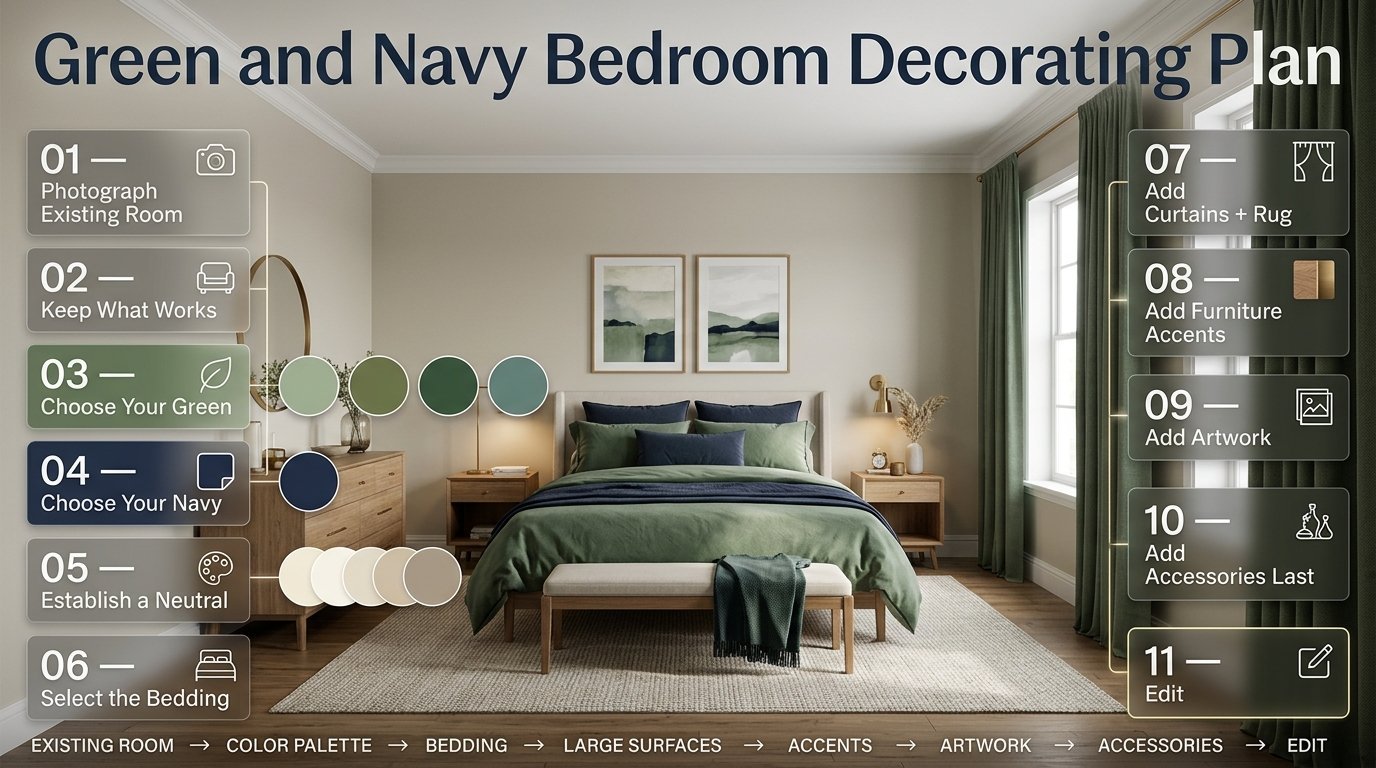
Introduction
Green and Navy Bedroom Design | A bedroom can have beautiful furniture, attractive bedding, and carefully chosen accessories, yet still feel slightly unfinished. In many cases, the problem isn’t the furniture at all. It’s the relationship between the colors.
Green and navy are two colors that can create an exceptionally sophisticated bedroom, but they need to be handled carefully. Both have enough visual depth to dominate a room, especially when you choose forest green, emerald, olive, or deep navy. Without the right balance, the result can feel heavy. With the right balance, however, the same colors can create a bedroom that feels calm, polished, classic, modern, or distinctly preppy.
A successful green and navy bedroom design is therefore less about putting two colors together and more about understanding proportion, undertones, lighting, furniture, patterns, textures, and contrast.
If you’re building your overall decorating direction and want to see how these colors can fit into a wider preppy aesthetic, Preppy Room is a useful starting point for exploring the broader design language behind coordinated preppy interiors.
In this guide, you’ll learn how to choose the right green and navy shades, decide which color should dominate, select walls and bedding, coordinate furniture, mix patterns, work with different room sizes, create modern and classic versions, avoid common mistakes, and turn the color palette into a complete bedroom design rather than simply a collection of matching accessories.
What Is a Green and Navy Bedroom Design?
A green and navy bedroom design uses green and navy as the main color relationship while relying on neutrals, materials, patterns, and lighting to create balance. The combination can range from soft sage and muted navy to rich forest green and deep navy, depending on the desired atmosphere.
The important point is that green and navy don’t need to appear in equal amounts.
One can be the dominant color while the other becomes a supporting accent. A third neutral such as cream, ivory, beige, or warm white can provide the visual space needed to keep the room comfortable.
For example:
Warm white + sage green + navy + light oak
creates a softer modern atmosphere.
Meanwhile:
Ivory + forest green + deep navy + walnut + brass
creates a richer, more traditional look.
The colors are similar in concept, but the overall experience is completely different.
Why Does This Color Combination Work?
Green and navy both have a grounded quality. Green connects the room with nature, plants, and organic materials, while navy introduces depth, structure, and a classic feeling.
That makes them particularly useful for bedrooms because neither color has to feel excessively energetic.
The combination also works across several design directions:
- Classic
- Traditional
- Modern
- Cozy
- Minimal
- Preppy
- Transitional
- Sophisticated
- Nature-inspired
The secret is deciding what role each color should play.
How Should You Balance Green and Navy in a Bedroom?
The simplest approach is to avoid giving both colors equal visual importance. Choose a dominant shade, a secondary color, and a neutral foundation.
A practical starting point is the 60-30-10 principle:
| Design Role | Approximate Share | Example |
|---|---|---|
| Dominant | 60% | Cream, warm white, or soft neutral |
| Secondary | 30% | Green or navy |
| Accent | 10% | The remaining color, brass, or pattern |
These percentages aren’t strict rules. They’re simply a way to think about visual weight.
For example, you could have warm-white walls and cream bedding as the visual foundation, navy as the major furniture or bedding color, and green appearing through curtains, pillows, artwork, and plants.
Or you could reverse the relationship.
Navy-Dominant Approach
Choose navy as the stronger color if you want:
- A sophisticated appearance
- A classic atmosphere
- More visual depth
- A tailored look
- Stronger contrast
A navy headboard, navy curtains, and smaller green accents can create this effect.
Green-Dominant Approach
Choose green as the stronger color if you want:
- A softer atmosphere
- A nature-inspired feeling
- More visual warmth
- A relaxed bedroom
- Less formal styling
Sage or muted olive walls with navy bedding can work especially well.
Pro Tip: Decide which color should be noticed first when someone enters the room. That color should receive the larger or more visually important surfaces.
Which Green Shades Work Best With Navy?
Green is a broad color family, so the exact shade makes a major difference.
Sage Green and Navy
Sage is one of the safest choices because it is muted rather than highly saturated.
It works particularly well when you want:
- A calm bedroom
- A modern preppy look
- A softer color palette
- A small bedroom to feel lighter
- Easy coordination with cream and wood
Sage can appear on walls, curtains, bedding, upholstery, or artwork.
A particularly reliable combination is:
Sage + navy + warm white + light wood
The warm white prevents the navy from feeling too heavy, while light wood adds natural warmth.
Olive Green and Navy
Olive creates a warmer and earthier atmosphere.
It works beautifully with:
- Beige
- Cream
- Walnut
- Brass
- Tan
- Natural fibers
- Warm white
Olive is a good option if you don’t want the bedroom to feel overly bright or overly formal.
It can also make navy feel less cold.
Forest Green and Navy
Forest green is richer and more dramatic.
It can produce a traditional or luxurious atmosphere, especially when combined with ivory, walnut, brass, and tailored textiles.
Because both forest green and navy are dark, contrast becomes especially important.
A forest-green wall with navy furniture can look impressive in a bright bedroom, but the same combination can become heavy in a room with limited natural light.
Emerald Green and Navy
Emerald is more saturated and energetic than sage or olive.
Instead of covering large surfaces with emerald, consider using it as a controlled accent:
- Velvet cushion
- Small chair
- Decorative artwork
- Throw
- Lamp
- Accent stool
This allows the color to create richness without overpowering the room.
Mint Green and Navy
Mint is lighter and more playful.
It can work especially well in:
- Youthful bedrooms
- Bright rooms
- Cute preppy interiors
- Smaller spaces
- Fresh modern designs
Because mint is much lighter than forest green, it creates more contrast against navy.
Which Navy Shade Should You Choose?
Navy also varies significantly.
A traditional navy can look crisp and classic, while a blue-black navy can feel dramatic and sophisticated.
If the bedroom doesn’t receive much daylight, an extremely dark navy may make the space feel heavier than expected.
A slightly softened navy can be easier to work with.
Before committing to paint or large furniture, test the color in the actual bedroom.
Look at it:
- In morning daylight
- In afternoon light
- Under ceiling lighting
- Beside the furniture
- Next to your bedding
- Against the flooring
Expert Tip: Never judge a dark paint color only from a small store sample. Large walls reflect light differently, and the same navy can look completely different during the day and evening.
Should the Walls Be Green or Navy?
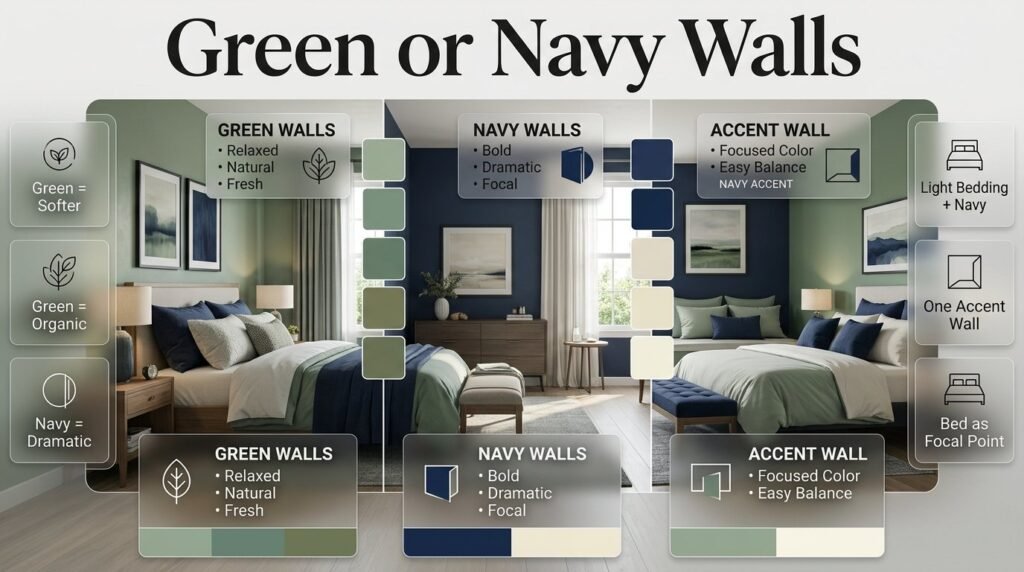
Both can work, but they create different experiences.
Green Walls
Green walls usually feel softer and more organic.
Sage, eucalyptus, and muted olive are particularly flexible.
Choose green walls if you want the bedroom to feel:
- Relaxed
- Natural
- Comfortable
- Fresh
- Less dramatic
Navy can then appear through the bed, bedding, curtains, artwork, or furniture.
Navy Walls
Navy walls create a stronger focal atmosphere.
They work particularly well when:
- The room has good natural light
- The ceiling is reasonably light
- Bedding is lighter
- Furniture isn’t overwhelmingly dark
- You want a dramatic bedroom
Cream or ivory bedding can provide a strong visual contrast against navy walls.
Accent Wall
If you’re unsure about covering the entire room in a dark color, use one accent wall behind the bed.
This is often the easiest wall to emphasize because the bed already acts as the room’s main focal point.
A navy accent wall can be paired with sage bedding.
A green accent wall can be paired with navy pillows, a navy bench, or navy artwork.
How Do You Choose Bedding for a Green and Navy Bedroom?
Bedding is one of the easiest areas in which to establish the color palette.
Unlike paint or furniture, bedding can be changed relatively easily when your style evolves.
A balanced setup could be:
- Cream sheets
- Navy duvet
- Sage quilt
- Neutral throw
- Navy-and-green patterned pillows
Another option is:
- White sheets
- Sage duvet
- Navy lumbar pillow
- Cream throw
- Botanical accent cushion
The important thing is to avoid making every layer equally strong.
Why Neutral Bedding Often Works Better
If your walls and furniture already contain green and navy, neutral bedding can provide breathing room.
Cream, ivory, beige, and warm white are particularly useful.
You can then introduce the stronger colors through smaller layers.
This makes the room easier to update later.
How to Style Green and Navy Bedding
Choosing the right bedding is an easy way to bring a green and navy color scheme together without making your bedroom feel too dark or overly coordinated. You can combine navy duvet covers with sage-green cushions, cream sheets, or subtle plaid patterns to create a balanced and inviting look. If you want more inspiration for coordinating these colors, explore our guide to green and navy bedding ideas, which offers practical ways to layer colors, mix patterns, and create a cohesive preppy bedroom style.
How Can Patterns Improve Green and Navy Bedroom Design?
Patterns are especially valuable when you want the room to feel layered rather than flat.
Good choices include:
- Stripes
- Plaid
- Gingham
- Checks
- Botanical prints
- Traditional florals
- Subtle geometric patterns
The trick is pattern hierarchy.
You don’t want every pattern fighting for attention.
A useful structure is:
Large pattern → medium pattern → small pattern → solid surfaces
For example:
- Large navy-and-cream stripe on bedding
- Medium green botanical cushion
- Small gingham accent
- Solid cream throw
This gives the eye somewhere to rest.
For a broader inspiration-based approach to this color family, you can also explore Green and Navy Bedroom Ideas.
That page can work as a companion resource for visual inspiration, while this article focuses more heavily on the design principles behind building the room.
How Many Patterns Should You Use?
You don’t need many.
Two or three carefully selected patterns are often enough.
One Hero Pattern
This is the pattern people notice first.
Examples:
- Large stripe
- Bold botanical
- Traditional plaid
One Supporting Pattern
This should be quieter.
Examples:
- Small check
- Narrow stripe
- Subtle floral
One Optional Accent
Use this only if the room still needs visual interest.
The mistake is not using too many patterns because patterns are bad. The mistake is giving too many patterns the same visual importance.
Common Mistake: Choosing several large patterns simply because they all contain green and navy. Matching colors cannot compensate for competing scales.
What Furniture Works Best With Green and Navy?
Furniture determines whether the color palette feels light, traditional, modern, or dramatic.
White Furniture
White furniture can keep the bedroom bright.
It’s especially useful when:
- The walls are dark
- The room is small
- The bedding is colorful
- You want a youthful atmosphere
Light Wood
Light oak and similar wood tones add warmth without making the room feel heavy.
They pair particularly well with sage and navy.
Medium Wood
Medium wood produces a more traditional atmosphere.
It works beautifully with:
- Olive
- Forest green
- Navy
- Cream
- Brass
Walnut and Dark Wood
Dark wood can create a luxurious and classic result.
However, use it carefully when the rest of the room is already dark.
A walnut bed, navy bedding, and forest-green walls may look beautiful, but they need cream textiles and good lighting to prevent visual heaviness.
How Should You Choose the Bed?
The bed is usually the largest piece of furniture and therefore one of the strongest visual anchors.
Navy Upholstered Bed
This is an excellent choice when the walls are neutral or soft green.
It immediately establishes navy as a major color.
Neutral Upholstered Bed
A cream or beige bed gives you more freedom with bedding.
You can introduce both green and navy through textiles without permanently committing the furniture to either shade.
Wooden Bed
Wood gives the room warmth and can make a green-and-navy palette feel more traditional.
If you’re using dark wood, balance it with lighter bedding and walls.
How Can You Use Green Without Making the Room Too Green?
Green doesn’t need to appear on every surface.
Instead, distribute it across several levels.
For example:
Large: Sage wall
Medium: Green chair
Small: Botanical cushion
This creates repetition without monotony.
Another approach is to keep the large surfaces neutral and introduce green through:
- Curtains
- Pillows
- Artwork
- Plants
- Throws
- Upholstery
- Small accessories
This is especially useful if you’re not sure whether you’ll love the color long term.
How Can You Use Navy Without Making the Bedroom Too Dark?
Navy works best when it has visual support.
If you use a navy bed, consider:
- Cream bedding
- Light curtains
- Warm white walls
- Light wood
- A neutral rug
- Brass lighting
If you use navy walls, consider:
- White or cream bedding
- Lighter furniture
- Reflective surfaces
- Good bedside lighting
- A lighter ceiling
The objective isn’t to remove navy.
It’s to give navy enough contrast to remain intentional.
What Neutral Colors Work Best With Green and Navy?
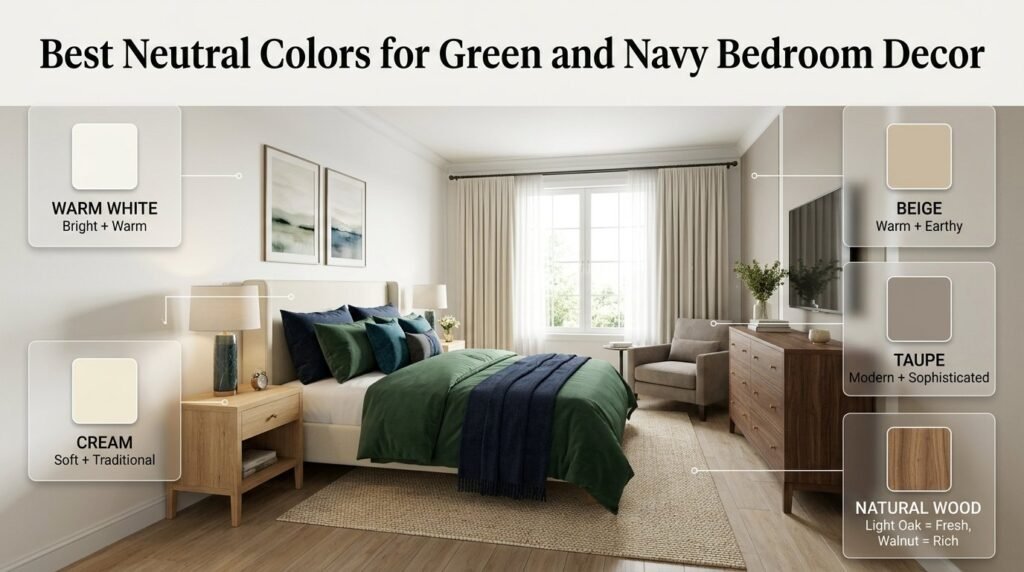
Neutrals are extremely important in this palette.
Warm White
Warm white keeps the room bright while avoiding an overly cold appearance.
Cream
Cream is excellent with forest green, olive, and deep navy.
It creates a softer traditional atmosphere.
Beige
Beige works especially well when the green has warm or earthy undertones.
Taupe
Taupe can support a sophisticated modern palette without becoming too bright.
Natural Wood
Wood isn’t technically a paint color, but it functions as a visual neutral.
Light oak can make the room feel fresh.
Walnut can make it feel richer.
What Materials Complement Green and Navy?
Color becomes much more interesting when texture is involved.
Consider combining:
- Linen
- Cotton
- Quilted fabrics
- Velvet
- Woven baskets
- Natural wood
- Rattan
- Brass
- Ceramic
- Wool
- Upholstery
You don’t need all of them.
Choose a few that fit the style.
For example:
Modern: linen + light oak + simple metal
Classic: velvet + walnut + brass
Cozy: quilted cotton + wool + natural wood
Preppy: tailored upholstery + stripes + polished wood
Texture is especially important when your palette contains only a few colors.
How Do You Create a Modern Green and Navy Bedroom?
A modern version should focus on simplicity rather than adding more decoration.
Try:
- Warm white walls
- Sage green
- Deep navy
- Light oak
- Simple furniture
- Minimal artwork
- Linen bedding
- One controlled pattern
For example:
Warm white wall + navy bed + cream bedding + sage cushions + light oak nightstands
The room will still have a recognizable green-and-navy identity without feeling overly traditional.
Modern style comes more from restraint, clean lines, and material choices than from removing color.
How Do You Create a Classic Green and Navy Bedroom?
Classic styling gives the colors a more traditional context.
Use:
- Forest green
- Deep navy
- Ivory
- Walnut
- Brass
- Stripes
- Plaid
- Botanical artwork
A navy upholstered headboard can become the main anchor.
Forest-green cushions and curtains can then introduce the secondary color.
Add a traditional rug and brass lamps for a more established appearance.
If you want to explore the wider preppy application of this palette, Green and Navy Preppy Bedroom is a useful companion topic. The bedroom design here remains focused on planning and execution rather than repeating a separate preppy-bedroom guide.
How Do You Create a Cozy Green and Navy Bedroom?
Cozy design isn’t only about darker colors.
It depends heavily on texture and lighting.
Use:
- Soft bedding
- Quilted layers
- Linen curtains
- Warm lamps
- Textured rugs
- Natural wood
- Woven storage
- Upholstered furniture
A deep navy blanket can feel much cozier when combined with cream linen rather than another dark blue textile.
Similarly, a forest-green cushion becomes more inviting when placed beside warm wood and soft cream fabric.
Quick Tip: If your room feels cold, add texture and warmer lighting before adding another accent color.
How Do You Design a Green and Navy Bedroom for a Small Space?
Small bedrooms require more control over visual weight.
You don’t have to avoid navy or green.
Instead, use them strategically.
A reliable small-bedroom formula is:
Light walls + navy focal point + soft green accents + light furniture
For example:
- Warm-white walls
- Navy upholstered headboard
- Cream bedding
- Sage curtains
- Light oak nightstands
- Neutral rug
- One green-and-navy pattern
This creates color identity without making every surface dark.
What Should You Avoid?
Try not to combine all of these at once:
- Dark green walls
- Navy bed
- Dark wood
- Dark rug
- Black accessories
- Heavy curtains
Each element can work independently, but together they may visually compress the room.
How Do You Design a Green and Navy Bedroom for a Large Space?
Large bedrooms give you more freedom.
You can distribute colors across separate areas rather than concentrating everything around the bed.
For example:
Sleeping Area
Navy bed + cream bedding.
Reading Area
Green upholstered chair + wooden side table.
Window Area
Green curtains + neutral rug.
Wall Area
Botanical artwork with navy and green details.
This makes the room feel coordinated without requiring every item to contain both colors.
Large rooms can also handle larger patterns, deeper green, and richer wood tones more comfortably.
How Does Natural Light Affect Green and Navy?
Lighting can completely change how these colors appear.
A north-facing or naturally darker room may make navy and forest green look deeper.
A bright room can handle stronger shades more comfortably.
Before choosing your final colors, observe the room at different times.
Bright Morning Light
Colors may appear clearer and lighter.
Afternoon Light
Warm daylight can bring out earthy green undertones.
Evening Light
Warm bulbs may make cream and olive look richer while making navy appear darker.
This is why samples should be tested in the actual room rather than selected from a screen alone.
How Do You Coordinate Green and Navy Without Making Everything Match?
There’s an important difference between matching and coordinating.
Matching means using the exact same color repeatedly.
For example:
- Green curtains
- Green pillows
- Green rug
- Green artwork
Coordinating means allowing colors to repeat in different ways.
For example:
- Sage curtains
- Navy bedding
- Botanical artwork
- Cream rug
- Light wood
- Navy lamp
The second approach usually feels more natural.
The colors are connected, but the room doesn’t look like a matching furniture set.
How Do You Make a Green and Navy Bedroom Look More Expensive?
A polished room isn’t necessarily expensive.
It usually looks expensive because the proportions, materials, and colors feel intentional.
Focus on:
Better Proportions
Choose furniture that fits the room.
An oversized bed in a small bedroom can make even beautiful colors look wrong.
Quality-Looking Textiles
Simple, well-layered bedding often looks better than bedding overloaded with decoration.
Repeated Materials
If you use brass on one lamp, repeat it subtly elsewhere.
If you use light oak on the nightstands, introduce a similar wood tone in another area.
Controlled Accessories
Don’t fill every surface.
One meaningful accessory can have more impact than five random pieces.
Layered Lighting
Use a combination of:
- Ceiling lighting
- Bedside lamps
- Accent lighting
- Natural daylight
Lighting can make a simple bedroom feel much more sophisticated.
Green and Navy Bedroom Design for Different Styles

The same colors can produce very different results depending on the style.
| Style | Green | Navy | Supporting Elements |
|---|---|---|---|
| Modern | Sage | Deep navy | Warm white, light oak |
| Classic | Forest | Traditional navy | Ivory, walnut, brass |
| Cozy | Olive | Soft navy | Linen, wool, warm wood |
| Preppy | Forest or sage | Classic navy | Plaid, stripes, gingham |
| Minimal | Eucalyptus | Muted navy | Beige, simple furniture |
| Elegant | Emerald | Deep navy | Cream, brass, velvet |
| Youthful | Mint | Medium navy | White, light wood |
This makes the palette flexible rather than tied to one decorating style.
How Can You Make the Room More Preppy Without Overdoing It?
Preppy style doesn’t require every item to be striped or plaid.
Instead, choose a few recognizable elements.
Good options include:
- Navy stripes
- Green botanical prints
- Plaid pillows
- Gingham accents
- Tailored upholstery
- Symmetrical bedside tables
- Brass lamps
- Traditional artwork
- Natural wood
If you want a broader room-level approach rather than focusing only on the bedroom, see Green and Navy Preppy Room Ideas.
That resource is better suited to exploring the wider room concept, while the present article focuses specifically on designing the bedroom itself.
What Are the Most Common Green and Navy Bedroom Design Mistakes?
Mistake 1: Using Too Much Dark Color
The combination can become heavy when dark green and navy cover most major surfaces.
Why it happens: Both colors look attractive individually, so it feels logical to use more of them.
Why it’s a problem: Their combined visual weight can make the room feel smaller.
Better solution: Add cream, warm white, light wood, and lighter textiles.
Mistake 2: Ignoring Undertones
Not every green works equally well with every navy.
Why it happens: People focus on the color name rather than the actual appearance.
Why it’s a problem: A cool gray-green may feel disconnected from a very warm navy.
Better solution: Place samples beside each other before committing.
Mistake 3: Making Every Item Match
A room can look artificial when everything is the exact same shade.
Better solution: Repeat the color but change the material, pattern, or intensity.
Mistake 4: Using Too Many Patterns
Patterns create interest, but too many strong patterns create noise.
Better solution: Use a clear pattern hierarchy.
Mistake 5: Forgetting the Floor
Dark flooring plus dark furniture plus dark walls can create excessive visual weight.
Better solution: Use a lighter rug or introduce natural wood.
Mistake 6: Ignoring Lighting
A color can look perfect during the day and completely different at night.
Better solution: Test the palette under both natural and artificial lighting.
A Step-by-Step Green and Navy Bedroom Design Plan
If you’re starting from an empty room, follow this order.
Step 1: Decide the Mood
Choose one:
- Calm
- Classic
- Modern
- Cozy
- Dramatic
- Preppy
- Minimal
This determines your shades.
Step 2: Choose the Dominant Color
Decide whether green, navy, or a neutral will occupy the most visual space.
Step 3: Choose the Neutral Foundation
Select cream, warm white, beige, or another soft neutral.
Step 4: Choose the Main Furniture
Start with the bed because it’s usually the largest visual element.
Step 5: Add the Second Color
Introduce green or navy through bedding, curtains, upholstery, or artwork.
Step 6: Add Texture
Bring in wood, linen, rugs, woven materials, and upholstery.
Step 7: Introduce One Main Pattern
Choose a stripe, plaid, botanical, or another pattern that connects the palette.
Step 8: Add Lighting
Use bedside lamps and warm ambient lighting.
Step 9: Add Small Accessories
Only add accessories that improve the room.
Step 10: Edit
Stand at the doorway and look at the entire room.
If one color feels too dominant, move some pieces around.
A Practical Green and Navy Bedroom Formula
Here is one complete design you can use as a starting point.
Walls
Warm white.
Bed
Navy upholstered headboard.
Bedding
Cream sheets with a navy-striped duvet.
Pillows
Sage green pillows with one botanical accent.
Curtains
Soft sage linen.
Nightstands
Light oak.
Lamps
Warm brass.
Rug
Cream with a subtle navy pattern.
Artwork
Muted botanical prints.
Accessories
One plant, a small stack of books, and a woven basket.
This approach creates a clear green-and-navy identity without turning every surface into a competing color block.
A Rich Traditional Formula
For a deeper and more sophisticated room:
Walls: Warm ivory
Bed: Walnut or deep navy
Bedding: Cream and ivory
Curtains: Forest green
Accent: Navy plaid
Rug: Traditional muted pattern
Furniture: Walnut
Lighting: Brass
Artwork: Botanical or classic prints
This combination works especially well when the room has good natural light.
A Soft Modern Formula
For a lighter interpretation:
Walls: Warm white
Bed: Simple navy frame
Bedding: Cream
Pillows: Sage and muted green
Furniture: Light oak
Curtains: White linen
Rug: Soft beige
Artwork: Minimal botanical or abstract art
Accent: Small brass details
This gives you the color relationship without making the bedroom feel overly formal.
How Can You Add Personality?

A bedroom shouldn’t look like a showroom.
Once the basic palette is established, introduce personal elements.
Consider:
- Books
- Framed photographs
- Favorite artwork
- Travel objects
- Handmade accessories
- A meaningful collection
- Personal textiles
These details can make the room feel authentic.
The strongest bedroom designs usually have a clear visual system but still show something about the person who lives there.
Green and Navy Color Palettes to Try
Soft and Fresh
Sage + Navy + Warm White + Light Oak
Best for modern and relaxed rooms.
Classic
Forest Green + Deep Navy + Ivory + Walnut + Brass
Best for traditional rooms.
Earthy
Olive + Navy + Beige + Medium Wood
Best for warm, comfortable spaces.
Youthful
Mint + Medium Navy + White + Pale Wood
Best for lighter, playful rooms.
Elegant
Emerald + Navy + Cream + Brass
Best when you want richer accents.
Relaxed
Muted Green + Soft Navy + Linen + Natural Wood
Best for comfortable everyday bedrooms.
Is green and navy a good color combination for a bedroom?
Green and navy are an excellent combination for a bedroom because they create a balanced mix of natural softness and deeper visual contrast. Green brings an organic, calming quality, while navy adds structure and sophistication. The key is choosing shades that complement each other and introducing a lighter neutral such as cream, ivory, warm white, or beige to prevent the room from feeling too dark.
For the best result:
Use one color as the dominant shade and the other as an accent.
Add cream or warm white to create visual breathing room.
Use natural wood to introduce warmth.
Repeat the colors through different materials rather than matching every item.
Consider the room’s natural lighting before choosing very dark shades.
A softer sage-and-navy combination is particularly versatile, while forest green and deep navy create a richer and more dramatic bedroom.
What colors go best with a green and navy bedroom?
The best supporting colors for green and navy are generally warm neutrals and natural tones. Cream, ivory, warm white, beige, taupe, and natural wood can soften the depth of the two main colors without competing with them. Brass and muted earthy accents can also add warmth when used in moderation.
Consider these combinations:
Sage + navy + warm white + light oak for a modern bedroom
Olive + navy + cream + walnut for a traditional look
Forest green + navy + ivory + brass for a sophisticated atmosphere
Muted green + navy + beige + natural wood for a relaxed bedroom
The supporting colors should have a clear purpose. Instead of introducing several unrelated accent shades, choose one or two materials or neutral tones that help connect the green and navy throughout the room.
Should I paint my bedroom walls green or navy?
The right wall color depends on the size, lighting, and atmosphere you want to create. Green walls generally produce a softer and more natural feeling, while navy walls create a stronger, more dramatic focal point. In a bright bedroom, deeper navy or forest green can look sophisticated. In a darker or smaller room, a lighter green or warm neutral wall may provide better balance.
Before making the final decision:
Test paint samples on the actual wall.
Check the color in morning and afternoon daylight.
View it under your bedroom’s artificial lighting.
Consider the color of your flooring and furniture.
Use an accent wall if you’re uncertain about painting the entire room.
A navy accent wall behind the bed is often an effective way to introduce drama without making every wall visually heavy.
How can I make a green and navy bedroom look modern and expensive?
A sophisticated bedroom doesn’t require expensive furniture. The biggest difference usually comes from proportion, consistency, texture, and restraint. Instead of filling the room with decorative pieces, create a controlled palette and invest attention in the larger visual elements such as the bed, curtains, rug, lighting, and bedding.
To create a more polished appearance:
Keep the main color palette limited.
Choose bedding with simple, quality-looking textures.
Use properly sized curtains and rugs.
Introduce natural wood or warm metallic details.
Layer bedside and ambient lighting.
Repeat green and navy subtly throughout the room.
Avoid using too many competing patterns.
Leave some surfaces intentionally uncluttered.
For example, a navy upholstered bed, cream bedding, sage cushions, light oak furniture, and warm brass lighting can look considerably more refined than a room filled with expensive but unrelated accessories.
How do you balance dark green and navy without making a bedroom feel too dark?
The best way to balance dark green and navy is to create contrast rather than removing the darker colors altogether. Since both shades have significant visual weight, surround them with lighter surfaces and reflective or natural materials. Cream bedding, warm white walls, light rugs, lighter curtains, and natural wood can give the darker colors enough space to stand out.
Use these strategies:
Keep at least some large surfaces light.
Choose cream or ivory bedding against dark walls.
Add light or medium-toned wood furniture.
Use mirrors where appropriate to reflect available light.
Layer several light sources rather than relying on one ceiling fixture.
Avoid combining dark walls, dark flooring, dark furniture, and dark bedding everywhere.
Use deep green and navy strategically instead of covering every surface.
The goal is to create contrast and depth, not simply brightness. When the dark colors are balanced correctly, they can make the bedroom feel intimate and sophisticated rather than small or gloomy.
Conclusion
A well-designed green and navy bedroom doesn’t depend on using more color; it depends on using each color with purpose. Green can bring a natural and relaxed feeling, while navy adds depth, character, and sophistication. When these shades are supported by cream, warm white, natural wood, soft textiles, and suitable lighting, the result can feel balanced rather than dark or overwhelming.
Start by choosing the mood you want and then decide which color should have the stronger visual presence. Sage and navy can create a softer modern look, while olive, forest green, and deep navy can produce a richer traditional or dramatic atmosphere. From there, use bedding, furniture, artwork, curtains, patterns, and accessories to repeat the colors naturally without making everything match.
Most importantly, consider your room’s size, natural light, existing furniture, and personal style before making major changes. Test colors in the actual space, introduce darker shades gradually, and use lighter elements wherever the room needs visual breathing room.
With thoughtful color balance, layered textures, and a controlled approach to patterns and accessories, green and navy can become a timeless bedroom palette that feels comfortable, polished, and personal.