
Introduction
Colorful Maximalist Preppy Rooms | A colorful room can look incredible in inspiration photos, yet recreating that feeling at home isn’t always easy. You may love navy, pink, green, blue, yellow, floral prints, stripes, artwork, patterned rugs, and decorative accessories, but putting all of them together can quickly make a room feel crowded.
The solution isn’t necessarily to remove color.
It’s to understand how color, pattern, furniture, texture, and decoration work together.
Colorful maximalist preppy rooms combine the classic character of preppy interiors with a much more expressive approach to color and layering. The style gives you permission to use several colors, mix patterns, display artwork, combine different textures, and add personality while still maintaining a clear visual structure.
If you’re beginning your room design from the foundation, Preppy Room is a useful place to explore the broader aesthetic before deciding how maximalist you want your space to become.
In this guide, you’ll learn how to build a colorful maximalist palette, combine patterns without creating visual chaos, choose furniture, layer textiles, decorate walls, create focal points, balance bright colors with neutrals, and avoid the mistakes that often make maximalist rooms feel cluttered.
The goal isn’t simply to make the room colorful.
The goal is to make it colorful with intention.
What Are Colorful Maximalist Preppy Rooms?
Colorful maximalist preppy rooms combine the traditional visual language of preppy design with a richer use of color, pattern, artwork, textiles, furniture, and decorative accessories.
A traditional preppy room might rely heavily on navy, white, cream, stripes, checks, and classic furniture.
A maximalist interpretation can take those familiar elements and expand them.
You might see:
- Navy upholstery
- Pink bedding
- Emerald green cushions
- Blue artwork
- Yellow decorative details
- Floral curtains
- Striped pillows
- Patterned rugs
- Brass lighting
- Traditional furniture
- Gallery walls
- Books and personal objects
The difference is that maximalism introduces more layers.
However, maximalism doesn’t mean randomness.
A successful room still has a visual hierarchy.
Think of the style as:
Classic foundation + multiple colors + pattern layering + texture + personality
The classic foundation keeps the room recognizable as preppy.
The additional layers make it expressive.
This distinction is important because simply adding more objects doesn’t automatically create a sophisticated maximalist interior.
A room becomes successful when the different elements have relationships with one another.
Why Does Maximalist Style Work So Well With Preppy Interiors?
Preppy design already includes many of the ingredients that make maximalist decorating interesting.
Traditional preppy interiors commonly use:
- Stripes
- Plaid
- Gingham
- Checks
- Florals
- Layered textiles
- Framed artwork
- Classic furniture
- Decorative books
- Polished hardware
- Coordinated colors
These elements naturally create opportunities for layering.
For example, imagine a room with a navy-and-cream striped chair.
Instead of stopping there, you could introduce:
- A floral cushion containing navy and green
- A pink throw
- A cream rug
- Green artwork
- Brass lighting
The room becomes much richer, but the repeated colors connect everything.
That’s one of the central principles of colorful maximalism:
Different doesn’t have to mean disconnected.
Current interior-design coverage also continues to highlight expressive color, layered patterns, and personality-driven spaces, while emphasizing that bold color works best when there is a sense of balance and flow.
If you’re looking for practical ways to combine vibrant shades while keeping your room balanced and stylish, explore this detailed guide to Bright Preppy Room Colors for ideas on color combinations, patterns, furniture, and overall room balance.
How Do You Choose a Color Palette for a Colorful Maximalist Preppy Room?
The easiest way to avoid chaos is to choose the color system before buying lots of decorative pieces.
You don’t need to select every shade at once.
Instead, divide your palette into roles.
1. Choose a grounding color
Your grounding color provides stability.
Good choices include:
- Navy
- Deep green
- Burgundy
- Dark blue
- Warm brown
- Cream
- Ivory
A grounding color doesn’t have to be dark.
A soft cream room can also act as the foundation for colorful furniture and accessories.
2. Choose two supporting colors
These shades should create the main personality of the room.
Examples include:
Navy + green
Blue + pink
Green + pink
Blue + coral
Navy + red
3. Add one or two small accent colors
This is where maximalist rooms become playful.
A yellow lamp, lavender cushion, coral artwork, or red book can introduce a small surprise without changing the entire palette.
4. Keep a neutral somewhere
Cream, ivory, white, beige, natural wood, or another quiet material can give the eye somewhere to rest.
A useful starting point is the familiar 60-30-10 approach: roughly 60% dominant color, 30% supporting color, and 10% accent. It isn’t a rigid rule, but it can help organize a colorful room before you become more experimental.
What Are the Best Color Combinations for Colorful Maximalist Preppy Rooms?
There is no single perfect palette.
Your best combination depends on the mood you want.
Navy + Pink + Green + Cream
This combination has a strong preppy foundation but still feels playful.
Use:
- Cream walls
- Navy furniture
- Green bedding accents
- Pink cushions
- Small brass details
Blue + Coral + Yellow + White
This is brighter and more energetic.
It’s particularly useful when you want a cheerful room rather than a formal one.
Emerald + Pink + Navy + Ivory
This combination feels richer.
Emerald provides depth.
Pink introduces warmth.
Navy anchors the palette.
Ivory prevents the combination from becoming too intense.
Green + Lavender + Blue + Cream
This can create a softer interpretation of maximalism.
It works particularly well when the room needs color but you don’t want extremely saturated shades everywhere.
Red + Navy + Pink + Cream
This has a classic preppy foundation with a more energetic accent system.
Red can be powerful, so using it selectively often works better than covering large areas with it.
If you want more combinations before choosing your palette, explore Multicolor Preppy Palettes for additional ways to organize several shades within one room.
How Many Colors Should a Maximalist Preppy Room Have?
There isn’t a fixed number.
A room can successfully contain five, six, or even more visible colors.
The important factor is visual weight.
Imagine a room containing:
- Cream
- Navy
- Green
- Pink
- Yellow
- Blue
That sounds like a lot.
But suppose:
- Cream covers the walls
- Navy appears on furniture
- Green appears in bedding and artwork
- Pink appears in cushions
- Yellow appears in small objects
- Blue appears in a pattern
The colors have different responsibilities.
Now imagine every color covering a large surface.
That would create much more visual competition.
So instead of asking:
“How many colors can I use?”
ask:
“How much visual space should each color occupy?”
That question produces a much more useful design decision.
How Do You Make Multiple Colors Feel Cohesive?

Cohesion comes primarily from repetition.
If you use green once, it may feel random.
If you repeat green in three or four places, the eye starts to recognize it as part of the room’s design language.
For example:
Green
- Accent chair
- Artwork
- Cushion
- Small vase
Pink
- Bedding
- Artwork
- Throw
- Decorative object
Navy
- Rug
- Furniture
- Pattern
- Lamp detail
The colors don’t have to appear in identical shades.
A dark green chair can relate to a softer botanical green in artwork.
A dusty pink cushion can relate to a stronger pink flower in a patterned fabric.
This kind of repetition creates connection without making everything match.
How Can You Use Bold Preppy Colors Without Making the Room Overwhelming?
Bold colors work best when you give them different levels of importance.
For example:
Navy = dominant
Green = supporting
Pink = accent
Yellow = small highlight
This is more effective than making navy, green, pink, and yellow equally dominant.
You can use bold colors on:
- Furniture
- Curtains
- Bedding
- Artwork
- Rugs
- Lamps
- Cushions
- Decorative objects
But try not to make every large surface highly saturated.
A colorful maximalist room still benefits from visual breathing space.
For more ideas on using stronger combinations, see Bold Preppy Color Combinations.
How Do You Mix Patterns in a Colorful Maximalist Preppy Room?
Pattern mixing is one of the defining features of this style.
But pattern mixing needs hierarchy.
A simple system is:
Large pattern + medium pattern + small pattern + solids
For example:
- Large floral bedding
- Medium striped cushion
- Small gingham pillow
- Solid navy throw
The patterns are different, but they aren’t fighting for exactly the same amount of attention.
Large patterns
Use them on larger focal elements such as:
- Curtains
- Bedding
- Accent chairs
- Large rugs
Medium patterns
Use them on:
- Cushions
- Throws
- Smaller upholstered furniture
- Medium artwork
Small patterns
Use them for:
- Small cushions
- Decorative boxes
- Accessories
- Small fabric details
The result is much more layered.
Can You Mix Florals, Stripes, Gingham, and Plaid?
Yes.
In fact, these patterns can work beautifully together in preppy interiors.
The important thing is to create connections.
Imagine:
Large floral
Navy + green + pink
Medium stripe
Navy + cream
Small gingham
Pink + cream
Subtle plaid
Green + navy
Now all four patterns have a relationship.
They don’t match exactly.
They coordinate.
That distinction is essential.
⚠ Common Mistake
Don’t choose four patterns simply because you love each one separately.
A pattern can look beautiful in a store and still fail inside your room.
Before buying it, ask:
- Does it share a color with something already in the room?
- Is its scale different from nearby patterns?
- Is it competing with the main focal point?
- Does it introduce a completely unrelated visual style?
If the answer to all four is unfavorable, the pattern may not belong in that particular room.
How Do You Choose Furniture for a Colorful Maximalist Preppy Room?
Furniture creates the structural foundation beneath the decorative layers.
Because furniture is usually larger and more expensive than accessories, choose it carefully.
Useful choices include:
- Upholstered headboards
- Classic wooden beds
- Painted dressers
- Traditional desks
- Upholstered chairs
- Wooden nightstands
- Bookcases
- Storage benches
- Small accent tables
Furniture doesn’t have to match.
In fact, slightly different pieces can make the room feel more collected.
For example:
Cream dresser + navy chair + natural wood desk + green accent table
The pieces are different, but the color palette can connect them.
Should furniture be colorful?
It can be.
But you don’t need colorful furniture everywhere.
One colorful furniture piece can be enough to establish the room’s personality.
A navy chair or green cabinet can become a focal point while the rest of the furniture remains relatively calm.
How Do You Create a Colorful Maximalist Preppy Bedroom?
The bedroom is one of the easiest spaces for this style because bedding provides a natural opportunity for color and pattern layering.
Start with the largest visual element: the bed.
Step 1: Choose the bed foundation
Your headboard can be:
- Navy
- Cream
- Green
- Natural wood
- Patterned upholstery
Step 2: Add a primary bedding pattern
Choose something that establishes the room’s main decorative direction.
Examples:
- Floral
- Stripe
- Check
- Plaid
- Botanical
Step 3: Add supporting cushions
Use smaller patterns and solid colors.
Step 4: Add a contrasting throw
A pink, green, yellow, blue, or red throw can introduce another layer.
Step 5: Repeat the colors around the room
If your bedding contains green and pink, repeat those colors through artwork, lamps, books, or a small chair.
This creates a connected composition.
How Can You Use Rugs in Maximalist Preppy Rooms?
A rug can either stabilize the room or add another major pattern.
If your room already has heavily patterned bedding and curtains, consider a quieter rug.
If your furniture and walls are relatively simple, a colorful rug can become the main focal point.
For example:
Busy bedding
Use:
- Solid rug
- Simple curtains
- Less detailed furniture
Simple bedding
Use:
- Patterned rug
- Colorful curtains
- Decorative cushions
The goal is to distribute visual intensity rather than concentrate it everywhere.
How Do Curtains Affect the Color Palette?
Curtains cover a significant area, so they should be part of your color strategy.
You can choose:
- Solid curtains
- Striped curtains
- Floral curtains
- Plaid curtains
- Gingham curtains
If the room already contains a strong patterned rug, patterned curtains may create too much competition.
Instead, use curtains to repeat an existing color.
For example:
Navy rug + green bedding + pink artwork
could use:
Cream curtains with a subtle navy or green detail.
This maintains the palette without adding another major visual event.
How Important Is Wall Color?
Wall color establishes the background against which everything else appears.
For a highly colorful room, useful background colors include:
- Warm white
- Ivory
- Cream
- Pale blue
- Soft sage
- Muted beige
But maximalist rooms can also work with deeper walls.
Navy or deep green walls can create a dramatic backdrop for lighter furniture and colorful artwork.
The decision should depend on the intensity of the other elements.
If your walls are very strong, keep some large furniture pieces lighter.
If your walls are neutral, you can afford to be more adventurous with furniture and textiles.
Can You Use Wallpaper in a Colorful Maximalist Preppy Room?
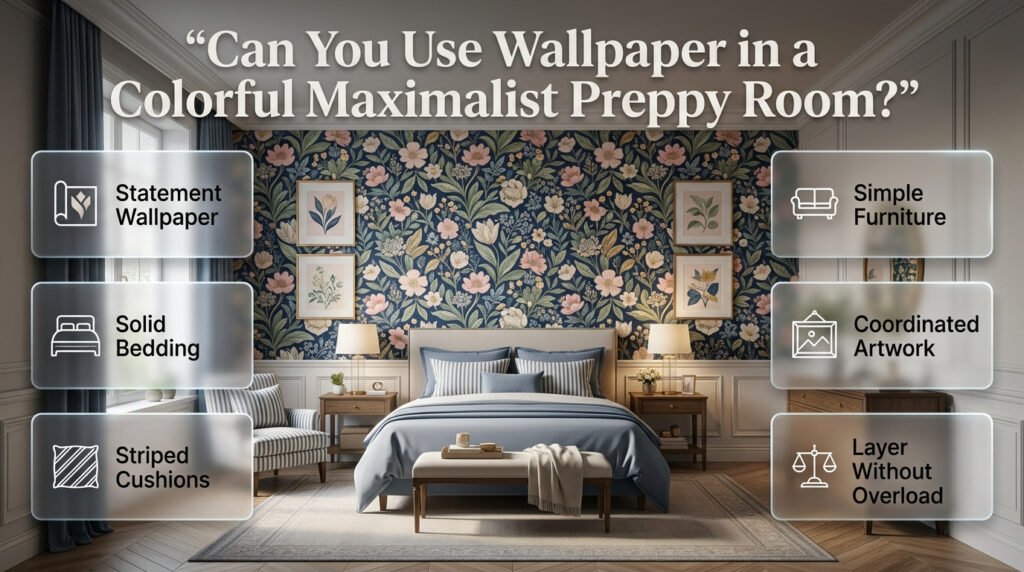
Yes, and wallpaper can be one of the most effective ways to establish maximalist character.
Consider:
- Floral wallpaper
- Botanical wallpaper
- Striped wallpaper
- Small geometric patterns
- Traditional motifs
However, wallpaper is already a major pattern.
If you use a strong wallpaper, you don’t necessarily need equally strong patterns everywhere else.
A floral wall can be supported by:
- Solid bedding
- Striped cushions
- Simple furniture
- Coordinated artwork
This creates layering without visual overload.
How Should You Decorate the Walls?
Walls provide a major opportunity to introduce personality.
You can combine:
- Gallery walls
- Framed artwork
- Decorative prints
- Mirrors
- Personal photographs
- Botanical illustrations
- Small shelves
- Collections
A gallery wall is particularly effective because it allows multiple colors to appear together.
Instead of trying to find one artwork that contains every color in your room, combine several pieces that collectively repeat the palette.
For example:
- Blue artwork
- Green botanical print
- Pink illustration
- Neutral photograph
- Brass-framed mirror
The collection becomes more interesting because each piece contributes something different.
How Can Gallery Walls Work With Maximalism?
Gallery walls naturally fit maximalist decorating because they create layers without taking up floor space.
Start with one larger anchor piece.
Then add smaller pieces around it.
You can mix:
- Different artwork sizes
- Different frame styles
- Photographs
- Prints
- Illustrations
- Mirrors
However, some consistency is helpful.
You might keep:
- Similar frame colors
- Similar color themes
- Similar visual weight
- Similar spacing
The wall doesn’t have to look perfectly symmetrical.
It simply needs to feel intentional.
How Do You Use Personal Items in a Maximalist Room?
Personal details are what keep maximalism from feeling like a generic design trend.
Consider displaying:
- Favorite books
- Travel memories
- Family photographs
- Artwork
- Collected objects
- Hobby-related items
- Meaningful souvenirs
These details can introduce colors naturally.
For example, a collection of books may add navy, green, red, and cream without requiring you to intentionally purchase decorative pieces in those colors.
That kind of imperfection often makes a room feel more authentic.
How Can You Make a Maximalist Room Feel Sophisticated?
The easiest way is to balance abundance with structure.
Use:
- Traditional furniture
- Coordinated colors
- Different pattern scales
- Quality-looking textiles
- Repeated materials
- Organized artwork
- Some neutral surfaces
A sophisticated maximalist room doesn’t necessarily contain fewer things.
It contains things that relate to one another.
The room can be full without feeling careless.
What Role Does Lighting Play?
Lighting is often underestimated in colorful interiors.
The same color can look completely different under different lighting conditions.
Use several layers where possible:
General lighting
Provides overall illumination.
Task lighting
Useful for:
- Reading
- Studying
- Working
- Getting ready
Accent lighting
Highlights:
- Artwork
- Shelves
- Decorative objects
- Architectural features
Warm lighting can make creams, pinks, reds, and wood tones feel richer.
Cooler lighting may make blue and green appear more prominent.
Always consider how your palette looks during both daytime and evening.
How Do You Use Metallic Details?
Brass, gold-toned, chrome, or other metallic finishes can provide small points of contrast.
Brass works particularly well with:
- Navy
- Green
- Pink
- Cream
- Burgundy
- Natural wood
You don’t need metallic pieces everywhere.
A few details can be enough:
- Lamp
- Mirror frame
- Drawer handles
- Curtain hardware
- Small decorative object
Repeating the metal finish two or three times usually creates more cohesion than introducing several unrelated finishes.
How Do You Balance Bright Colors With Neutrals?
Neutrals provide visual breathing room.
Useful choices include:
- Cream
- Ivory
- White
- Beige
- Natural wood
- Soft gray
Imagine a room with:
Bright pink + emerald green + cobalt blue + yellow
Without any neutral, the room could become intense.
Now introduce:
Cream walls + natural wood + ivory bedding
The colors become easier to appreciate.
This is why maximalism doesn’t mean eliminating empty or quiet areas.
Sometimes the strongest color looks better because it’s surrounded by calm.
What Is the Difference Between Maximalism and Clutter?
This is one of the most important questions.
Maximalism is intentional abundance.
Clutter is uncontrolled accumulation.
A maximalist room might contain many objects, but each object contributes to:
- Color
- Texture
- Function
- Memory
- Pattern
- Personality
- Composition
Clutter often happens when objects have no relationship to one another or interfere with daily use.
A simple test
Look around your room and ask:
“If I remove this object, will the room lose something useful, meaningful, or visually important?”
If the answer is no, you may not need it.
What Are the Most Common Mistakes in Colorful Maximalist Preppy Rooms?
Using Too Many Dominant Colors
The room becomes difficult to read when everything demands attention.
Better approach
Choose one dominant color and let other colors support it.
Making Every Pattern Equally Strong
Large floral + large plaid + large geometric + large stripe can quickly become exhausting.
Better approach
Mix large, medium, and small patterns.
Introducing New Colors With Every Accessory
A colorful room can become chaotic if every decorative purchase introduces another unrelated shade.
Better approach
Repeat existing colors before introducing new ones.
Matching Everything Too Precisely
Maximalism shouldn’t look like a furniture showroom.
Better approach
Coordinate rather than match.
Decorating Every Surface
Not every shelf, table, wall, and corner needs decoration.
Better approach
Leave some quiet areas.
Ignoring Room Function
A beautiful room isn’t successful if you can’t comfortably move, study, sleep, store things, or use the furniture.
Better approach
Design around everyday life first.
How Can You Make a Small Room Maximalist?
A small room can absolutely have maximalist character.
The key is using vertical space and controlling visual scale.
Try:
- Tall curtains
- Vertical shelving
- Wall artwork
- Mirrors
- Layered bedding
- Smaller decorative objects
- One strong rug
- Coordinated colors
Avoid filling the floor with too many furniture pieces.
Wall space can carry much of the decorative story.
A smaller room may actually benefit from a stronger visual concept because the design feels intentional rather than unfinished.
How Can You Create Maximalism on a Budget?
You don’t need to buy everything new.
Start with what you already own.
Look for:
- Existing artwork
- Books
- Cushions
- Throws
- Lamps
- Frames
- Small tables
- Baskets
- Decorative objects
Then identify the colors that already appear.
Suppose you already have navy furniture.
Instead of replacing it, build around navy.
Add:
- Cream
- Green
- Pink
- Natural wood
This can transform the room without requiring a complete redesign.
Buy in stages
Start with:
- Major furniture
- Rug
- Curtains
- Bedding
- Lighting
- Artwork
- Small accessories
This prevents unnecessary purchases.
How Do You Create a More Modern Maximalist Preppy Room?
Modern maximalism doesn’t require abandoning traditional preppy elements.
Instead, simplify the shapes.
For example:
Traditional foundation:
Navy + cream + stripes + wooden furniture
Modern interpretation:
Navy + warm ivory + clean-lined furniture + one bold floral + contemporary artwork
You can also use natural wood, simple lamps, and less ornate furniture to make the room feel current.
The palette remains recognizable, but the composition becomes cleaner.
How Do You Create a Cute Colorful Maximalist Preppy Room?
A playful room can use:
- Pink
- Light blue
- Green
- Lavender
- Yellow
- Cream
Use cheerful patterns such as:
- Small florals
- Gingham
- Hearts
- Checks
- Stripes
- Botanical prints
However, don’t make every element equally playful.
Balance cute details with:
- Traditional furniture
- Simple bedding
- Classic frames
- Neutral walls
That gives the room personality without making it feel visually immature.
How Do You Create a More Elegant Maximalist Preppy Room?
For an elegant direction, use deeper colors and richer materials.
Try:
Navy + emerald + ivory + walnut + brass
or:
Burgundy + cream + navy + warm wood
Focus on:
- Traditional furniture
- Rich textiles
- Layered curtains
- Framed artwork
- Brass details
- Deep accent colors
Keep the brightest colors controlled.
The result can feel dramatic while remaining polished.
How Do You Make Bold Color Feel Cohesive?
One of the most reliable methods is repeating the same color in different forms.
Suppose you choose emerald green.
Use it in:
- Chair upholstery
- Small cushion
- Artwork
- Decorative vase
Now add pink.
Use pink in:
- Bedding
- Artwork
- Small throw
Then add cream.
Use cream for:
- Walls
- Rug
- Curtains
- Furniture
Suddenly the room has a visual system.
This principle also applies when creating stronger colorful spaces. For additional inspiration, explore Bold Colorful Room Ideas and focus on how strong colors can be distributed rather than simply added.
How Do You Know When a Room Has Enough Decoration?
Step away from the room for a few minutes.
Then look at it as a whole.
Ask:
- What do I notice first?
- What do I notice second?
- Is anything competing with the focal point?
- Are there enough calm surfaces?
- Are the colors repeated?
- Are the patterns too similar in scale?
- Can I move around comfortably?
- Does the room still feel like a place to live?
If everything catches your attention simultaneously, editing may help.
Remove one or two things and look again.
Sometimes the best finishing touch is subtraction.
A Step-by-Step Formula for Designing Your Room

If you’re starting from an empty room, use this sequence.
Step 1: Choose the mood
Decide whether you want the room to feel:
- Playful
- Classic
- Elegant
- Cozy
- Fresh
- Energetic
- Eclectic
This influences your colors.
Step 2: Choose your foundation
Select:
- Wall color
- Flooring
- Main furniture
- Main neutral
Step 3: Select your dominant color
Choose one shade that will appear repeatedly.
Step 4: Add supporting colors
Choose two or three related shades.
Step 5: Choose one hero pattern
This might be:
- Floral
- Plaid
- Stripe
- Gingham
Step 6: Add supporting patterns
Use smaller or quieter patterns.
Step 7: Layer textiles
Add:
- Rug
- Curtains
- Bedding
- Cushions
- Throws
Step 8: Add artwork
Repeat the palette through artwork and frames.
Step 9: Add personal items
Introduce books, photographs, collections, and meaningful objects.
Step 10: Edit
Remove anything that doesn’t contribute to the room.
This last step is essential.
A Practical Colorful Maximalist Preppy Example
Imagine you’re designing a bedroom.
Your starting palette is:
Navy + emerald + pink + cream + yellow
Now assign each color a role.
Cream
- Walls
- Rug
- Curtains
Navy
- Bed
- Lamp
- Small pattern
Emerald
- Chair
- Cushion
- Artwork
Pink
- Bedding
- Throw
- Artwork
Yellow
- Small vase
- Book covers
- Decorative object
Now introduce patterns:
Large floral bedding
Medium navy stripe cushion
Small gingham accent
The room contains five colors and several patterns.
But each element has a job.
That’s what creates controlled maximalism.
What Makes a Colorful Maximalist Room Feel Personal?
Trends can provide inspiration, but personality comes from the details you choose yourself.
Maybe you love:
- Botanical artwork
- Vintage books
- Family photographs
- Travel souvenirs
- Colorful ceramics
- Music-related objects
- Handmade decorations
- Traditional furniture
Use them.
A room doesn’t need to look like a professionally photographed showroom to be successful.
In fact, some of the most appealing interiors feel collected because they contain objects that appear to have been gathered over time.
The design should support your personality rather than erase it.
Professional Tips for Better Colorful Maximalism
Use repetition before adding more
If a room feels incomplete, don’t automatically buy another color.
First ask whether an existing color needs to be repeated somewhere else.
Use different textures
Color isn’t the only source of visual interest.
Combine:
- Cotton
- Linen
- Velvet
- Wood
- Metal
- Woven materials
This gives the room depth even when some colors are relatively simple.
Use pattern strategically
One large pattern can often accomplish more than five small ones.
Give your strongest pattern a clear position.
Keep functionality visible
Storage, seating, lighting, and movement still matter.
Don’t chase perfection
Maximalism should feel expressive.
Slight differences in frames, furniture, and accessories can actually make the room feel more natural.
Quick Comparison: Controlled Maximalism vs. Overdecorating
| Controlled Maximalism | Overdecorating |
|---|---|
| Colors are repeated | Colors are random |
| Patterns have different scales | Patterns compete |
| Furniture has clear roles | Furniture blocks movement |
| Accessories tell a story | Accessories accumulate |
| Neutral space remains | Every surface is filled |
| One or two focal points | Everything is a focal point |
| Room remains functional | Decoration interferes with use |
| Different elements coordinate | Everything tries to match or compete |
The difference isn’t necessarily the number of objects.
It’s the level of intention behind them.
How Do You Make a Colorful Maximalist Preppy Room Look Cohesive?
The easiest way to make a colorful maximalist preppy room feel cohesive is to create relationships between the colors, patterns, and decorative elements rather than trying to make everything match. Choose one dominant color, two or three supporting shades, and repeat those colors throughout the room in different forms.
For example, navy might appear on a chair, rug, and artwork, while green could appear in bedding, cushions, and a small decorative object. Pink might be used more sparingly through artwork or textiles. This repetition helps the eye recognize the colors as part of the same design story.
Pattern coordination is equally important. A floral print, stripe, plaid, and gingham pattern can work together when they share at least one or two colors. Varying their scale also prevents them from competing.
Practical points:
Choose one dominant color before adding accent shades.
Repeat important colors in at least two or three areas.
Combine large, medium, and small patterns.
Use cream, ivory, or natural wood as visual breathing space.
Avoid giving every color the same level of importance.
Professional tip: Don’t ask whether every item matches. Ask whether every major element has a visual relationship with something else in the room.
What Colors Work Best in a Colorful Maximalist Preppy Room?
Navy, emerald green, pink, blue, coral, red, yellow, lavender, cream, and ivory are particularly versatile for colorful maximalist preppy interiors. The best combination depends on the atmosphere you want to create and how much visual intensity you’re comfortable with.
For a classic direction, navy, cream, green, and pink create a strong foundation. For something brighter, blue, coral, yellow, and white can create a more energetic atmosphere. Emerald, pink, navy, and ivory can produce a richer and more sophisticated palette.
The important factor isn’t simply selecting attractive colors. It’s deciding how much of each color should appear.
A strong color can become overwhelming when it covers too many large surfaces. Instead, use powerful shades strategically through furniture, bedding, artwork, cushions, rugs, or decorative accessories.
Practical points:
Use darker shades such as navy or emerald for visual grounding.
Use pink, coral, yellow, or lavender as supporting or accent colors.
Keep cream or ivory available to soften stronger combinations.
Repeat colors rather than continuously introducing new shades.
Test colors under both natural and artificial lighting.
Professional tip: If you’re working with several colors, assign each one a specific role—foundation, supporting color, accent, or highlight. This makes even an adventurous palette feel intentional.
How Do You Mix Patterns Without Making a Maximalist Preppy Room Look Too Busy?
Successful pattern mixing depends on scale, color, and visual hierarchy. Instead of choosing several patterns that are equally bold, give each pattern a different level of attention.
For example, start with a large floral pattern on bedding or curtains. Add a medium-scale stripe through cushions or upholstery, then introduce a small gingham or check pattern as a secondary detail. Solid-colored pieces should sit between some of these patterns to give the eye a place to rest.
The colors inside the patterns should also connect. A floral containing navy, green, and pink can easily relate to a navy stripe and a pink gingham because they share colors even though their designs are different.
This creates a collected look rather than a mismatched one.
Practical points:
Start with one hero pattern.
Add a medium-scale pattern for structure.
Use smaller patterns for detail.
Repeat at least one color between different patterns.
Place solid colors between highly detailed patterns.
Avoid putting several large, high-contrast patterns directly beside one another.
Professional tip: When you’re unsure whether two patterns work together, don’t immediately remove one. First reduce its visual importance by surrounding it with solid-colored elements.
How Can You Make a Small Bedroom Look Colorful and Maximalist Without Making It Feel Cluttered?
A small bedroom can have a strong maximalist personality when decoration is concentrated strategically rather than spread randomly across every available surface. The most effective approach is to use walls, textiles, and vertical storage to create visual richness while keeping the floor plan practical.
Start with a controlled color palette and one major focal point. This could be a patterned bed, colorful headboard, gallery wall, or statement rug. Then use smaller decorative elements to repeat the colors found in that focal point.
Vertical space is especially valuable in smaller rooms. Artwork, shelves, tall curtains, and vertically arranged decorative displays can add layers without consuming much floor space.
It’s also important to leave some areas visually quiet. A small amount of empty wall or a simple surface can actually make colorful elements appear more noticeable.
Practical points:
Keep the floor plan open and functional.
Use wall space for artwork and decoration.
Choose one primary focal point.
Repeat colors rather than adding many unrelated shades.
Use lighter neutrals around strong colors.
Avoid placing too many decorative objects on small surfaces.
Professional tip: In a small room, don’t try to make every corner equally interesting. Create one or two strong visual moments and let the rest of the room support them.
How Do You Make a Colorful Maximalist Preppy Room Look Sophisticated Instead of Cluttered?
Sophistication comes from organization, proportion, and intentional repetition—not from using fewer colors. A maximalist room can contain numerous patterns, accessories, and decorative pieces while still looking polished when there is a clear visual hierarchy.
Traditional preppy furniture is particularly useful because its structured shapes provide stability beneath more expressive colors and patterns. Pairing colorful textiles with cream walls, natural wood, brass details, classic furniture, and coordinated artwork can create a sophisticated foundation.
Editing is just as important as adding. Once the room is decorated, remove anything that doesn’t contribute to color, texture, function, personality, or visual balance. Maximalism should feel abundant, but each layer should have a reason to exist.
Practical points:
Use traditional or structured furniture to anchor bold decoration.
Combine bright colors with cream, ivory, wood, or other calmer materials.
Keep pattern scales varied.
Repeat colors instead of matching every item.
Use a few high-impact decorative pieces rather than many unrelated objects.
Leave some surfaces intentionally quiet.
Edit accessories after the room is complete.
Professional tip: Step back and look at the room from the doorway. If everything catches your attention at once, identify the strongest element and reduce the visual intensity around it.
Conclusion
Creating colorful maximalist preppy rooms is not about filling every corner with bright colors, patterns, and accessories. The real goal is to create a space where bold choices feel intentional, connected, and comfortable. A strong color palette, repeated shades, varied pattern scales, structured furniture, and carefully selected decorative pieces can give the room plenty of personality without making it feel chaotic.
The best approach is to start with a clear visual direction. Choose a dominant color, add a few supporting shades, and repeat those colors throughout the room using bedding, curtains, rugs, artwork, cushions, furniture, and smaller accessories. Mixing florals, stripes, checks, geometric patterns, and traditional preppy details can add depth, but keeping a balance between bold and quieter elements helps maintain visual harmony.
Maximalism also gives you room to express your personality. Whether you prefer colorful bedrooms, elegant layered interiors, playful patterns, or a modern interpretation of preppy style, you do not need to follow a rigid formula. Use the ideas that fit your space and lifestyle, then edit anything that feels unnecessary.
For more inspiration, explore Preppy Room for a wider range of decorating ideas, or discover Multicolor Preppy Palettes when you want to experiment with more adventurous color combinations.
Ultimately, a successful colorful maximalist preppy room should feel layered, personal, balanced, and full of character. When every color and pattern has a purpose, maximalism becomes less about having more and more about creating a room that feels thoughtfully designed and genuinely yours.